


Thank you dear subscribers, we are overwhelmed with your response.
Your Turn is a unique section from ThePrint featuring points of view from its subscribers. If you are a subscriber, have a point of view, please send it to us. If not, do subscribe here: https://theprint.in/subscribe/
We live in an era dominated by Big Data, predictive algorithms, and Artificial Intelligence. We are constantly told that if we gather enough information, track enough metrics, and fix our code, we can eliminate error, predict market trends, and solve every human problem. This strong belief has created a unique kind of modern arrogance. In our race for absolute data certainty, we have completely forgotten how to say the three most liberating words in corporate leadership: I do not know.
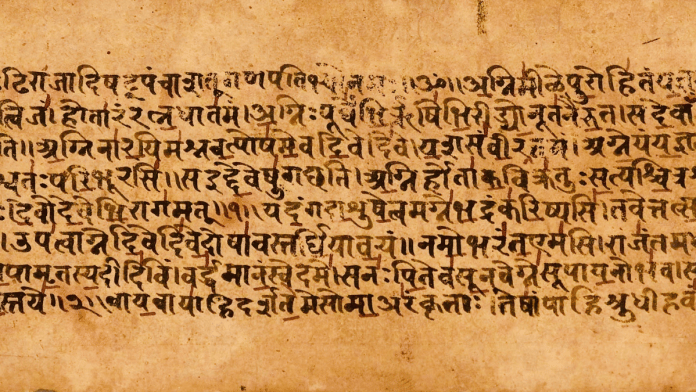
When navigating an unpredictable world, we do not always need a better algorithm. Sometimes, we need a better philosophy. The Nasadiya Sukta, found within the tenth book of the Rig Veda, is perhaps one of the most intellectually honest pieces of writing in human history. It does not claim to hold a monopoly on final answers. Instead, it explores the very boundaries of what can be humanly known, offering a timeless toolkit for managing complexity through intellectual humility.
Our modern systems are built entirely on rigid binaries. We look at the world through the narrow lens of true or false, success or failure, is or is not, or one and zero. While this binary logic is highly effective for programming computers, it is incredibly limiting when applied to the messy reality of human life and leadership.
The Nasadiya Sukta challenges this mindset from its very first line. It states that in the beginning, there was neither non-existence nor existence. To a mind trained strictly in binary logic, this statement sounds entirely paradoxical. How can something neither exist nor not exist?
Yet, the Vedic sages were pointing toward a profound reality. They suggested that the root of existence is a fluid, potential space that language cannot easily define. This is the ultimate logic of “And”. It recognizes a third state where opposites dissolve and raw potential takes shape. To find clarity in complex times, we must first learn to accept that our usual corporate labels and binary metrics do not always apply.
The text eventually moves from this silent void to a sudden spark of movement, noting that desire arose in the beginning, which was the very first seed of the mind.
This insight is incredibly relevant for modern professionals working within highly mechanicalenvironments. It suggests that the universe, and by extension our creative lives, do not function purely on cold, automated logic or random accidents. Creation requires a spark of intention, an active desire to build, feel, and understand. The world is not merely a stage we watch passively from the outside. Our inner clarity and focus help actively shape our external professional environments.
The most revolutionary aspect of the hymn appears at its very conclusion. The text asks who truly knows how everything began, concluding with the radical observation that the overseer in the highest heaven surely knows, or perhaps even he does not know.
This statement is not a lack of conviction. Rather, it represents the highest imaginable form of intellectual honesty. It reminds us that a degree of deep mystery and uncertainty is woven directly into the fabric of reality. If the primary source of the universe does not claim absolute certainty, we should certainly question our own rigid dogmas.
In modern management, professionals are frequently pressured to rush to shallow, immediate conclusions just to appear decisive. The Nasadiya Sukta provides the mental resilience to sit quietly with ambiguity. Accepting that some data points will always remain hidden is not a professional failure. It is the hallmark of a mature, strategic mind.
By deliberately ending with a question mark rather than a dogmatic full stop, this ancient text draws a sharp line between being a passive follower and being an active seeker. A follower demands easy, pre-packaged absolute truths from external experts. A seeker understands that the quest for clarity is a personal, continuous journey that never truly ends.
Embracing this ancient scepticism allows us to step away from the exhausting demand of being a know-it-all. It allows us to step into the curiosity of a true seeker. The complex professional world around us is an open book, and the most impactful chapters are always the ones we have yet to write.
Submitted by: R Srinivasa Murthy, corporate leader, author of “Logic of And: Sanatana Dharma as a tool kit for modern seeker” and dedicated to demystifying ancient wisdom for the next generation.
These pieces are being published as they have been received – they have not been edited/fact-checked by ThePrint.