





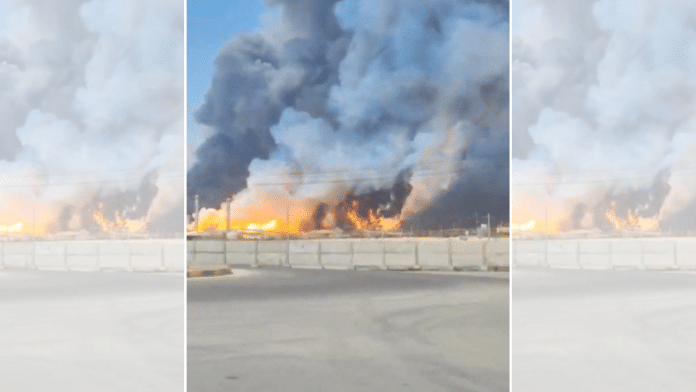



New Delhi: Iran and Israel struck each other’s energy infrastructure for the first time Wednesday, targeting facilities directly tied to fossil fuel production in a significant and dangerous escalation in the West Asian conflict.
Until now, both the US and Israel had largely avoided hitting Iran’s core energy production sites in the Gulf, wary of triggering wider disruption in global markets. Even when US President Donald Trump ordered strikes on Kharg Island, the hub for roughly 90 percent of Iran’s oil exports, the attacks were limited to military targets.
That restraint ended when Israel struck the South Pars gas field, which Iran shares with Qatar. As the world’s largest gas field, it is a crucial economic and energy lifeline for Iran and Qatar.
Trump distanced himself from the strike, claiming the US had no prior knowledge of the attack.
“Israel, out of anger for what has taken place in the Middle East, violently lashed out at a major facility known as South Pars Gas Field in Iran,” he said in a post on social media platform Truth Social.
However, according to AP, Israel had informed the US of its plans to hit the site.
ThePrint delves into why the South Pars field is important beyond the regions engaged in the widely escalating West Asian conflict.
Largest natural gas reservoir
The South Pars field, known on the Qatari side as the North Dome, lies beneath the Persian Gulf and is widely considered the largest natural gas reservoir on Earth.
Shared between Iran and Qatar, it spans an area roughly the size of a small country and holds an extraordinary concentration of the world’s known gas reserves. By some estimates, it contains about 1,800 trillion cubic feet of gas.
This single reservoir is central to the global energy system.
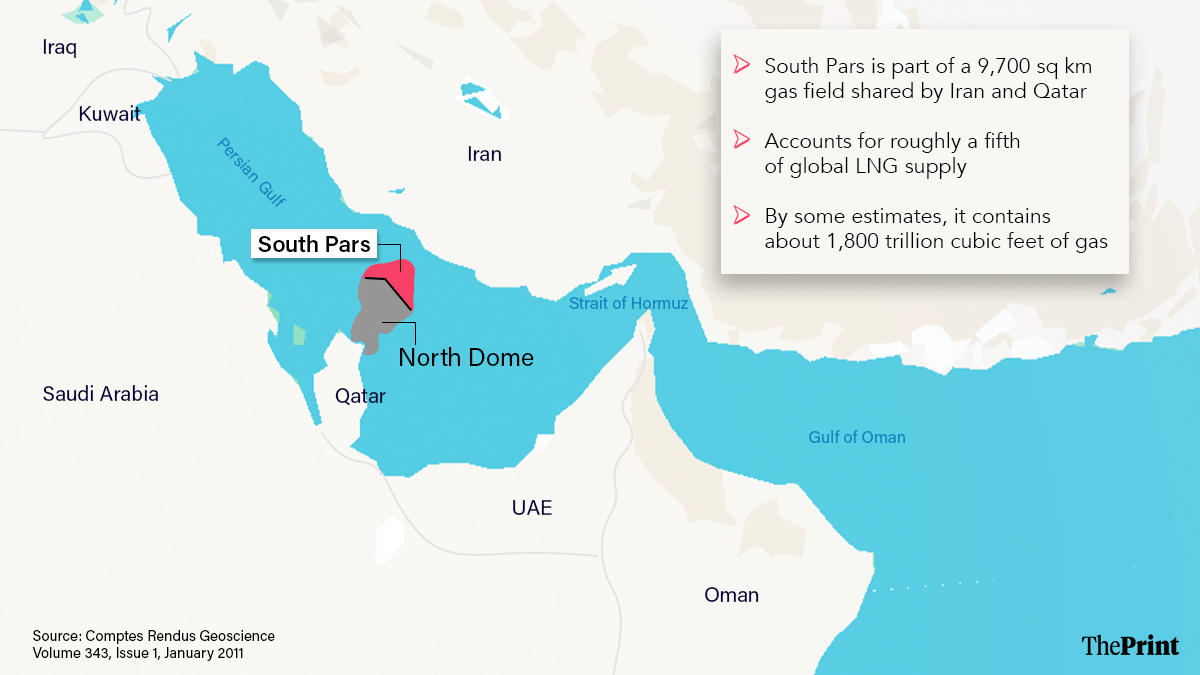
Qatar, which controls the larger and more efficiently developed portion, has built its economy around extracting and exporting liquefied natural gas (LNG) from the field.
Moreover, it is still relatively undepleted, with around 90 percent yet to be extracted.
Before the latest escalation, it was producing tens of billions of cubic feet of gas each day, accounting for a substantial share of global LNG supply and the vast majority of its government revenue.
That gas is shipped worldwide, helping to power homes, industries and electricity grids from Europe to Asia, including India.
Iran, by contrast, has struggled to fully develop its side of the field. Years of sanctions, technological constraints and underinvestment have limited its production.
Even so, South Pars remains the backbone of Iran’s domestic energy system, supplying much of the gas used for electricity generation and heating. Disruptions there can quickly translate into power shortages inside the country.
What makes the field especially significant is its shared nature.
With both Iran and Qatar effectively tapping into the same underground reservoir, damage to infrastructure on one side can affect the overall rate at which gas can be extracted.
The system depends not just on the resource itself, but on a network of processing plants, pipelines and export terminals that take years and tens of billions of dollars to build.
That infrastructure is precisely what has come under attack. Recent strikes have hit production and processing facilities rather than just transport or storage sites, a significant shift that could lead to a major escalation.
Unlike pipelines, which can sometimes be repaired relatively quickly, gas processing plants and liquefaction terminals are highly specialised and difficult to replace. Restoring them can take years, even under stable conditions.
Global consequences
The implications extend well beyond Iran. After the strike on the South Pars gas field, Iran warned that major oil and gas installations across Saudi Arabia, the United Arab Emirates and Qatar were now “direct and legitimate targets,” calling for evacuations. Within hours, reports of loud explosions emerged from Riyadh.
I strongly condemn attacking Iran’s energy infrastructure. Such aggressive acts will yield nothing for the Zionist–American enemy & their supporters. This will complicate the situation & could have uncontrollable consequences, the scope of which could engulf the entire world. https://t.co/FGtTZZjA6Y
— Masoud Pezeshkian (@drpezeshkian) March 18, 2026
Qatar, a key US ally that hosts the largest American airbase in the region, attributed the attack to Israel while stopping short of implicating Washington.
A spokesperson for its foreign ministry described the strike as a “dangerous and irresponsible” escalation that risked destabilising global energy security.
The UAE echoed those concerns, warning that the attack not only threatened energy supplies but also the broader security and stability of the region.
Hours later, QatarEnergy’s Ras Laffan facility was struck.The Qatari side of the field feeds into Ras Laffan Industrial City, home to the world’s largest LNG export complex.
Any sustained disruption in this area could lead to tighter global energy supplies, drive up prices and complicate energy planning for countries dependent on imported gas.
The longer-term concern is structural. Even if the fighting were to stop soon, the damage to facilities on both sides of the shared field could limit output for years.
Given the field’s outsized role in global supply, that could reshape energy markets, increase competition for alternative sources and deepen geopolitical tensions tied to energy security.
Ras Laffan accounted for roughly a fifth of global LNG supply and required about $70 billion to build, according to Energy Intel.
With critical infrastructure damaged on both the Iranian and Qatari sides, a significant portion of the world’s largest gas resource could remain inaccessible for years, constraining supply and heightening global energy uncertainty.
Markets have already reacted. Oil and gas prices rose sharply after the strikes, driven by fears that the conflict could spread to other energy facilities in the Gulf.
This region is one of the world’s most critical energy hubs, and major powers wary of triggering a broader economic shock have long treated its infrastructure as a red line.
Energy has long shaped how countries in the region manage both rivalry and cooperation.
In 2024, Saudi Arabia and Iran maintained a détente because easing tensions and redirecting resources toward economic diversification were key priorities for Saudi Arabia’s de facto ruler, Crown Prince Mohammed bin Salman. Iran was also under massive US sanctions.
Qatar has also historically maintained close ties with Iran due to shared stakes in South Pars. As The Guardian said: The field has at times acted as a diplomatic bridge not just between Doha and Tehran but more widely.
(Edited by Sugita Katyal)
Also Read: The key figures steering Iran amid war & regional tensions: Mapping Pezeshkian’s presidential circle