





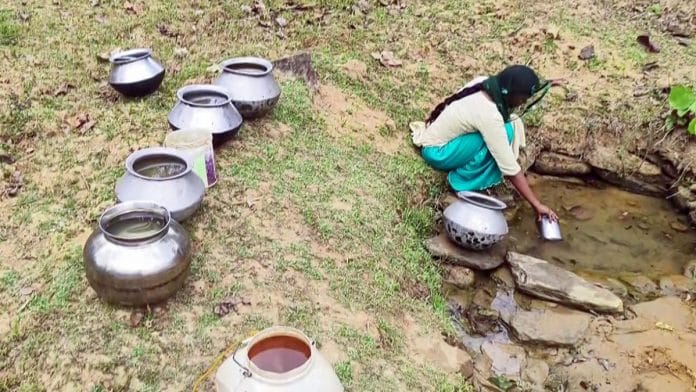



New Delhi: Unsafe water, poor sanitation and lack of hygiene are still killing people, even as most countries now have plans to fix the problem. In 2019, at least 1.4 million people died from preventable causes linked to unsafe water and sanitation, and over 560,000 cholera cases with 6,000 deaths were reported in 2024 across 60 countries.
The UN-Water Global Analysis and Assessment of Sanitation and Drinking-Water (GLAAS) 2025 report released Monday, developed jointly by the World Health Organization (WHO) and UNICEF, warns that progress on drinking water, sanitation and hygiene is slowing at a time when the 2030 deadline to meet the UN’s Sustainable Development Goals (SDGs) is fast approaching.
The SDGs are 17 global targets adopted by UN member states in 2015 to improve development outcomes by 2030, with SDG 6 focused on ensuring universal access to safe drinking water, sanitation and hygiene.
The report looks at water, sanitation and hygiene — known as WASH — in 105 countries and territories, covering 62 per cent of the world’s population. It checks whether countries have policies, targets, monitoring systems, financing and workforce in place.
The report finds that plans exist, but delivery is weak. Nearly 90 per cent of countries now have policies for at least one part of WASH, and around 70 per cent have approved policies and plans for both urban and rural drinking-water and sanitation.
But fewer than 13 per cent of these countries said they have enough money and trained staff to fully implement these plans.
“With less than five years until 2030, we are at a critical moment to review SDG 6 and take decisive action,” said Dr Alvaro Lario, Chair of UN-Water. “The choices we make now will determine whether we achieve our common goals and ensure WASH is a catalyst for better public health, particularly for vulnerable people.”
Targets are uneven. While 85 per cent of countries have national targets for drinking-water and 87 per cent for sanitation, only 49 per cent have targets for hand hygiene. Around 64 per cent of countries reported overlapping roles between government agencies, leading to poor coordination.
Funding and climate risks
The GLAAS report says that data from at least 20 countries show a 46 percent funding gap in identified needs and available funding.
Climate risks are increasingly recognised, with 80 per cent of countries addressing them in WASH policies, but only 20 per cent have financing measures for communities most affected by climate change.
“Millions of lives continue to be lost each year due to inadequate access to safe drinking-water, sanitation and hygiene,” said Dr Rüdiger Krech, Director, Department of Environment, Climate Change, One Health & Migration at the World Health Organization.
“This demands stronger WASH systems – how water and sanitation services are planned, resourced and run – and greater investment from governments and partners.”
The report was released at the opening of the High-Level Preparatory Meeting for the 2026 UN Water Conference, held on 26–27 January 2026 in Dakar, Senegal, co-hosted by Senegal and the United Arab Emirates, ahead of the main conference scheduled for December 2026.
(Edited by Niyati Kothiyal)