








US President Donald Trump’s threat to blockade the Strait of Hormuz after talks with Iran collapsed over the weekend risked widening a war now entering its seventh week, lifting oil prices and raising the prospect of further economic pain around the globe.
The US military said it would implement a blockade of all maritime traffic entering and exiting Iranian ports at 10 a.m. on Monday Washington time, adding that it would allow other vessels to transit the Strait of Hormuz if they’re not stopping in the Islamic Republic. Iran’s military adviser to the supreme leader, Mohsen Rezaee, has said the nation “will not allow” such an embargo and says it has “great untapped leverage to counter it.”
The fresh showdown came after the US and Iran failed to reach a deal in marathon talks in Pakistan, jeopardizing a ceasefire reached last week that raised hopes of a quick resolution to the war. The negotiations, led by US Vice President JD Vance and Iranian Parliament Speaker Mohammad Bagher Ghalibaf, broke down due to differences over the future of Iran’s nuclear program.
Trump told reporters on Sunday evening that he didn’t care if Iran returned to the negotiating table, arguing the US had already achieved its military objectives, including depleting the nation’s capability to manufacture missiles and drones.
“If they don’t come back, I’m fine,” he said.
Earlier on Sunday, Trump said the US was “LOCKED AND LOADED” and ready to “finish up the little that is left of Iran.” The US leader threatened to retaliate in the event of Iranian resistance to the blockade, posting on social media that “Any Iranian who fires at us, or at peaceful vessels, will be BLOWN TO HELL!”
The developments threatened to prolong and widen a war that has led to thousands of deaths and roiled global energy markets, with higher oil and gas prices threatening to stoke inflation while slowing economic growth. Around the world, there’s now a desperate effort among refiners and traders to secure immediately available crude cargoes as physical supplies tighten.
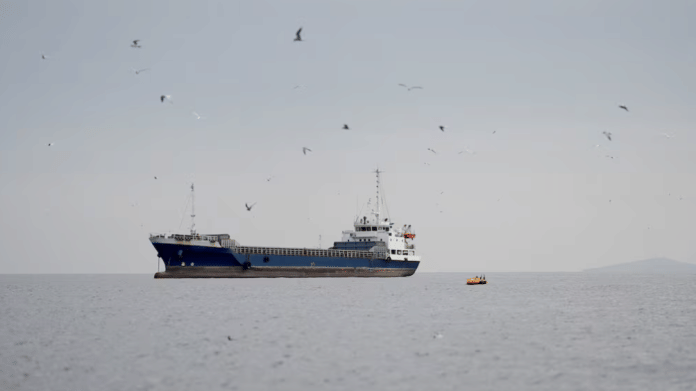
The Strait of Hormuz is the world’s most important energy chokepoint, accounting for about a fifth of the world’s oil and liquefied natural gas. A full blockade would further pressure global oil markets by squelching the remaining trickle of shipments that have continued to move through the waterway. Oil and natural gas surged Monday morning, with Brent rallying as much as 9.1% to near $104 a barrel while European gas futures spiked up to 18%.
“The blockade is meant to increase economic pressure on Iran, but blockades are rarely quick in their effects though they can be decisive in the long run,” said Euan Graham, a senior fellow at the Australian Strategic Policy Institute. “And what Washington prizes above anything else is a quick result.”
The two-week ceasefire agreement is set to expire on April 22, if the blockade doesn’t lead to its collapse before then. Iran’s Islamic Revolutionary Guard Corps said that any military vessels attempting to approach the strait “under any pretext” would be considered a violation of the ceasefire, according to Iranian state TV.
While neither side has committed to a second round of diplomatic talks, Iran’s Foreign Ministry spokesman Esmail Baghaei said the nations reached an understanding on various issues but disagreements remained “on two or three key points.”
“It was natural that one should not have expected to reach an agreement in a single session from the outset,” he said on state television after the talks. “Diplomacy never ends” and Iran will “continue to pursue national interests under all circumstances,” he added.
An American official, who requested anonymity, said on Sunday it was clear to the US team that the Iranian delegation didn’t understand the Trump administration’s main objective, which was to guarantee the Islamic Republic would never obtain a nuclear weapon.
Hormuz, which links the Persian Gulf to wider markets, has been effectively closed since US and Israeli strikes on Iran began at the end of February. Tehran has frustrated the White House by tightening its grip, imposing payments for some vessels and keeping traffic at a fraction of pre-war levels.
While the US is capable of enforcing a blockade, it would entail substantial costs and risks, Bloomberg Economics’ analysts including Jennifer Welch wrote in a note. US warships would be closer to Iranian drone and missile threats, leading to a dangerous escalation cycle if any of them are hit. The Houthis, who are allied with Iran, may also look to disrupt oil and gas flows in the Red Sea, the Bloomberg Economics’ analysts wrote.
“The risks and costs of a sustained blockade — and potential for pressure from other stakeholders like China — suggest Trump may not follow through or may not sustain a blockade,” they wrote, adding that Beijing may even use its leverage over the US with critical minerals in an effort to pressure Trump. “Still the threat itself increases the odds of miscalculation, reduces space for diplomacy and keeps downside risks to oil flows and markets elevated.”
The Trump administration used a similar approach against Venezuela earlier this year — effectively enforcing a blockade against its sanctioned crude on the open seas before its January capture of Nicolas Maduro. In his threat on Sunday, Trump said that “no one who pays an illegal toll will have safe passage on the high seas.”
Vice President JD Vance speaks in Islamabad.
Trump has suggested that other countries would also be participating in the blockade, but has yet to name any specific nations that will be sending ships or other assets to the region to assist. Britain won’t be taking part in the blockade, people familiar with the government’s position said. The UK has autonomous mine-hunting drones in the region but will only deploy them to the strait if a viable plan emerges in conjunction with other allies to reopen it, they said.
Trump has repeatedly called on European and Asian allies to assist in the re-opening of the Strait of Hormuz, but has largely been rebuffed. Some allies, including the UK and Japan, have said they would assist in efforts only after fighting in the region has come to a halt.
It’s not essential for the US to attack every ship, and just the threat alone can reduce the flows to and from Iranian ports, according to John Bradford, executive director at Yokosuka Council on Asia Pacific Studies and former US naval officer. Still, he said, it’s unclear if the tactic will work against Iran.
“It’s particularly risky with Iran to seek de-escalation through escalation,” Bradford said. “The tactic works better with some actors than others, and Iran has shown it’s resilient to that tactic.”
This report is auto-generated from Bloomberg news service. ThePrint holds no responsibility for its content.