





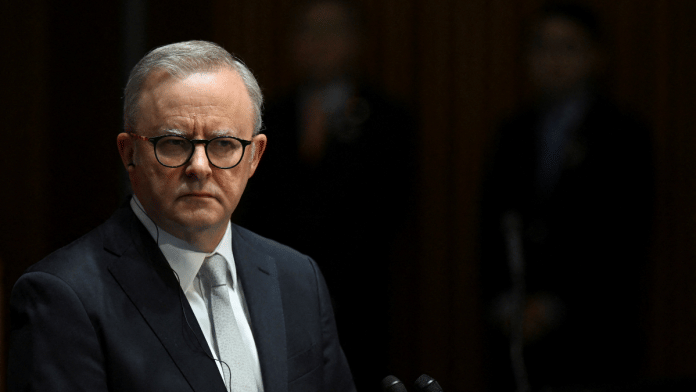



New Delhi: Australian Prime Minister Anthony Albanese Wednesday called on fellow citizens to switch to public transport in an effort to save fuel as the conflict in West Asia has begun to impact energy supplies globally.
In a notably circumspect address, Albanese said that “no government can promise to eliminate the pressures that this war is causing”. The conflict between the US, Israel and Iran is in its fifth week with the flow of fuel in particular remaining disrupted due to the effective closure of the Strait of Hormuz. The international waterway accounts for the flow of roughly 20 per cent of the world’s oil supplies.
“Enjoy your Easter, and if you’re hitting the road, don’t take more fuel than you need, just fill up like you normally would. Think of others in your community, in the bush and in critical industries. And over the coming weeks if you can switch to catching the train or bus or tram to work, do so,” Albanese said in an address to the nation.
The Australian PM added: “That builds our reserves and it saves fuel for people who have no choice but to drive. Farmers and miners and traders who need diesel every single day. And all those shift workers and nurses who do so much for our country. The months ahead may not be easy. I want to be up front about that. No government can promise to eliminate the pressures that this war is causing.”
Australia has cut taxes on a litre of petrol by around 26 cents, or roughly 50 percent. For Australian truckers, the government has slashed the “heavy vehicle road user charge” to zero. Both these are moves to keep the economy ticking despite challenges to the Australian energy systems.
The Australian Cabinet Monday accepted a ‘National Fuel Security Plan’, which is a four-stage plan to update communities and businesses of the government’s actions with regards to the fuel situation in the country. The four-stages are: Plan and prepare, keep Australia moving, taking targeted action, and protecting critical services.
Currently, Australia is in the second stage—keeping the country moving. Under this, Canberra is seeking to maintain the flow of fuel across the country, while urging its citizens to only purchase the fuel they need, while calling on those who can use public transport to work to make the switch.
“We are working to bring the price of fuel down, to make more fuel here and to keep it onshore, and get more fuel here, using our strong trading relationships with our region to bring more petrol, diesel and fertiliser to Australia. Now it’s the Australian way that people want to do their bit, and there are simple ways that you can. You should go about your business and your life as normal,” said Albanese.
Addresses to the nation by an Australian prime minister are considered a rarity. The last such address was by former Prime Minister Scott Morrison on 12 March 2020, at the start of the COVID-19 pandemic. At the time, Australia had 140 confirmed cases of COVID-19, according to the Australian newspaper The Sydney Morning Herald.
Countries around the world are looking to shore up their fuel stocks, as the effective closure of the Strait of Hormuz continues to impact the global economy. Prime Minister of the United Kingdom Keir Starmer is also set to address the nation Wednesday, while American President Donald Trump is set to make a similar address later on Wednesday evening.
The price of oil has seen a surge since the war began on 28 February. However, Trump late Tuesday evening indicated that the war will only continue for maybe two to three weeks, which has seen the prices of crude tumble to below $100 a barrel on the Brent futures benchmark on Wednesday.
Iran has maintained that there are no active negotiations at the moment, while clarifying that messages have been passed through third countries—Pakistan—and the US envoy Steve Witkoff. Trump has lashed out at the US’ European allies in recent days, stating that the America will no longer work to reopen the Strait of Hormuz and it is up to the Europeans to “get their own oil”.
(Edited by Nardeep Singh Dahiya)
Also Read: Strait of Hormuz is Iran’s trump card. Why has US superiority not secured the seas?