







By Ece Toksabay and Huseyin Hayatsever
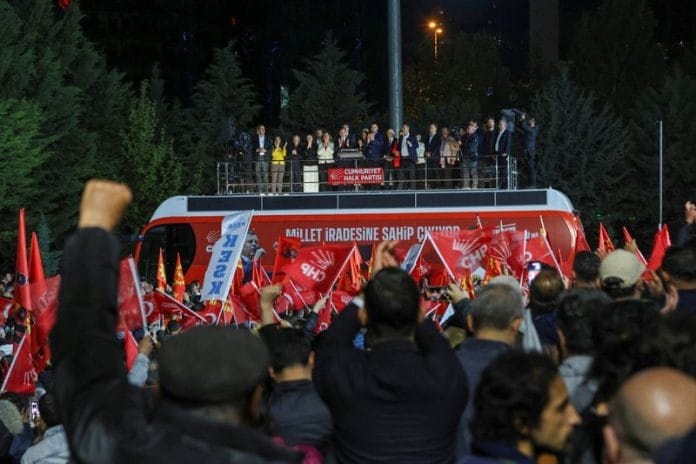
ANKARA, May 22 (Reuters) – Turkey’s opposition vowed on Friday to resist an unprecedented court ruling that ousted its leader, inflamed a political crisis and sent investors running from Turkish assets over concerns of increasing instability.
Analysts said the ruling, seen as a test of Turkey’s shaky balance between democracy and autocracy, could further prolong President Tayyip Erdogan’s 23-year rule even as it risks another setback in the country’s long battle against soaring inflation.
The appeals court on Thursday annulled the Republican People’s Party’s (CHP) 2023 congress at which leader Ozgur Ozel was chosen, citing unspecified irregularities. In his place, the court reinstated former CHP chairman Kemal Kilicdaroglu, a divisive figure who lost to Erdogan in elections earlier that year.
The CHP condemned the ruling as a “judicial coup” and Ozel promised to fight it through legal appeals and to personally remain “day and night” in the main opposition party’s headquarters in Ankara.
DEMOCRATIC TEST
The ruling could rekindle anti-Erdogan protests and also spark opposition disarray and infighting in the large NATO member country and emerging market economy.
The court move “marks an unprecedented development in our administrative law and political history,” said Berk Esen, a political scientist at Sabanci University. “If upheld, it would open the door for courts to determine party leadership, with no comparable example in Turkey’s electoral system since 1946.”
Turkish stocks initially plunged on the news and remained volatile but flat on Friday. The lira touched a record low, prompting the central bank to sell billions of dollars in foreign reserves to maintain stability. JPMorgan predicted the bank would need to quickly hike interest rates.
“The key risk is local dollarisation,” said Roger Mark, emerging market fixed income analyst at Ninety One, referring to a rush to sell lira for hard currencies.
The outflows, however, were less intense than last year due to “firmer central bank intervention and lower offshore positioning” by foreign investors, he said.
Vice President Cevdet Yilmaz shrugged off what he called “daily market developments” and said Turkey remained focused on its economic programme of lowering inflation, which was above 32% last month.
LEGAL CRACKDOWN
The CHP, the party of modern Turkey’s founder Mustafa Kemal Ataturk, has separately faced an unprecedented legal crackdown in which hundreds of members and elected officials have been detained since 2024 on corruption and other charges that it denies.
Among those jailed is Istanbul Mayor Ekrem Imamoglu, Erdogan’s main rival and the CHP’s presidential candidate, whose detention last year set off a sharp market selloff and temporarily reversed a monetary easing cycle.
The next national election is set for 2028 but would need to come earlier if Erdogan, 72 and facing a term limit, wants to run again. The court ruling was seen as raising chances of an early vote.
The government denies criticism that it uses courts to target political rivals, saying the judiciary is independent.
APPEAL TO ELECTION BOARD
The CHP, running roughly even with Erdogan’s ruling AK Party (AKP) in polls, called the court ruling null and void and appealed to the Supreme Election Board (YSK), which it says is the only authority empowered to annul a party congress.
Though the YSK oversees all elections and party congresses and its decisions are not subject to appeal, the court issued its ruling citing a law on associations – an unprecedented move in modern Turkey.
The YSK convened on Friday to discuss the CHP application.
(Reporting by Ece Toksabay and Huseyin Hayatsever; Additional reporting by Ezgi Erkoyun in Istanbul and Karin Strohecker in London; Editing by Jonathan Spicer and Gareth Jones)
Disclaimer: This report is auto generated from the Reuters news service. ThePrint holds no responsibility for its content.