





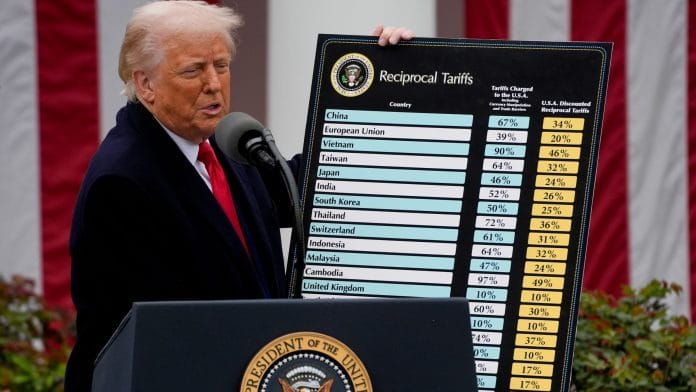



The fate of the majority of President Donald Trump’s tariffs is in the hands of the US Supreme Court, which could rule sometime in January on the legality of the sweeping levies. Lower courts ruled in 2025 that the tariffs were issued illegally, but the import taxes remained in place to allow the Trump administration to make its case before the Supreme Court.
At a hearing on Nov. 5, the justices appeared skeptical that Trump had the authority to unilaterally impose tariffs under a 1977 law that gives the president special powers during emergency situations. While the court never says in advance when it will hand down a decision, the justices have scheduled Jan. 14 as the next “opinion day,” making that date a possibility for a ruling in the tariffs case.
A ruling against Trump on tariffs would undercut the president’s signature economic policy and deliver his biggest legal defeat since returning to the White House. It also would set the stage for potentially complicated legal fights over refunds of billions of dollars in tariffs paid so far by US importers, with more than 1,000 companies already lined up in court.
Which tariffs are under threat?
At issue are Trump’s April 2 “Liberation Day” tariffs, which placed levies of between 10% and 50% on most imports.
Lower courts have struck down these tariffs, which Trump imposed by invoking the International Emergency Economic Powers Act (IEEPA).
The levies include a minimum baseline tariff of 10%, with some exceptions; so-called reciprocal tariffs ranging from 10% to 41% on goods from countries that failed to reach trade deals with the US; and extra levies on some imports from Mexico, China and Canada that Trump said were justified by the fentanyl crisis in the US.
The Supreme Court case doesn’t touch upon the duties imposed on certain product categories using different legal foundations. For example, the Trump administration has put in place levies on steel, aluminum, automobiles, copper products and lumber by harnessing Section 232 of the 1962 Trade Expansion Act. Those tariffs depend on Commerce Department investigations that concluded that imports of such products pose a national security risk.
What powers does the president have to impose tariffs?
Article 1 of the US Constitution gives Congress the power to levy taxes and duties, and to “regulate commerce with Foreign Nations.” But lawmakers have for decades delegated parts of their power over trade via various bits of legislation, most of which allow presidents to deploy tariffs only for limited reasons.
While Trump tested the boundaries of those powers in his first term, this time around, he invoked what he claimed were virtually unlimited powers under IEEPA to impose tariffs via executive orders. The 1977 law had never been used for this purpose before and doesn’t mention tariffs.
IEEPA grants the president authority over a variety of financial transactions during certain emergencies, although the typical tool is sanctions. Trump cited US trade deficits with other countries and drug trafficking at the US border as national emergencies that allowed him to invoke the law to impose tariffs.

What did the lower courts decide?
The US Court of International Trade concluded that because of the Constitution’s “express allocation of the tariff power to Congress,” IEEPA does not “delegate an unbounded tariff authority to the President.”
The ruling determined that Trump’s initial executive order announcing global tariffs, as well as his subsequent order imposing additional levies on imports from countries that retaliated, exceeded the president’s authority under the emergency law.
Another set of executive orders — hitting goods from Mexico, Canada and China — were deemed illegal because those levies didn’t directly address the fentanyl-trafficking emergency used justify them.
The trade court made clear that it wasn’t passing judgment on the “wisdom or likely effectiveness of the president’s use of tariffs as leverage.” Instead, the judges said that Trump’s imposition of tariffs was “impermissible not because it is unwise or ineffective, but because [federal law] does not allow it.” Their decision was affirmed by the US Court of Appeals for the Federal Circuit.
In a separate case, a federal judge in Washington declared unlawful a number of Trump’s tariffs related to trade with China and other countries. US District Judge Rudolph Contreras limited his decision to the pair of family-owned toy manufacturing businesses that sued.
If IEEPA-based levies go down, what are the implications for Trump’s tariff agenda?
Not only would the administration no longer be able to collect IEEPA-based tariffs, it would face demands to refund those that have already been paid. The unraveling of a large portion of Trump’s tariffs could exacerbate concerns about the state of America’s public finances. Bond market investors, in particular, have been questioning the trajectory of the country’s mounting debt load. The administration had cited increased tariff revenue as a way to offset the tax cuts adopted in the tax and spending bill that Trump signed into law on July 4.
At the same time, the loss of IEEPA-based tariffs might not be a permanent setback for Trump’s push to reshape global trade. Trump has other tools available to impose tariffs, such as his Section 232 national security powers, though they are more limited than what he attempted to use IEEPA for.
To take similarly sweeping action, he could temporarily roll out import taxes as high as 15% for a maximum of 150 days using a provision of the Trade Act. But this can only be done unilaterally in the event of a “large and serious” US balance-of-payments crisis, to help correct an international balance-of-payments disequilibrium, or to prevent an “imminent and significant” depreciation of the dollar.
The administration could also initiate more investigations into countries’ unfair trade and economic policies under Section 301, but those would take longer to implement.
Disclaimer: This report is auto generated from the Bloomberg news service. ThePrint holds no responsibility for its content.
Also read: Thank you Trump, again. India now has reason to shed fear of free trade and spur reform