


By David Lawder and Andrea Shalal
WASHINGTON, Nov 25 (Reuters) – US President Donald Trump fired a new tariff salvo on Wednesday on 14 major trading partners including China, Japan and the European Union, undeterred in his protectionist push by the losses his Republican Party suffered in US midterm elections.
His administration proposed new maximum potential rates of 20% to 40% to counter excess industrial capacity that it says these countries are promoting. But the US Trade Representative’s office said it intends to cap new tariffs at lower levels agreed under trade deals that are completed or still under negotiation.
In unveiling the results of an eight-month unfair trade practices investigation into excess industrial capacity, USTR aims to more fully rebuild Trump’s tariff leverage after the Supreme Court in February struck down his broad global duties under a national emergencies law.
The effort also seeks to put Trump’s tariffs and associated trade agreements on more solid legal and political grounds by backing them with a court-tested trade law, Section 301 of the Trade Act of 1974, and addressing foreign subsidies and industrial policies that are viewed as major trade problems by both Republicans and Democrats.
Separately, USTR proposed a new 10% tariff on imports of Brazil’s finished Embraer commercial aircraft, and an increase in duties on imports of Brazilian sugar that exceed quotas as part of an effort to push Brasilia to rectify alleged unfair trade practices.
The products were previously exempted from Trump’s 25% tariffs on Brazilian goods that were imposed in July under a separate Section 301 investigation. US Trade Representative Jamieson Greer said he decided to propose the tariff increases after months of talks between the US and Brazil made “no meaningful progress.”
CHINA TOPS EXCESS CAPACITY RATES
Under the excess factory capacity probe, USTR said China would face the highest capped rate of 20%, which would be added to duties of roughly 25% imposed during Trump’s first term.
That rate would comply with a US-China trade truce that expires on January 10. But if the truce unravels, China’s rate would rise to 40%, the USTR said.
Vietnam would face a capped tariff rate of 20% if it reaches a trade agreement with Washington, rising to 35% if negotiations fail.
Greer said the tariffs, which would not take effect until after a January 25 public hearing, were intended to counteract “industrial strategies built on targeting manufacturing, wage and labor suppression, financial and other support, non-market economy inputs, and other market-distorting practices” that undermine the US manufacturing base.
The duties would not stack on top of prior tariffs of 10% or 12.5% imposed under a separate US probe into lax enforcement of anti-forced labor laws in 60 economies, nor would they add to sectoral national security duties on steel, aluminum, autos and other goods.
Greer said the proposed tariffs also would not apply to about $30 billion of Chinese imports under consideration for tariff reductions through a bilateral mechanism known as the Board of Trade.
Washington has long accused China of subsidizing industry and flooding global markets with low-cost exports ranging from steel to electric vehicles and solar products.
A spokesperson for China’s embassy in Washington rejected allegations that China is a source of excess capacity, but stopped short of threatening retaliation.
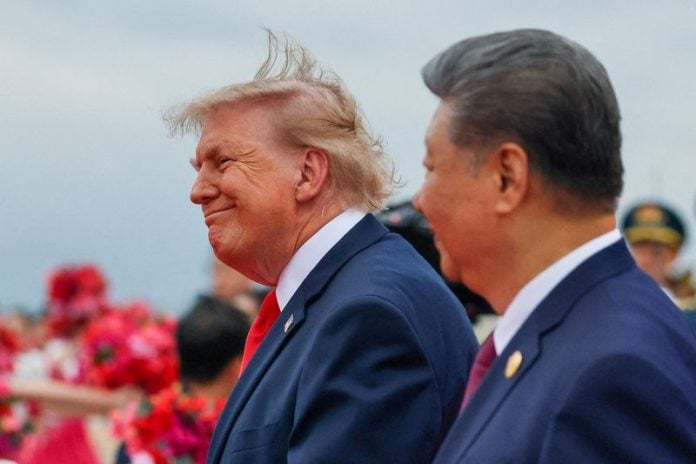
“The so-called issue of ‘industrial overcapacity’ does not really exist and should not be used as a pretext for political manipulation,” the spokesperson said, urging the two sides to jointly deliver on agreements between Trump and Chinese President Xi Jinping.
LOWER RATES FOR TRADE DEALS
The USTR also proposed capped tariff rates of 18% for imported goods from Cambodia, Indonesia, Malaysia, Thailand and Bangladesh, and 15%, including existing “Most Favored Nation” duties, for Japan, South Korea, Taiwan, the EU and Switzerland.
India, which has yet to reach a trade deal with the Trump administration, would face a 17% tariff rate if an agreement is finalized and a 25% rate if talks fail, the USTR said. Singapore would receive a capped tariff rate of 10%.
Greer told CNBC the proposed caps were consistent with trade agreements reached over the past year that also lowered barriers to US exports.
“We’re sticking to that in terms of our proposals because we think a lot of these deals we made actually solve a lot of the problems we see in excess capacity or can go toward it,” Greer said, adding that the capped rates are no surprise to trading partners.
Mexico and Norway were excluded from the proposals because investigations into their trade practices remain under way, Greer said.
Even so, the prospect of new trade barriers weighed on stock markets on Wednesday amid a renewed selloff in tech stocks. Major US indexes opened down more than 1%, with the tech-heavy Nasdaq composite down more than 3%.
“It is another reminder that while the legal justification for tariffs keeps changing, US protectionism is becoming increasingly difficult to unwind,” ING analysts wrote.
MORE SUPPORT, DURABILITY
Trump’s tariffs and their impact on rising living costs were a major issue in Democrats’ sweeping victory in midterm elections. A Reuters/Ipsos opinion poll conducted after Republicans’ midterm losses found 62% of respondents supported efforts by Democrats to repeal them.
US Senator Ron Wyden, an Oregon Democrat who is expected to chair the Senate Finance Committee when the new Congress begins in January, said: “Not even a month after voters rejected his disastrous trade agenda, Trump has decided to yet again increase prices for Americans. As Finance Committee Chair, I will use every tool at my disposal to end Trump’s disastrous tariffs.”
But that won’t be easy, because there is bipartisan support in Congress for countering excess capacity largely centered in China, said Nathaniel Halvorson, a former USTR official who is now a trade partner at Baker Mckenzie.
Undoing the tariffs also could cause some trade deals to collapse, Halvorson said, and Democrats “would have to consider whether they want to undo a settlement that might be working for US interests to some extent.”
(Reporting by David Lawder and Andrea Shalal, additional reporting by Jasper Ward; Editing by Tomasz Janowski, Mark Potter and Sanjeev Miglani)
Disclaimer: This report is auto generated from the Reuters news service. ThePrint holds no responsibility for its content.