





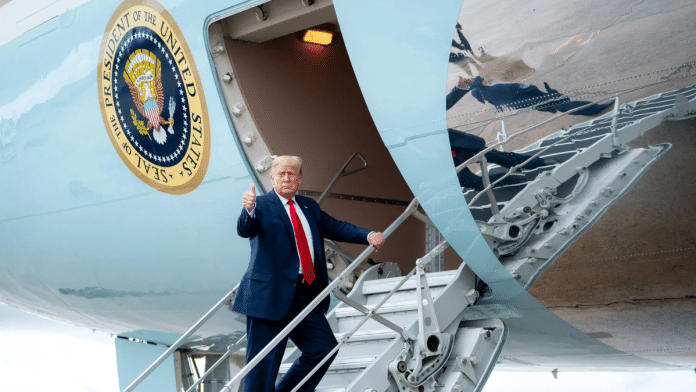



ABOARD AIR FORCE ONE: U.S. President Donald Trump signaled he was reversing course on blocking oil shipments to Cuba on Sunday, saying he had “no problem” with any country sending in crude as a Russian tanker neared a Cuban port with a badly needed shipment.
A sanctioned Russian vessel, part of the country’s “shadow fleet,” was just off the coast of eastern Cuba on Sunday, according to ship tracking data, and was expected to reach port on Monday, a lifeline for the country’s economy that has nearly ground to a halt under a de facto oil blockade imposed by Washington.
The U.S. cut off Venezuelan oil exports to Cuba after toppling Venezuelan President Nicolas Maduro on January 3, and Trump threatened to slap punishing tariffs on any other country that sent crude to Cuba. Mexico, the largest supplier to Cuba along with Venezuela, then halted its shipments.
As a result, Cuba has not received an oil tanker in three months, according to President Miguel Diaz-Canel, exacerbating an energy crisis that has led to strict rationing of gasoline and a series of blackouts across the country of 10 million people. Cuban health officials say the crisis has increased the mortality risk for Cuban cancer patients, especially children.
Speaking to reporters aboard Air Force One, Trump expressed sympathy for the Cuban people’s need for energy and said he was unconcerned with any assistance it might provide the Communist government in Havana because he predicted it would soon fall on its own.
“If a country wants to send some oil into Cuba right now, I have no problem with that, whether it’s Russia or not,” Trump said.
“Cuba is finished. They have a bad regime. They have very bad and corrupt leadership, and whether or not they get a boat of oil, it’s not going to matter,” Trump said. “I’d prefer letting it in, whether it’s Russia or anybody else, because the people need heat and cooling and all of the other things that you need.”
While expressing concern for Cubans, Trump has issued a series of threatening statements against the Cuban government and said he would turn more of his attention to the country 90 miles (150 km) from U.S. shores after dealing with Iran.
OIL CARGO COULD SHORE UP CUBA FOR A MONTH
Earlier in March, the U.S. temporarily eased sanctions on Russia to help improve the global flow of oil that has been restricted by the U.S.-Israeli war with Iran. However, that measure also created exemptions that explicitly banned transactions involving Cuba and other places such as Iran, North Korea and Crimea.
The Anatoly Kolodkin departed from Russia’s Primorsk port carrying some 650,000 barrels of crude, LSEG ship-monitoring data showed. Other reports said the vessel contained 730,000 barrels.
The official Cuban news outlet Cubadebate called the Russian shipment a direct challenge to the U.S. oil blockade, after the Russian navy escorted the sanctioned vessel through the English Channel on its way to the Caribbean.
The New York Times, citing a U.S. official briefed on the matter, reported the U.S. Coast Guard allowed the sanctioned vessel to sail to Cuba, though it was unclear why. Blocking the tanker by force, however, could have escalated the risk of conflict with Russia at a precarious time in geopolitics.
Brett Erickson of the consulting firm Obsidian Risk Advisors said the arrival of the Anatoly Kolodkin was significant in light of the British government allowing another ship from Russia’s shadow fleet, the VAYU 1, to pass through the English Channel after announcing last week it had authorized its military to board such ships passing through UK waters.
He said Russia has been receiving a “very big windfall from the war in Iran,” while also providing crucially needed oil for Cuba, whose strategic importance to Moscow has increased since the fall of allies in Syria and Venezuela and with Iran under attack.
“Havana doesn’t need very much oil to operate. The Kolodkin is carrying about two and a half weeks of oil, but that can be extended to about a month in total,” Erickson said, considering Cuban rationing.
(Reporting by Steve Holland aboard Air Force One, Daniel Trotta in Carlsbad, California, Marianna Parraga in Houston, and Dave Sherwood in Havana; Writing by Daniel Trotta; editing by Costas Pitas, Jonathan Oatis, Paul Simao and Sonali Paul)
Disclaimer: This report is auto generated from the Reuters news service. ThePrint holds no responsibility for its content.
Also read: Secret tokens, semi trucks: How ‘king’ Guramrit Sidhu moved $17mn worth of cocaine, meth into Canada