








In Episode 1815 of Cut The Clutter, Shekhar Gupta delineates the shifting and often contradictory signals from Donald Trump amid the US–Iran confrontation, from calls for “total surrender” to talk of negotiations and reclaiming enriched uranium. He looks at the debate over Iran’s nuclear stockpile and the limits of its conventional military strength versus its missile capabilities. He argues that Trump’s approach reflects a strategy of ambiguity and flexibility, the goal post can be shifted to declare victory at any point.
Here’s the full transcript.
Of all the episodes of Cut the Clutter we’ve done so far on the crisis in the Gulf, or the Gulf War as we might call it, what’s going on right now — or the Gulf War last year, which was more a case of Israel carrying out raids over Iran for 11 days and Americans joining on the 12th day, and many other crises in between before and after — this is probably the most complicated, the most challenging. Why? Because I’m trying to read Donald Trump’s mind. I’m trying to explain to you what does Trump want and what does Trump mean.
Because one day he says, “I’m going to obliterate everything. I want total surrender.” That was on March 6. On another day he says, “I just want that they should be of no threat to anybody.” Then he says, “I’ve already destroyed all their ability to enrich uranium. They don’t have any of that. They can’t do any more of that.” Then he says — and that is the latest statement from him this morning, that is Monday morning Washington time — that he wants all the nuclear dust also back from Iran.
That nuclear dust, if I may remind you, is something that Steve Witkoff had talked about, he is special envoy to the Middle East and to Russia-Ukraine. Steve Witkoff had said that at one of their negotiations the Iranian representative had said that they are holding about 960 pounds, which makes about 440 kilograms, of 60% enriched uranium. That stock they have, and if they want, he said, they can convert this into bombs within about two weeks, or maybe less than two weeks, because from 60% to get to weapons grade does not take too long.
Now that is something that Trump has not talked about so far. Then he was asked, “How do you intend to get it, now that you say you want that nuclear dust back? How will you get it?” So Trump said, we want the nuclear dust, and he goes on to say we want no enrichment. And he was saying this talking to the media at Palm Beach airport in Florida, obviously on his way to Washington from Mar-a-Lago after his weekend. “We want no enrichment and we also want the enriched uranium. If this happens, it’s a great start for Iran to build itself back.”
Then he’s asked, “How will you get this nuclear dust?” I presume it’s the same 970 pounds. He says, and I quote, “If we have a deal, we are going to go down and take it ourselves.”
Now before that, he said — and this has come after a frenetic round of posting and talking from him — this latest conversation Monday morning Washington time, Monday evening our time, in fact just a little before I started to record, and that caused a little delay also because I had to incorporate what he said now. And dealing with Trump is actually like following the commentary in a T20 cricket match because the odds and facts change with every ball. Odds, facts, asking rate, everything changes every ball. That’s how it is with Trump.
This is the latest. I have to stop somewhere, this is where I have stopped in the sense of his latest statement. This statement started with his claiming that he’s talking to Iran’s most respected leader — not Mojtaba, he said, not Mojtaba Khamenei. He said nobody knows whether he’s dead or alive, where he is. And he said, I don’t want any leaders killed anymore in Iran because there are no leaders, all leaders are killed, and he does not want the leader who he is talking to killed. So he’s not naming the leader. He just says that if everything goes through, we’ll have a deal and we’ll get this uranium back, and then add it on to whatever is said in the past.
Now as we speak, Jerusalem Post, which is a reliable newspaper — in fact some of the Israeli newspapers are quite reliable, they also get stories out of Washington which are quite authentic — the Jerusalem Post says in a scoop that the Iranian leader Trump is talking to is Mohammad Bagher Ghalibaf, the speaker of the national parliament, the Majlis there. The speaker there is a particularly important position, that’s the position that Larijani had for almost 12 years. That position is close to the ayatollahs, that position speaks for the ideological side and the revolutionary side much more than the elected government often.
Now Ghalibaf is also somebody who’s been writing the angriest and the most emphatic tweets to counter Trump over the last few days. Ghalibaf wasn’t that visible for a long time. In fact, even I hardly knew him. If two weeks back you had asked me for his name, I would not have been able to tell you. But now we’ve known him because he’s been posting quite often. So we’ve also seen the rise of a new power in Iran.
Now if Jerusalem Post is right and Trump is talking to him, what he means is that his administration, the Trump administration, will be talking to Ghalibaf. It’s not clear. He does not say that he will be talking. However, who knows with him. Trump also said that he’s setting up a call and he may be talking to this leader later today. So we don’t know what happens. When something happens, the whole world will come to know.
And you know what, you get a sense of how fast this is moving, that as I am recording, Barak Ravid of Axios and Jerusalem Post have broken a story that a round of talks is going to take place between the Iranian and the American side, where America may be represented maybe by JD Vance, the Vice President, and you know what, where these talks are likely to take place — if these reports are correct — these talks will take place in Islamabad, the capital of Pakistan.
And details are still coming in and they are sketchy, but looks like from whatever has come out now from the American side, Steve Witkoff and Jared Kushner, that is Donald Trump’s son-in-law, they will be there. And from the Iranian side, these reports say the delegation will be led by the speaker of the Majlis, Ghalibaf.
Earlier, Donald Trump wanted complete surrender by the Iranians, that was on March 6. Then he said people of Iran should come out and take their country, this is your opportunity. From all of that, he’s now come to a situation where, number one, he says no nuclear capability. So Iran should turn over everything that it has by way of enriched uranium, should not enrich uranium anymore, and America should have the ability to monitor that the promise is being kept. Number two, no missiles and missile capability, ballistic missile capability—that should go. Number three, that it should be of no threat to America, first of all because they said that Iran is developing missiles that might reach further than their current ranges.
Iran did display the range of two of its missiles getting to about three-and-a-half to four thousand kilometers. Although they did not quite get to the destination, those were missiles fired at Diego Garcia. One failed in launch or maybe midway, the other one was intercepted somewhere or maybe lost its way, we don’t know. But the two were fired to display that Iran had added range to its missiles, which means if those missiles work, they can hit European cities as well, which are America’s allies in NATO.
Nevertheless, he wants the missile capability to go. And he also wants, third — and this is part of his third objective — that Iran is of no threat to America and to any of America’s allies, especially in the Middle East. And there he names all the countries — Israel, but also Qatar, Saudi Arabia, UAE, Bahrain, Kuwait, and so on and so forth.
So in a way, for the first time, he’s giving you a tangible set of targets. So far he’s kept on moving from one to the other…
In fact, if you go right back to 28th of February, his first statement — I will read from it — “It has been the policy of the United States, particularly my administration, that this terrorist regime can never have a nuclear weapon. I will say it again: they can never have a nuclear weapon.” This is why, in Operation Midnight Hammer last June, we obliterated the regime’s nuclear program at Fordow, Natanz and Isfahan. Those are the three facilities that were hit by very heavy bombs with penetration fuses, so they could go through a great deal of granite, the mountain, and destroy those facilities underneath, at least bury them under the rubble. And that apparently was achieved also.
If that was achieved, these facilities were now being watched by American satellites constantly, 24/7, so there was no question of Iran being able to enrich that again. But once again, Americans came up with the idea — and that comes from Witkoff’s statement — that Iranians told him that they were still sitting on this 440 kilos or 970 pounds of uranium enriched up to 60%, which everybody knows can be enriched further into weapons grade, maybe not fully weapons grade but definitely up to a dirty weapons grade. And that was unacceptable to the Americans.
So that is how he started on 28th February, and since then — 28th February to 6th March — total surrender. Then to say that all the leadership has been killed, and he goes on and on saying that Iran’s navy is destroyed, air force is destroyed. Now the fact is, when this war began, Iran did not have an air force, barring a whole bunch of helicopters, maybe the odd museum-quality or museum-vintage fighter sitting here and there. Iran did not have an air force. They have some Russian aircraft, but really not effective.
They also hardly had a navy. He keeps on saying they had a very formidable navy — no. They just had four frigates, one of which was sunk off Sri Lanka, as we know, IRIS Dena. There were three more frigates which have been sunk in the course of time. They had one large submarine, a Soviet-origin Kilo-class, of the kind that we also have — our older submarines — that’s been sunk. And they had some Ghadir submarines, smaller submarines, eleven of them. Those have all been sunk.
If at all the Iranians have some submarines which still exist, or some of which still exist, they can lay mines. Iranians, at the beginning of the war, had about 3,000 mines. Many have been destroyed or may have been destroyed, but even if they’re left with 300 and they release them in the Strait of Hormuz, that can become a nuisance. And then it becomes a big challenge to clear those mines and to certify that those waters are safe.
So he keeps on saying, “I destroyed the air force,” which did not exist when this war began, or “I destroyed the navy,” which hardly existed. This is like the navy of a tiny country. This is not the navy of any size. The Iranians never invested in a navy because they wanted land forces for one set of purposes. Second, they invested big time — or to use Trump’s favorite expression, “bigly” — in missiles and one-way drones. Those they invested in, not just in quality — they got quite a bit of quality with their missiles — but also in numbers, in quantity.
And as we keep saying, Joseph Stalin had said that in warfare, quantity is its own quality. So my planes may not be as good as Hitler’s planes, but I have many more planes than them. My tanks may not be as good as Hitler’s tanks, but I have many more of them. That is what the Iranians played with also this time — just the number of missiles, and more importantly missile launchers they produced. That has taken everybody by surprise, because so many launchers have been hit and yet Iranians have kept on firing ballistic missiles at Israel. And I mention Israel especially because Israel is the most distant point to which Iranians fire their missiles. All the others in the Middle East are closer than Israel.
Now, the statement this morning that Trump made — we’ll go back and forth with this statement because he goes back and forth with his views, right? So sometimes you have to go back and forth to see where he’s come from, where he’s headed, or where you think he’s headed. He might land you up someplace else tomorrow. I can’t guarantee that.
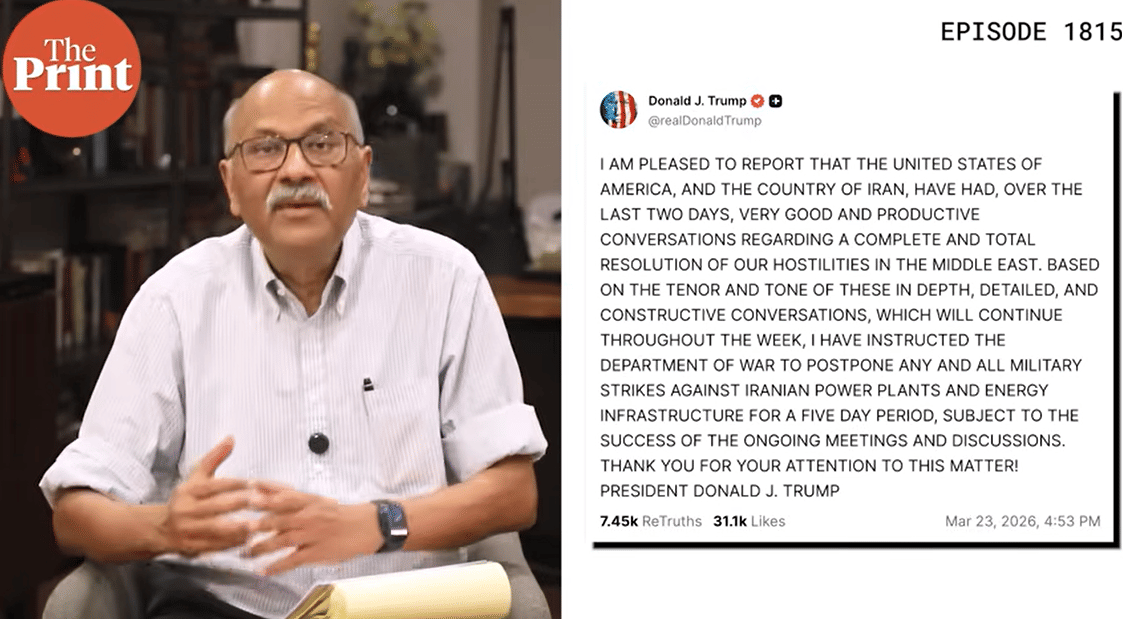
What he said today followed a Truth Social post that he had put out earlier this morning, Washington time. He must be a very early riser, or maybe he writes these at night and gets somebody to post them, I don’t know. But these are all written by him because they’re full of spelling mistakes, bad syntax, sometimes bad grammar. He gets proper names wrong, nouns wrong. There is no way he will even pass the prelims in a UPSC exam. So these are all written by him. Just as I say on my Twitter bio, typos are my fingerprints — these errors are Trump’s fingerprints. So you know that he’s written them.
Now this post that he put out in the morning, where he said, “I’m pleased to report that the United States of America and the country of Iran have had, over the last two days, very good and productive conversations regarding a complete and total resolution of our hostilities in the Middle East. Based on the tenor and tone of these in-depth, detailed and constructive conversations, which will continue throughout the week, I have instructed the Department of War to postpone any and all military strikes against Iranian power plants and energy infrastructure for a five-day period, subject to the success of the ongoing meetings and discussions. Thank you for your attention to this matter.”
Now first of all, immediately the market saw it as a ceasefire, and that’s how American markets added $2 trillion to their value. Once denials came from Iran saying no such talks were taking place, a trillion dollars was lost. So this was the most dramatic $3 trillion movement in US markets within an hour or so — quite remarkable in the history of markets. $2 trillion gained, $1 trillion lost, net gain still $1 trillion.
Now there are some important points in this post. First of all, I will tell you, we have not put it in all caps for you to be able to read it better — Donald Trump put this out in all caps. When he wants you to take him really seriously, or when he wants to threaten you, then he puts it in all capitals. That is what old, cheap bosses used to do when they wanted to intimidate their employees or subordinates.
Now there are things that people are picking up from this. First of all, he said he’s got productive conversations going on, but he does not say with whom. Some people are laying store by his using the expression “country of Iran,” saying that he’s saying “country of Iran,” not “regime of Iran.” That means he’s talking to somebody who is not currently key or visible in the power structure. We don’t know.
Is there a method to Trump’s madness? We’ll come to that with the help of some readings, especially a Foreign Affairs article by Richard Fontaine, who served in the National Security Council and the Department of State and now runs a powerful think tank called the Center for a New American Security. However, let’s also look at the way he’s been shifting his targets. He’s been shifting his targets and he’s also been missing them.
There is this article by David Sanger of The New York Times, a very respected journalist — we’ve quoted from him many times. He wrote an article saying that Trump had set many objectives for himself, he has not achieved any of those fully, and now he’s looking for an exit ramp and he’ll declare peace and victory, but he has not achieved any of his objectives.
Now this is what got Trump riled up, and in one of his posts he again claimed that he has achieved all his objectives. And he said The New York Times — and usually when he says The New York Times, he would say “the failing New York Times” — and its very weak journalist, he says, David Sanger, who has said that I have not achieved any objectives.
When Trump takes notice of you as a journalist, as a critical journalist, you can pretty much believe that either a phone call from him for an interview or maybe even a lunch invitation is on the way, because he takes you seriously. He has countered David Sanger by saying, no, I am achieving all my objectives, and ahead of time.
What does David Sanger say? David Sanger says that Trump has not been able to achieve his objectives because a few surprises cropped up in this war. I will list them as three.
Number one, that he did not understand how much energy disruption this will cause and how much market chaos that will lead to. And Iranians, meanwhile, discovered that market chaos was a super weapon in Iranian hands. The Iranians discovered that in the process.
He says Trump got so off-balance that he lifted sanctions on Russian oil and then Iranian oil as well. So in the process he benefited the enemy of Ukraine, which is America’s ally, and also its own enemy — the one it’s at war with — that is Iran. That surprise sowed confusion at Trump’s end, and he took these drastic steps which otherwise are difficult to explain, in fact they are inexplicable.
Number two, he says the surprise that Trump, who thought that NATO was not needed, that America was all-powerful and the American military could do everything by itself, suddenly he realised that America needed allies. And that’s when he asked NATO to come and help America, and also for policing the Strait of Hormuz. That was the second surprise.
The third surprise was that his expectation that after the killing — the decapitation strike on day one, when all of the leadership of Iran was killed — the people of Iran would rise in revolt, because after all just this January, literally lakhs of them had risen in revolt and they had continued protesting even though tens of thousands had been massacred by the IRGC and other regime forces. But in spite of all of that, no public protests took place. People did not come out on the streets.
That is what surprised him, because he miscalculated in not realising that Iran is not Venezuela, that you can pick up Maduro, you can make his number two in charge, and the country goes on as normal. No — Iran is a civilizational country. That is something that we keep saying all the time. Iran, at least its recorded history, goes back to 550 BC under Cyrus the Great, a Zoroastrian king. Iranians have a sense of culture, they have a sense of patriotism, and Iranian politics also is multi-layered. And once it’s multi-layered, then stability gets built into the system. If one goes, the next one takes over, the next one takes over — like that.
That is something that Trump and his people did not appreciate, also because Trump’s people do not do any homework. They are reckless. They rush into things believing that in two days it will all be over.
And I see in another analysis — that is the Richard Fontaine analysis — that Trump has got spoiled by successes in the past, because he has launched short wars or short strikes and got results right away. In his previous term, he killed Qasem Soleimani. It was just a drone strike. Qasem Soleimani was the head of the Quds Force in the IRGC, the most powerful IRGC general. He was killed close to Baghdad, on the outskirts of Baghdad. He also carried out a raid successfully on ISIS chief Abu Bakr al-Baghdadi. That was a success on his part because it was just a raid that killed the guy he was after, and nobody in the world felt sorry for Abu Bakr al-Baghdadi, including the Islamic world.
Similarly, he carried out raids in Syria over Assad’s forces and some other elements of ISIS there. But these were all one-off raids. He did not get involved in anything with a clear, complex objective.
To that extent, Fontaine explains in this article — headline “Trump’s Way of War” — that his doctrine, the Trump doctrine, the Trump way of war, is the exact opposite of the Colin Powell way of war. Colin Powell, former general and also Secretary of State — Colin Powell’s way of war was that you should use force only after exhausting all other methods: diplomatic, political, economic, sanctions, etc. After all of that had failed, then you use force.
Trump’s method is the opposite. Trump’s method is: when you get an opportunity, use force. Don’t give any clear objectives. What that does is, because you don’t have clear objectives, you can decide when to declare victory. And when you can decide when to declare victory and stop fighting, then the other possibility — of having to admit defeat, as the Americans did in Afghanistan, much before that in Vietnam, and not exactly in Iraq but to some extent — that doesn’t happen.
That’s where I give you a highlight from Trump’s press conference over the weekend, where he talked at great length to journalists. When he was asked about succession, the new regime in Iran, the new system in Iran, he said — look, Iraq — and that is a rare sensible thing, as in seriously sensible. He said that in Iraq, everybody was killed, all the officials were killed, then generals were killed, nobody was left to run the country. Ultimately, what happened? The country went to ISIS. We don’t want that happening in Iran.
I thought that was a sensible argument made by him, which means that he has now concluded that forced regime change is not an idea whose time has come. It’s also not going to be possible. So he will try and get a convenient regime out of whatever existed earlier, before these decapitation bombings.
As a matter of fact, even today, speaking to CNBC, he said, “All right, regime change — what’s unfolding in Iran right now can be described as regime change.” What he’ll then say is, the earlier regime — everybody got killed. Now new people have come in, they have different thinking, they’re making a deal with me, they are talking with me, and so on and so forth.
Fontaine goes on to say that both the Bushes — that is George H.W. Bush, the senior — he gave Saddam Hussein a deadline to get out of Kuwait, and it’s only after he did not meet the deadline, he said nothing doing, I will not go out of Kuwait, and there will be the “mother of all battles.” Umm al-Ma’arik, mother of all battles, that is the Arabic expression. After that, George H.W. Bush launched Desert Storm.
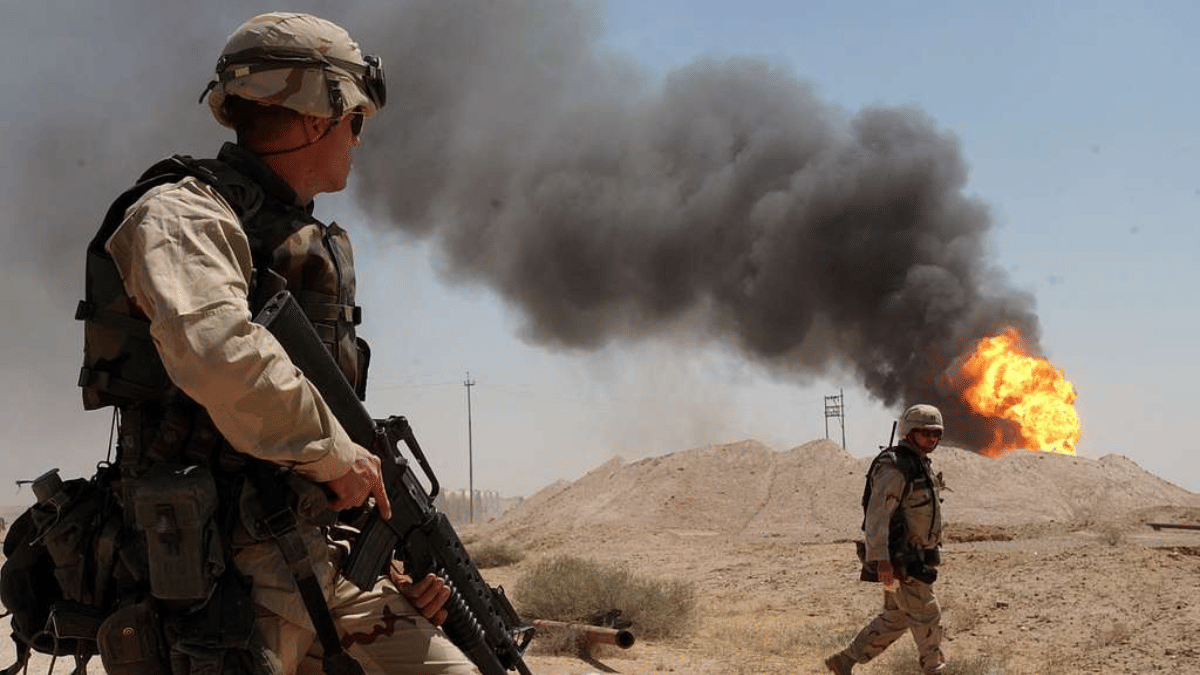
Then George W. Bush, in 2003 — Operation Iraqi Freedom — before that he gave an ultimatum to Saddam Hussein. And before that, in 2001, after 9/11, he had given an ultimatum to the Taliban as well: hand over bin Laden and all other al-Qaeda people, and we will not come and mess with you. But the Taliban said this is Pashtunwali, we’ve given him refuge, he’s our guest, we will not betray him. And that’s how the wars took place.
In the case of Trump, such things do not apply, because he uses ambiguity as a source of advantage. I’m quoting from Fontaine. He uses ambiguity as a source of advantage and catches his opponent off guard. So his raids on Iran in 2025 June, as well as now in 2026, were carried out while negotiations were going on, when Iranians were least expecting it.
He follows a doctrine which is the exact opposite of the Powell doctrine, which two earlier Republican presidents followed.
Fotaine goes on to say that Trump has never given anybody a warning, Soleimani was not given a warning, before being bumped off, Maduro was given no warning before being kidnapped.
He sees military power as one of the several tools available to increase leverage, maximise surprise, and produce outcomes. And then he can define victory.
And then he gives you the various definitions that Trump gave for victory — that he will finish the threat to American people, which threat did not exist because Iranians did not have the range to reach America; two, peace in the Middle East and the world; three, regime change or a new leader in Iran; fourth, total surrender. All of these are sort of vague targets, and he’s not close to achieving any of those.
But if he now says, “I’m getting this uranium back and they will not enrich anymore,” he will say this is a gain as well. “I have won a great victory.” That’s why he uses clarity versus flexibility, and he chooses flexibility over clarity. What that means is that he has multiple vague objectives, and he can declare victory any time during fighting and never need to admit defeat.
As an example, you could quote the Houthis. Until last year, Trump was bombing the Houthis. In fact, it was in that process that he had to fire his national security adviser and then cut a deal with the Houthis. Now you see all the shipping is coming around the Red Sea, through the Bab el-Mandeb, which the Houthis could have interrupted or interfered with, but they haven’t done so — using the same kind of arm-twisting, using military force to, quote-unquote, persuade the other side to talk, or to bring them closer to your objectives.
These don’t have to be fully met, because you have not clearly defined your objectives. You can then see, in the course of time, what is it optimally that I can achieve. If you can achieve that, you can declare victory.
If the Iranians come to Islamabad or wherever now, after being hit so many times, after having their entire leadership wiped out — their civilian as well as clergy and military leadership all wiped out — their nuclear facilities, to use Trump’s word, “obliterated,” most of their missile factories and drone factories and industrial base all demolished — after that, if the Iranians come for talks on some of these terms, Trump will immediately declare victory.
He will declare just the talks taking place as a victory, and he can stop fighting and go home. That is the Trump doctrine, and that is what you see coming out of all these vague, confusing messages which he keeps putting out.
(Edited by Tony Rai)
Also read: South Pars strike marks critical point for Gulf. Its ripples can trigger new phase of Iran war