






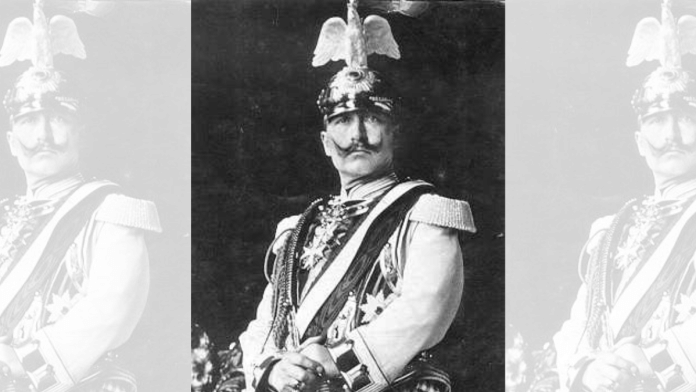



An admiral writes of a world leader who is familiar to us: “He is vanity itself, sacrificing everything to his own moods and childish amusements, and nobody checks him in doing so. I ask myself how people with blood rather than water in their veins can bear to be around him.”
I cheated by putting my first sentence above in the present tense. These words were, in fact, written in July 1914 by Germany’s Albert Hopman, about Kaiser Wilhelm II. A fellow historian who, like me, has written a book about the outbreak of World War I, messaged this week, asking if I share her view of the character matches between Wilhelm and today’s US president.
I do indeed. And find myself scared by them. Donald Trump’s extraordinary performance in Davos, littered with falsehoods, insults and explosions of grandiloquence, closely resembled one of the Kaiser’s public performances as he rattled his saber in the years before playing a major role in precipitating World War I.
Trump’s ruderies about how fast the Nazis overran Denmark in 1940, and about how NATO allies allegedly avoided the front line in Afghanistan — where Britain lost 457 dead — compare with the Kaiser’s jibes at other nations. He constantly abused “Slavdom” — the Russians. He despised the French as “a feminine race — not manly like the Anglo-Saxons or Teutons.”
It is not that Trump seems likely to start a third world war. But he has devoted his first year in office to tearing down the pillars of international order. He has set a new standard for US foreign policy, wherein the only constraints are his own whims. His narcissism, self-obsession, lust for flattery and absolute indifference to the welfare or interests of others echo Germany’s last kaiser.
Wilhelm ascended the throne of the newly united Germany in 1888, succeeding his father, and ruled for 30 years. He committed the second-most important political act of his life soon after taking over. Tiring of his domineering chancellor, the great Otto von Bismarck, in 1890 young Wilhelm sacked him.
It does not seem fanciful to compare the latter’s “dropping the pilot,” as Punch magazine characterized the event in a famous Tenniel cartoon, with Trump’s dismissal of the advisers who sought to check him in his first term. Wilhelm ended up surrounded by a court of sycophants, too.
Some of these people were very odd indeed. In 1908 the head of his military secretariat, Graf von Hülsen-Haeseler, died of a heart attack at a Black Forest shooting lodge, while performing a ballet dressed in a tutu, before a male audience that included Wilhelm.
After Bismarck’s fall, domestic affairs were run by a succession of unimpressive politicians, while the Kaiser directed his country’s erratic foreign policy. Obsessed with making Germany great, he was bitterly jealous of Britain and of his grandmother Queen Victoria. He loved soldiers and military display, but himself cut an unimpressive figure in uniform because of a withered arm.
Instead of Trump’s craved “piece of ice” — Greenland — Wilhelm wanted “our place in the sun,” an overseas empire to match those of Britain, France, even Belgium. His ambitions caused Germany to snatch fragments of Africa that had not been occupied by other Europeans, together with some Pacific islands.
He inherited a formidable army, and decided to build a navy to rival that of his British grandmother. He was addicted to bellicose declarations which frightened the life out of other nations, for instance writing in 1908 on a dispatch from his ambassador in London: “If they want a war they may start it. We are not afraid of it.”
That fine American historian Jonathan Steinberg wrote of the chaotic governance that evolved from Wilhelm’s lunges and plunges abroad: “The system slithered into the conspiracy, intrigue and bluster that made the Kaiser’s Germany a danger to its neighbors.”
Steinberg observes that Bismarck created a political structure that worked only when Germany had a genius as chancellor — himself — and a sensible emperor. Under weak chancellors and a “mildly deranged” kaiser, it became a menace.
Max Weber, the German political philosopher who was a contemporary of Wilhelm, wrote that Bismarck bequeathed a nation “totally bereft of political will. It had grown accustomed to submit patiently and fatalistically to whatever was decided for it in the name of monarchical government.” Germany’s supine parliament seems a forerunner of today’s supine US Congress.
Wilhelm was not exclusively responsible for the outbreak of World War I, but he played a large part by giving Austro-Hungary a so-called “blank cheque” to destroy Serbia, from which Europe-wide catastrophe followed. Trump’s obvious sympathy for Russia’s Vladimir Putin, and his obvious indifference to the fate of Ukraine, regardless of the current negotiations between Moscow and Washington, seem equally misjudged.
The Kaiser, like Trump, had an unerring instinct for the wrong gesture. On 1 Aug. 1914 in Berlin, after signing Germany’s declaration of war, he ordered celebratory champagne to be served to his staff. Even Helmuth von Moltke, the chief of his army, despaired of his master, saying “I want to wage war against the French and Belgians, not against such a kaiser!”
The world was dangerous enough when an unstable and irresponsible leader ruled Germany. It becomes vastly worse when a man with similar character flaws is the most powerful human being on earth.
As a historian, I see one especially important comparison between the old Germany and today’s US. The Kaiser’s nation yearned for European dominance. In 1914 it was well on its way to securing this, by peaceful means. Germany was powering ahead of France, Britain and Russia industrially and scientifically. By the key indicator of machine-tool production, it had overtaken Britain 20 years earlier, while Victoria was still on the throne.
If Germany had not precipitated conflict, it is hard to imagine anything that could have prevented it from achieving decisive superiority over its neighbors by, say, 1930. But the Kaiser and his generals measured strength, and success, in bayonets and battlefield victories. Thus they declared war on France and Russia; and Britain declared war on Germany thereafter .
Today’s US has achieved an extraordinary economic dominance, above all through its giant technology companies, which Europe and Britain have no prospect of matching in the years or even decades ahead.
To be sure, we know the vulnerabilities of US industries, which Trump’s back-to-the-future tariff policies seek to revive. But China faces its own economic, social and industrial difficulties. I am among those who believe that the American genius will enable the nation to continue to compete effectively — if the country’s leadership permits it to do so.
US might is threatened by the president’s reckless assault on international stability, which is making America disliked and feared by many peoples, as never before. Here is one last story of Wilhelm, absolutely relevant to Trump.
At his Berlin palace in 1899 the Kaiser received the British imperialist tycoon Cecil Rhodes. “Now tell me, Rhodes,” he said, “Why is it that I am not popular in England. What can I do to make myself popular?”
Rhodes answered: “Why don’t you try doing nothing, sire?” The Kaiser hesitated, then exploded into heavy laughter. He was incapable of taking such advice. And so, many of us fear, is the US president.
Disclaimer: This report is auto generated from the Bloomberg news service. ThePrint holds no responsibility for its content.