








Foreign student enrollment at US universities fell by 1.4% this fall, the first drop in three years after the Trump administration clamped down on immigration and took aim at a bevy of elite schools.
The number of international students across the country dropped by close to 5,000, even as the overall number of students grew by 1%, according to data released Thursday by the National Student Clearinghouse Research Center. The decline was driven by graduate student programs, where enrollment fell by 6% — or nearly 10,000 students — after shooting up more than 50% between 2020 and 2024.
It’s the latest blow to US colleges and universities as President Donald Trump pushes to remake higher education. The wealthiest institutions are facing a higher endowment tax under his tax-and-spending law from last year. And top schools have also been contending with federal funding freezes.
International students have been coveted by school administrators because they often pay full freight. Personal and family funds represented the primary source of funding for 51% of students in 2024-25, according to the Institute of International Education.
But the Trump administration has enacted travel bans, gummed up the visa application process and threatened deportations for campus activists. Earlier this week, the X account for the Department of State touted that it had revoked 8,000 student visas in its mission to “keep America safe.”
Matthew Holsapple, senior director of research at the Clearinghouse, said the drop in graduate students is a “stark difference” in the recruiting environment.
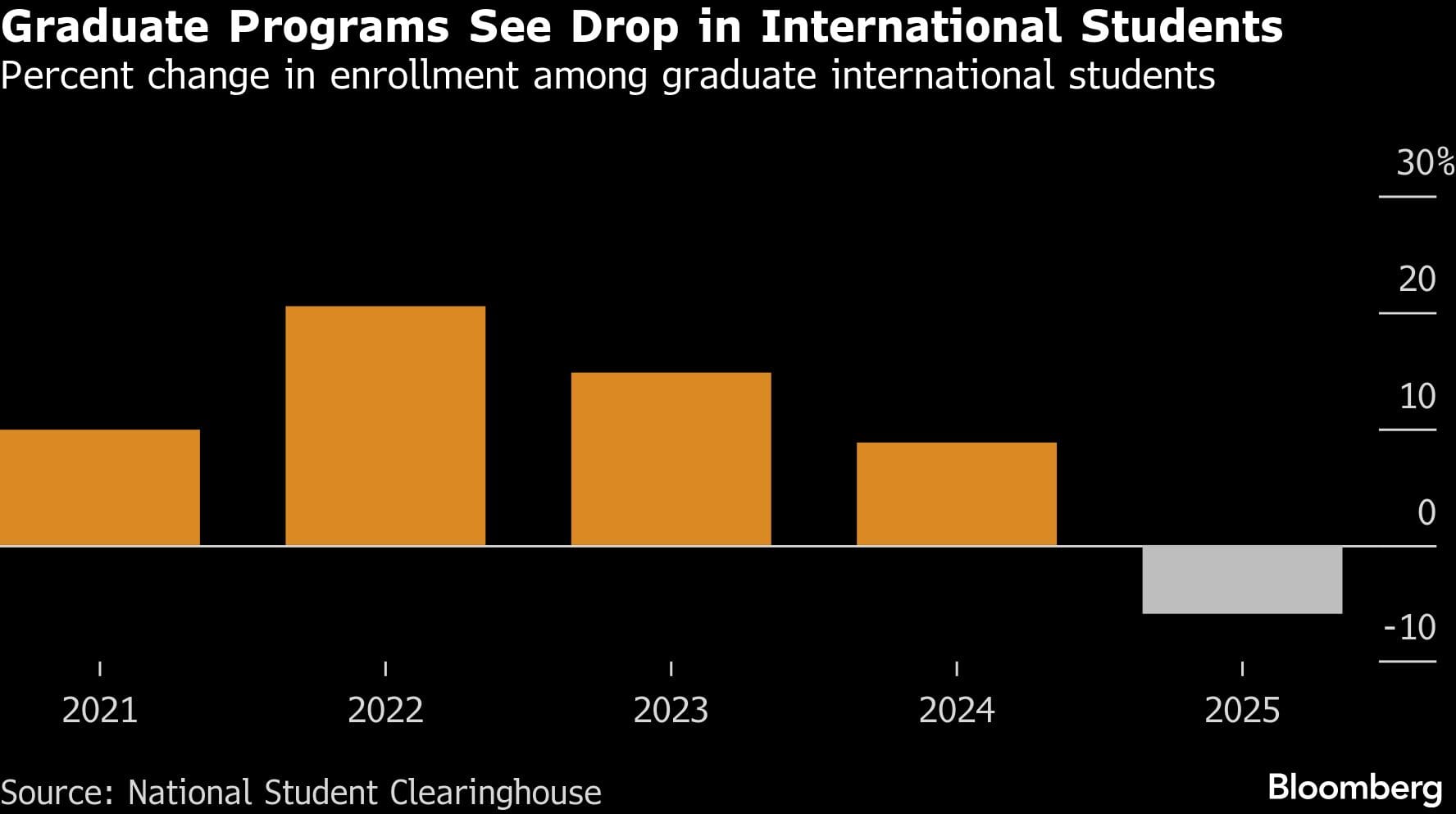
“It follows several years of strong growth, making this year’s downturn a pretty meaningful shift after that long period of expansion,” he said. The decline among that graduate international student cohort was particularly significant at public four-year institutions, which saw a nearly 9% drop, the Clearinghouse said.
At Lewis University, a private school just outside of Chicago, a summer pause in visa processing was followed by a 37% decline in the number of new international students in graduate programs. The loss forced the school to cut 10% of its employees.
“It was a very dramatic shift in a very small amount of time and we had to make quick adjustments,” Provost Christopher Sindt said in an interview. “We had been growing our staff and resources, but this decline required us to right-size the institution to a smaller enrollment profile.”
Harvard or Bust
The new policies have played out in very different ways across the higher education landscape. While the foreign population in graduate programs shrunk, it grew at the undergraduate level, though at a much slower pace than in recent years — a 3.2% increase this year, down from 8.4% growth the year before.
Harvard University, one of the main targets of Trump’s ire, managed to buck the trends when it recently reported that it had enrolled a record number of international students this academic year. The share of foreign students at the school in the fall of 2025 rose slightly to 28%, or 6,749 students — the most since at least 2002 — according to university data.
In Gurgaon, near New Delhi, Adarsh Khandelwal, co-founder of the college counseling firm Collegify, said that his clients – prospective students hoping for an American education – are focusing on elite schools in a “high-risk, high-reward” strategy.
Before, his students used to send out applications to about eight schools, and that pool could include liberal arts colleges. Now, the number has almost doubled and they’re only trying the most competitive schools. Visa scrutiny and a dismal job market have steered prospective students to only apply to top schools, Khandelwal said.
“Now the feeling in this part of the world is that if you want to go to the US, you should only look at a top school because only then you’ll have a good future or a good job or a good ROI,” he said.
At DePaul University, in Chicago, foreign student enrollment has taken a big hit. This past fall, the overall foreign student population was down 755 students compared to fall 2024, while the number of new graduate students from abroad was down nearly 62%. The school attributed losses to visa challenges and the “declining desire for international students to study in the U.S.”
“Our FY26 budget planning did not anticipate a reduction of this magnitude,” DePaul’s leadership team wrote in a September post announcing spending cuts.
Media representatives for DePaul did not respond to a request for comment.
Affordability Plays
Headcount in computer and information science studies, popular programs with international students, fell for the first time since 2020. Enrollment shrank by 14% at the graduate level and 3.6% in undergraduate programs. The drops come after the field saw 30% growth from 2020 to 2024.
In looking at the student population as a whole, the Clearinghouse data indicates that there was a shift this fall away from private four-year schools, where enrollment was down 1.6%, and toward public universities and community colleges, which grew by 1.4% and 3%, respectively.
“It’s a clear departure from the broad-based growth we’ve seen in recent years, when publics and privates have moved together and not in opposing directions,” Holsapple said. “The split is striking.”
Undergrads appear to be broadly pivoting toward more affordable, value-oriented studies. Certificate and associate degree programs grew by 1.9% and 2.2%, outpacing the 0.9% gains in bachelor’s degree programs, according to the Clearinghouse. Community colleges now enroll 28.3% more undergraduate students in certificate programs than they did in fall 2021.
“We are continuing to see students shifting out of some of the more traditional pathways into these shorter-term, more flexible, perhaps more job- and career-oriented fields,” Holsapple said.
–With assistance from Amanda Albright.
Disclaimer: This report is auto generated from the Bloomberg news service. ThePrint holds no responsibility for its content.