





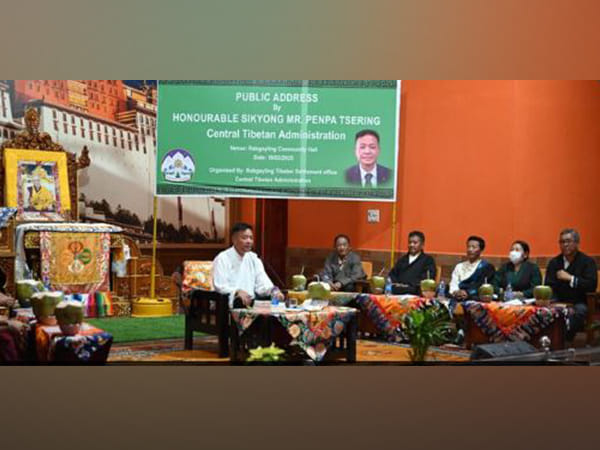


Hunsur (Karnataka) [India], February 20 (ANI): Tibetan President in-exile, Sikyong Penpa Tsering addressed Tibetans at the Rabgyaling Tibetan Settlement’s community hall on February 19, 2025, as part of his official visit to Hunsur.
The event was attended by local Tibetan officials, including the President of the Local Tibetan Assembly, Settlement Officer Norbu Tsering, abbots from nearby monasteries, and representatives of various Tibetan organisations, according to a report by the Central Tibetan Administration (CTA).
During his speech, Sikyong stressed the importance of preserving Tibetan culture and fostering unity among Tibetans. He reiterated the two primary goals of the Central Tibetan Administration: safeguarding the welfare of Tibetans in exile and seeking a resolution to the Sino-Tibetan conflict through the Middle Way Approach.
The CTA report highlighted that Sikyong also emphasised the need for maintaining good relations with local Indian communities, acknowledging India’s longstanding support for Tibetans. He reminded the community of their responsibility to abide by Indian laws and cultural norms, as well as those of any host country where Tibetans reside.
In addition, Sikyong praised the contributions of Tibetan youth in advocacy efforts, particularly through organisations like the Voluntary Tibet Advocacy Group (V-TAG). He noted that many young Tibetans are actively engaged in grassroots activism, lobbying, and awareness campaigns.
Encouraging them to continue their efforts, he urged the youth to use their skills and dedication to further strengthen the Tibetan cause on the global stage, as reported by CTA.
Tibet, once an independent nation with a distinct cultural, religious, and political identity, was invaded by China in 1949. The Seventeen-Point Agreement, signed under coercion in 1951, allowed China to impose its rule, stripping Tibet of its autonomy.
On March 10, 1959, a massive uprising against Chinese occupation in Tibet was violently suppressed, forcing the Dalai Lama to flee into exile and marking the beginning of Tibet’s struggle from abroad. (ANI)
This report is auto-generated from ANI news service. ThePrint holds no responsibility for its content.