





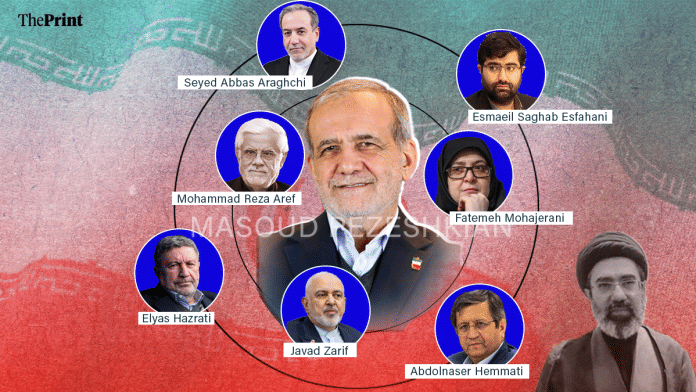



New Delhi: With the West Asia conflict now in its third week, attention has increasingly turned to the leadership of Iran President Masoud Pezeshkian.
The country’s ultimate authority rests with newly elected Supreme Leader Mojtaba Khamanei, but the president’s circle of ministers, advisers and technocrats plays a critical role in shaping economic policy, managing domestic unrest and projecting the government’s message at home and abroad.
A review of the figures Pezeshkian publicly follows on X from his official handle offers a snapshot of the network of officials helping steer the government through war, sanctions and mounting regional tensions.
Many occupy key cabinet positions or senior posts in the presidential office, while others are influential voices in Iran’s political and media landscape.
Key figures
At the apex of Iran’s political system is Mojtaba Khamenei, the country’s Supreme Leader, elected after his father Ali Khamanei was assassinated by US-Israeli missiles on 28 February. He holds final authority over the armed forces, foreign policy and major strategic decisions.
Others part of his close circle are Mohammad Reza Aref, the vice-president and a senior reformist politician responsible for coordinating government policy and overseeing cabinet affairs.
Aref—an Iranian engineer, academic and reformist politician—has served as the country’s first vice-president since 2024 under Pezeshkian. He had previously held the position from 2001 to 2005 during the presidency of Mohammad Khatami.
He represented Tehran, Rey, Shemiranat and Eslamshahr in the Iranian parliament, where he led the reformist Hope faction. He leads the Reformists’ Supreme Council for Policymaking, a strategy coordination body among reformist parties since 2015, and also plays an influential role within Iran’s political institutions. He is a member of the Expediency Discernment Council since 2002, and served in the Supreme Council of the Cultural Revolution before leaving the body in 2021.
The Expediency Discernment Council, formally known as the Expediency Discernment Council of the System (Majma’-e Tashkhīs-e Maslahat-e Nezām), is a powerful administrative body within Iran’s political structure. It functions primarily as an advisory council to the country’s supreme leader and as a mediator in legislative disputes between the Iranian parliament, known as the Islamic Consultative Assembly (Majles), and the Guardian Council.
He briefly entered the 2013 presidential race, but later withdrew his candidacy in an effort to consolidate support behind the reformist camp. During widespread protests in Iran in 2026, Aref submitted his resignation from the vice presidency. Pezeshkian refused to accept it and he continued in senior positions.
Among the other most prominent figures is Seyed Abbas Araghchi, the foreign minister of Iran since August 2024. He previously served as spokesperson for the Iranian foreign ministry, and as ambassador to both Finland and Japan.
Javad Zarif, the foreign minister under former president Hassan Rouhani, was a key figure in negotiations over Iran’s nuclear agreement with the US and others.
As then foreign minister in 2015, Zarif had led Iran’s negotiations with the P5+1 group of world powers, culminating in the Joint Comprehensive Plan of Action in July, 2015. This further led to the lifting of international economic sanctions on Iran in 2016. When Zarif submitted his resignation in 2019, it was declined by Iran’s then Supreme Leader Ali Khamenei.
On the economy front, Abdolnaser Hemmati, governor of the Central Bank of Iran, remains one of the key officials in the government, overseeing monetary policy during a period marked by sanctions, inflation and currency volatility.
Hemmati served as governor of the Central Bank of Iran from 2018 to 2021, and was appointed to the post again in December 2025. Earlier in his career, Hemmati had held several senior roles in Iran’s financial and media institutions. He served as vice-president of Islamic Republic of Iran Broadcasting from 1989 to 1994, and later led Central Insurance of Iran during two separate terms, from 1994 to 2006, and again from 2016 to 2018.
Hemmati entered national politics as a presidential candidate in the 2021 Iranian election, running as the only representative of the country’s moderate political camp. He finished third in the final vote. He attempted to run again in the 2024 presidential election, but his candidacy was disqualified by the Guardian Council, the body responsible for vetting candidates for public office in Iran.
Ahmad Midari, the minister of cooperatives, labour and social welfare, is responsible for employment policy, social protections and labor relations—areas closely watched as economic pressures mount.
Also Read: Iran’s new Supreme Leader Mojtaba Khamenei, his father’s confidante, gatekeeper and power broker
The Presidential Office
Several figures in Pezeshkian’s administrative team help coordinate the machinery of government.
Mohsen Haji Mirzai serves as the president’s chief of staff, overseeing operations within the presidential office. Others include Mohammad Jafar Qaem Panah, who heads the Presidential Institution, and acts as executive deputy to the president, facilitating work across ministries and agencies.
Another figure in the president’s inner circle is Yousef Pezeshkian, the president’s son and a communications adviser.
During the economy-related protests earlier this year, he had publicly urged authorities to restore internet access after a nationwide shutdown. Writing on his Telegram channel, he had warned that prolonged restrictions could deepen public frustration.
“Maintaining the internet blockade will generate discontent, and widen the gap between the people and the government,” he had written, arguing that limiting connectivity could heighten instability rather than contain it.
Fatemeh Mohajerani serves as the government’s spokesperson, regularly briefing the public on cabinet decisions and national policy. She is the first female government spokesperson, appointed at Pezeshkian’s own recommendation. A mechanical engineer with a doctorate in business policy-making, she has become one of the administration’s most visible voices. She previously served as head of Technical and Vocational Training University of Shariati (for women).
Elyas Hazrati, a journalist and former MP, heads the Government Information Council. He is also secretary-general of the reformist Etemad-e Melli Party.
The president also follows Pad Dolat, the Iranian government’s official information portal. Known in Persian as Paygah-e Etela-resani-ye Dowlat, the platform publishes official announcements, policy updates and reports on the activities of the president and cabinet.
Several ministers responsible for key sectors of the Iranian state also appear in the president’s orbit.
Sattar Hashemi, the minister of communications and information technology, oversees telecommunications infrastructure and digital policy. Seyyed Abbas Salehi, minister of culture and Islamic guidance, supervises cultural affairs, publishing and media regulation.
Shina Ansari is vice president and head of the Department of Environment Protection, and Zahra Behrouzazar is the vice president for women’s and family affairs.
Shahram Dabiri previously served as vice president for parliamentary affairs between 2024 and 2025, acting as a key liaison between the executive branch and the legislature.
Another key figure is Esmaeil Saghab Esfahani. Pezeshkian had faced criticism in 2025 after appointing him to lead the newly created Energy Optimisation and Strategic Management Organisation, a body tasked with tackling Iran’s deepening energy crisis.
It was established in 2025 to coordinate policy across electricity, oil, gas and renewable sectors amid blackouts and ageing infrastructure. Critics had called Esfahani a conservative hardliner lacking technical experience in energy policy, markets or grid management, having previously focused on administrative reform and social programmes.
Some analysts had also viewed his appointment as a political compromise aimed at appeasing conservatives tied to the administration of former president Ebrahim Raisi.
Then there is Seyyed Mohammad Mehdi Tabatabai, the Deputy for Communications and Information in Pezeshkian’s office. After Pezeshkian faced backlash domestically for apologising for attacking neighbouring countries, it was Tabatabai who had then put a message of clarification. As the head of public relations at the presidential office, he said the message was straightforward—if regional states do not cooperate with US attacks on Iran, Tehran will not target them.
“The Islamic Republic will not bow to pressure,” he wrote on X. “Our armed forces will respond firmly, according to rules of engagement, to any attack launched from US bases.”
(Edited by Nardeep Singh Dahiya)