






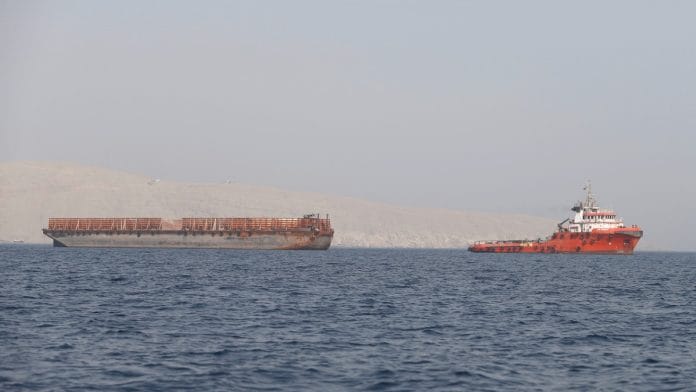



For a man who understands the power of leverage, Donald Trump is being remarkably slow to recognize the influence Iran has gained in the Strait of Hormuz. The US president’s threat to complete its closure by blocking Iranian exports through it, too, is far more likely to drag him deeper into a politically damaging war than to force Tehran’s capitulation.
Energy blockades are acts of war. If in doubt, recall Pearl Harbor, which took place roughly six months after the US imposed a total oil embargo on Japan. They also take time to work. So the already fragile two-week Gulf ceasefire is in trouble and all that’s clear is that the blockade itself is a throwdown the US can’t win.
Stopping Iranian and other countries’ oil exports through Hormuz — a waterway for about a fifth of the world’s oil supply — makes a kind of sense. Iran’s economy depends heavily on revenue from trade via the passage, and it was always extraordinary that the US had got itself into a position in which only Iranian crude and other goods were being let through. In theory, a blockade could increase pressure on Tehran without forcing a major war escalation.
But this works only if you believe the Islamic Republic won’t respond by hitting more energy assets around the Gulf, and will fold under the resulting pressure before Trump does. Both propositions seem so vanishingly unlikely that it’s hard to understand what it is the White House hopes to gain by trying.
Trump went to war amid negotiations that were failing to force the surrender he’d wanted to justify his first-term decision to collapse the 2015 nuclear accords. American demands for Iran to give up all uranium enrichment, limit its longer-range ballistic missile program and abandon the allies — from Lebanon’s Hezbollah to Yemen’s Houthis — who make up its “forward defense” strategy, were designed to strip the Tehran regime of its ability to destabilize the region.
Seen from Iran, though, these offensive weapons were also its protection. They were the deterrents it needed to keep US and Israeli retribution at bay. They clearly failed in their task. Yet the current war has given the Islamic Republic a new and more potent point of leverage: the power to disrupt, or potentially even control and monetize, the world’s most important energy chokepoint.
The odds of Tehran now giving up all four of its deterrents in exchange for sanctions relief, or any other carrots the US might offer, are more or less zero. Trump says he doesn’t care one way or another if the Iranians return to the negotiating table. Vice President JD Vance says the refusal to accept Washington’s last and final offer will hurt Iran more than America.
This is all, frankly, delusional and reveals the failure of Trump and his closest advisers to recognize that doing more damage to the other side is not the same as winning. I’d like to think the erratic nature of his wartime statements, at times self-contradictory within a single social-media post, are part of a cunning plan. But they’re merely expressions of frustration at the failure of US military supremacy to translate into success.
Trump says he has won the war, but also that he may still need to destroy Iran as a civilization if it doesn’t buckle. He says the country’s nuclear program has been “obliterated,” but also that Tehran’s refusal to give it up is a deal-breaker for any settlement. He says allies in the North Atlantic Treaty Organization can open up the Strait of Hormuz by force, which would be easy, at the same time as the US Navy is unwilling to do it. Now he wants to blockade the strait further, so that Iran will open it. This is a man in denial.
Wars have a way of defying plans and spinning out of control, and this one is no exception. It remains possible that the Iranian regime crumbles under pressure, although there is no sign of that as yet. And so long as that remains the case, the president will at some point have to recognize some hard truths: He has not won yet, he does not have a clear military path to doing so and neither he, nor the global economy, can afford to keep Hormuz closed.
Make no mistake, the Iranian regime is monstrous and should not be allowed to have a nuclear weapon. The only meaningful question is how this can be realistically achieved. Its leaders are also in a weaker position than their boasts of victory would suggest. Their situation will only get harder once the fighting stops and they have to find the money and popular acquiescence to their continued rule that they lacked even before the US-Israeli attack on Feb. 28.
For now the unfortunate reality is that the regime has “the whip hand,” as the former head of Britain’s MI6 Alex Younger put it last month. That isn’t because it is stronger than its enemies, but because it knows it can block Hormuz and is more willing to inflict the resulting economic pain on its own people than is Trump or other nations around the globe.
The US administration needs to recognize it cannot hope to get a quick win in these circumstances, even if it blockades all trade with Iran through Hormuz. It can if it wants to escalate a war with no clear path to success, and with enormous costs for the US and the rest of the world. Or Trump can accept that he will, at least temporarily, have to drop his ultimatums and return to talks on a more realistic timescale with a ceasefire in place and Hormuz open.
Iranian negotiators have made clear that they are ready to return to diplomacy, and commodity and stock markets seem — judging by their still relatively sanguine response — to believe that has to happen. Trump would come to regret testing that belief for too long.
This column reflects the personal views of the author and does not necessarily reflect the opinion of the editorial board or Bloomberg LP and its owners.
Marc Champion is a Bloomberg Opinion columnist covering Europe, Russia and the Middle East. He was previously Istanbul bureau chief for the Wall Street Journal.
Disclaimer: This report is auto generated from the Bloomberg news service. ThePrint holds no responsibility for its content.
Also read: Why Trump has threatened a blockade of Iran ports & what are the risks of such a move