





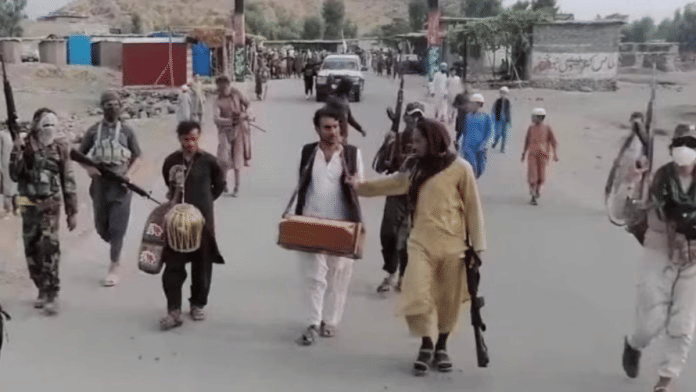



New Delhi: The Taliban police in the Parwan province set ablaze more than 500 musical instruments and sound systems in an open field in an effort to bar Afghan citizens from producing and listening to music.
Authorities in the neighboring Laghman Province also destroyed hundreds of instruments, according to the Taliban’s Ministry for the Promotion of Virtue and Prevention of Vice.
Parwan’s morality police had seized the instruments—including tabla, drums, harmoniums, guitars, tombaks, dafs, loudspeakers, and rubabs, which is the country’s national instrument—from across the province, and burned them to ashes Wednesday.
Since taking control of the country in 2021, the Taliban has dismantled thousands of musical paraphernalia and actively enforced the ban on music. Artistes often describe these acts as “cultural genocide” and “musical vandalism”.
More than 21,000 musical instruments were destroyed in 2024, according to official ministry figures.
The Taliban considers music ‘Haram’ (forbidden) because, they believe, it causes ‘moral corruption’. They have outlawed it under their interpretation of Islamic teachings.
The Taliban has taken several measures to prevent people from tuning in to music. Wedding halls are not allowed to host music, hotels cannot play music at social events, and schools do not offer fine arts subjects.
Even in the quotidian routine, music is strictly barred—taxi drivers and store owners, for example, are not allowed to broadcast it. Furthermore, women are completely forbidden from singing in public.
Music is also censored on radio and TV stations, and only religious chantings are allowed under the Taliban’s interpretation of Sharia.
Many people accused of making, playing, or listening to music have been detained over the past four years, according to Afghanistan International.
Countless artists and musicians have left Afghanistan, fearing for their safety.
To conserve the cultural nuance of Afghanistan’s traditional music, exiled musicians often perform or teach music abroad. For instance, the Afghanistan National Institute of Music (ANIM), the country’s first and only music school, is now based in Portugal and continues to run its programmes in exile.
Afghan music reflects the country’s mellifluous mix of ethnicities, languages, and cultures.
The country’s musical tradition is rich and varied, blending Persian tunes, Indian musical styles, and the distinctive sounds of ethnic communities like the Pashtuns, Tajiks, and Hazaras.
(Edited by Ajeet Tiwari)
Also Read: How Pakistan turned its back on Afghan musicians who fled Taliban rule
Isn’t this what Muslims residing in Bharat adhere to?
No wonder any music near their places of worship evokes same kind of violent attitude from them.