





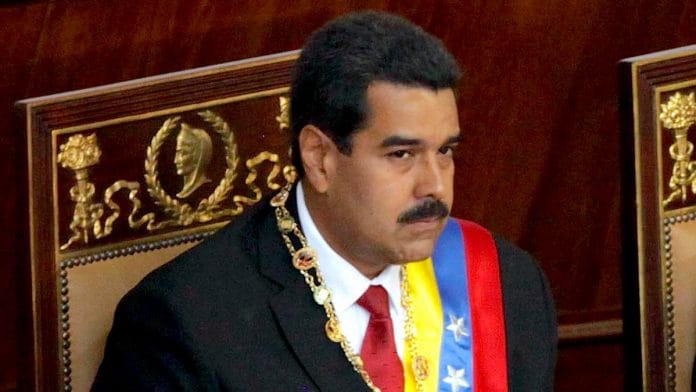



New Delhi: On Saturday, Venezuela saw the biggest US military build-up and subsequent strikes in decades, and at the heart of this crisis stands President Nicolás Maduro, a bus driver turned strongman who, Trump claims, was “captured” along with his wife and “flown away” from the country.
Maduro has been described as someone with “no charisma”. For Trump, he’s the “leader of a drug cartel”, for Venezuelans he’s the eccentric leader who oversaw mass migrations and democratic backsliding amid a failing economy.
In a 2014 interview to The Guardian, Maduro had said: “We are all a little bit hippy, a little bohemian.”
He had added, “I can tell you that I never aspired to be president. I always honour something that commander Chávez told us: that while we were in these posts we must be clothed in humility and understand that we are here to protect the man and woman of the streets.”
And yet, until being “captured” by US President Donald Trump and being “flown away”, he was Latin America’s longest serving president for 12 years.
According to Trump, Maduro has been emptying prisons and psychiatric facilities, while pushing inmates to migrate to the US, and that Maduro uses the country’s oil revenues to “fund drug cartels”. Before his capture, Maduro Thursday in an interview said he was willing to hold talks with Trump.
From ‘Son of Chávez’ to a dictator
Maduro first came to power in 2013 after having been picked as a successor by former president and military officer Hugo Chávez post his death from cancer. He met Chávez as a young union leader. According to a CNN profile on him, Maduro is an eccentric who “invents words in Spanish, celebrates Christmas two months early”, and believes that his political father, Hugo Chávez appeared in front of him “as a bird and a butterfly”.
It began when Maduro began the post-Chávez era by expelling US diplomats, accusing “historical enemies” of poisoning the president and labelling the domestic opposition “fascists” who want to divide the country. In the presidential race he claimed that the spirit of his “father” Chávez had visited him in the form of a bird and invoked ancient tribal curses on his political enemies.
But that is not all. He is mocked by Venezuelans for the democratic backsliding that his rule brought in the country even as he became popular as the ‘son of Chávez’ who would take his legacy forward.
However, within the ruling United Socialist Party of Venezuela (PSUV), Maduro then commanded only limited support, and his inner circle was reportedly locked in tense rivalry with allies of Diosdado Cabello, currently the Minister of Interior, Justice and Peace, over who should succeed Chávez in a moment of deep national uncertainty.
That uncertainty ended in early December 2012, when a sick Chávez publicly and unequivocally anointed Maduro as his successor, silencing internal dissent and recasting him as the “son of Chávez.”
From that moment on, Maduro presided over a government that saw disputed elections, mass protests, sweeping sanctions, arrest warrants, rumours of military rebellion, diplomatic isolation and constant speculation about his political demise.
Chávez, a popular Venezuelan leader, had come to power and transformed Venezuela through his “Bolivarian Revolution,” using oil wealth to fund social programmes that led to lesser poverty and greater access to education and housing. According to reports, at the time of Chávez’s passing, household poverty stood at 33.1 percent, while extreme poverty at 11.4 percent.
A decade later, those gains had unravelled.
Under Maduro, by 2021, poverty had surged beyond 80% while extreme poverty had gone to more than 50% in the country. Coupled with that, Venezuela had also become the source of the largest forced displacement crisis in Latin America.
More than 7.7 million Venezuelans fled the country, most to Colombia and Peru, while others went to the US which now hosts over half a million Venezuelan migrants.
Also Read: As Trump seeks regime change, the long arm of anti-Americanism in Venezuela—from Chavez to Maduro
From trade unionist to strongman
Born into a working-class family in Caracas, Maduro began his political life as a bus driver and trade union activist. He joined Chávez’s movement in the early 1990s, campaigned for his release after a failed coup attempt in 1992, and rose steadily through the ranks, becoming foreign minister, vice president and, finally, Chávez’s designated successor.
Maduro narrowly won the 2013 election, presenting himself as the guardian of Chávez’s legacy and a bulwark against US “imperialism”. He cultivated alliances with leaders such as Russian president Vladimir Putin, Turkey’s Recep Tayyip Erdoğan, and Cuba’s leadership, while increasingly relying on the military to secure power at home.
Under Maduro, Venezuela shifted from Chávez’s mass-based participatory politics to a military system, with the armed forces becoming central to governance. Senior officers were appointed to ministries, governorships and state-owned companies.
Estimates by analysts suggest that the military controls a third of governor roles, a quarter of ministries and dozens of public enterprises.
In such a situation, elections under him became increasingly contested. In 2017, the National Assembly, controlled by the Venezuelan opposition was dissolved, the 2018 elections too were widely boycotted.
Then in 2019, opposition leader Juan Guaido declared himself as interim president backed by the US but Maduro held on. He declared Guaido as an “American puppet” and the government was eventually dissolved in 2023.
Elections were then held in 2024 and former diplomat Edmundo Gonzalez was seen as the winner but electoral authorities declared Maduro the winner without any evidence, and Gonzalez took asylum in Spain.
Since 2019, more than 50 countries, including the United States, have refused to recognize Maduro as Venezuela’s head of state, according to a US state department report.
The US then imposed sanctions in 2017 on the Venezuelan state company and the EU followed with an arms embargo. It was temporarily eased in 2023 but was reinstated in 2024 when Opposition leader Maria Corina Machado was barred from contesting elections.
Even allies like Brazil and Colombia refused to accept the result of the 2024 elections.
Maduro and his supporters blame the US oil sanctions for the country’s economic collapse.
The US also claims Maduro is the head of the Cartel of the Suns, a Venezuelan drug cartel composed of high ranking military officials.
What is the Cartel of the Suns?
Running parallel to Venezuela’s political decay are long-standing allegations that parts of the state, particularly the military, are embedded in organised crime through the Cartel of the Suns.
The cartel is not a single hierarchy but a network of cells inside the armed forces, including the army, air force, navy and National Guard, reportedly involved in drug trafficking, illegal mining, gasoline smuggling and corruption. The name comes from the sun insignia worn by senior officers first accused of trafficking in the 1990s.
By the mid-2000s, military elements had allegedly moved from extortion to direct cocaine trafficking, using control over borders, ports, airports and radar systems to guarantee safe passage. U.S. estimates suggest cocaine transiting Venezuela rose from 50 tons in 2004 to 250 tons by 2007.
Under Maduro, scandals multiplied. In 2013, French authorities seized 1.3 tons of cocaine from an Air France flight departing Caracas. In 2015, a former presidential security chief accused senior ruling figure Diosdado Cabello of leading the cartel. Rather than investigate, Maduro promoted several accused officials.
In 2020, the U.S. indicted Maduro and top officials on “narco-terrorism” charges, accusing them of using state institutions to ship tons of cocaine. In 2025, Washington designated the Cartel of the Suns a terrorist organisation and raised the reward for Maduro’s arrest to $50 million, accusing him of being one of the largest narco-traffickers in the world. Several former senior officers later pleaded guilty in U.S. courts.
It is against this backdrop that the largest US military build-up in the Americas since the Cold War is unfolding.
What began as US airstrikes on speedboats allegedly carrying drugs through Venezuelan waters has expanded into operations across the eastern Caribbean, the Pacific and beyond, with more than 110 people reportedly killed. U.S. forces have seized two sanctioned Venezuelan oil tankers, with a third still being pursued.
Over Christmas last year, Trump even publicly alluded to the first land strike on Venezuelan soil. While details remain scarce, reports say it took place in Zulia, the oil-rich western state that also features prominently in drug trafficking allegations.
The escalation reached a new level when U.S. officials confirmed strikes on sites in Caracas and military facilities Saturday, footage of fire and smoke rising over the capital circulating soon after. Maduro responded by declaring a national emergency, denouncing what he called “U.S. military aggression”.
In a special communiqué, the Venezuelan government repudiated the attacks and called on its grassroots supporters and militias to mobilise nationwide, often seen as a familiar appeal to the socialist base that has sustained Maduro through repeated crises.
(Edited by Vidhi Bhutra)
Also read: State of emergency in Venezuela as Trump claims to have ‘captured’ Maduro, wife after US airstrikes