





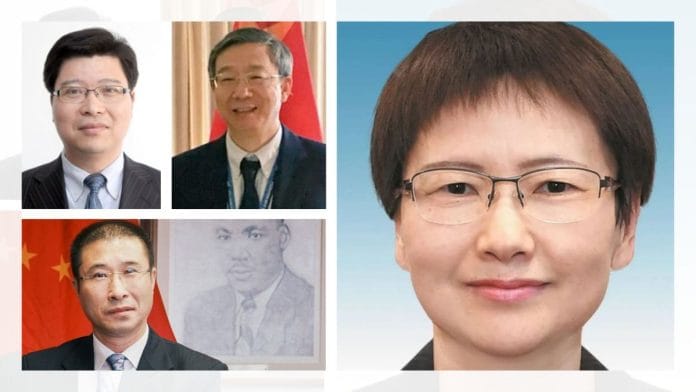



New Delhi: Several Chinese officials were removed from their positions in a systemic clearance of “naked officials”—individuals with spouses or children residing abroad—last year, according to the US-based, CIA-linked The Jamestown Foundation.
In November 2025, the Communist Party of China announced that 20 senior officials would “no longer hold” their leadership roles, citing “serious violations of party discipline” and corruption. The party, though, has not dismissed them. They continue to remain CPC members.
The move was fuelled by a need to counteract vulnerability to sanctions, foreign pressure, or intelligence coercion, a report released by The Jamestown Foundation last week said. The report asserts that Beijing has entered a phase of “zero tolerance” towards senior officials with overseas family ties.
The former CIA analyst Peter Mattis-run foundation attributes the “forced” removals of Yi Gang, the ex-governor of the People’s Bank of China, and Wang Rong, a former Guangdong power broker who enjoyed a long stint in Hong Kong and dealing in overseas affairs, among others, to the Chinese People’s Political Consultative Conference (CPPCC), a top advisory body under the Communist Party.
A ‘forced’ shuffle
According to The Jamestown Foundation, what appeared as a technocratic reshuffle has since emerged as part of a far-reaching campaign reshaping China’s governing elite.
Similar departures have unfolded through provincial governments, universities, research institutions, and legislative bodies over 2025, the US-based foundation reports, citing the removals of vice mayors, university presidents, and senior policy advisers with the same phrasing.
They include Liu Duo, the vice mayor of Shanghai, Yan Aoshuang, the vice chairman of the Beijing Municipal People’s Congress Standing Committee, Lin Shangli, the president of Renmin University of China and former deputy director of the Central Policy Research Office, and Zhang Guangjun, former vice minister of Science and Technology and later party secretary of Huazhong University of Science and Technology, it has been reported.
The changes suggest that “the CCP is recalibrating its organisational line through a campaign in which such officials are no longer carefully managed but actively excluded in pursuit of reinforcing national security”, the report adds.
Also Read: Why Trump wants Greenland: Minerals, Monroe Doctrine 2.0 and countering China
From asset to liability
For years, overseas exposure was often an asset in Chinese politics. Western-educated economists, scientists, and administrators steered the country’s integration into the global economy. Their family ties abroad were tolerated, even quietly valued, as bridges to the outside world. However, the foundation’s report says that the tolerance has now ended.
The shift is subtle in method but sweeping in effect—rather than public purges or disciplinary investigations, officials are removed administratively, reassigned to symbolic roles, or eased into early retirement, which, according to the report, marks the culmination of a policy that has evolved for more than a decade.
In the early 2010s, under Hu Jintao, China required officials with emigrant families merely to register and report their status. After Xi Jinping took power, new rules barred such officials from holding sensitive posts related to national security, diplomacy, and the military. According to The Jamestown Foundation, internal directives nowadays reportedly present senior cadres with a stark choice—bring their families home or leave their posts.
The removals are notable not only for their scale but also for the “big fish” they affected.
Yi Gang’s departure was particularly striking. A US-trained economist who long reassured global markets, Yi embodied a reform-era technocrat. His expertise once shielded him from stricter scrutiny. That protection, though, no longer applied once it became clear that his children remained overseas.
The president of Renmin University until recently, Lin Shangli, often described as the Communist Party’s “second Party School”, maintained close links with Wang Huning, a member of the Politburo Standing Committee. That association did not prevent Shangli’s abrupt removal, reportedly due to overseas family connections, stemming from earlier academic exchanges.
Sui Jun, a senior official long involved in overseas Chinese affairs, was sidelined, despite years of cultivating diaspora networks, the American report further states. In each case, the same logic prevailed—political security outweighs experience, expertise, and loyalty built over decades—according to The Jamestown Foundation.
The officials who lost their positions are likely only the visible edge of a much larger purge. According to the report, the officials view this as a “loyalty test” and have been calling back family members.
“By late 2025, continuing to keep family abroad was widely viewed as a deliberate act of defiance; thus, the return of families under these circumstances is fundamentally coerced,” mentions the report.
It further notes, “Through these high-pressure tactics, Xi Jinping has achieved a subtle but significant tactical victory: he has successfully ‘repatriated’ the strategic loyalty of the elite.”
According to the report, Chinese policymakers have closely studied the fallout from the Russia-Ukraine war. Western sanctions have proved particularly devastating to the Russian elites with assets, families, and residency in Europe and North America. Now, China is determined not to repeat the mistake.
“The clearance regulations reflect a ‘political purification’ of the bureaucracy, characterised by a shift from internationalisation to localisation under the conditions of long-term confrontation. By removing technocrats with deep Western backgrounds, Beijing is establishing a new screening standard in which international competence is no longer a bonus, but a potential security risk,” the report notes.
(Edited by Madhurita Goswami)