



By Nayera Abdallah and Yomna Ehab
DUBAI, Sept 17 (Reuters) – Saudi Arabia and Yemen’s Iran-backed Houthis exchanged fresh strikes across their border on Thursday and Yemenis took to boats in the Red Sea to escape fighting, as the spreading Middle East war created new threats to global oil supplies.
Houthi-controlled television reported fresh Saudi air strikes on Thursday in Hajjah province close to the Saudi border near the Red Sea coast, and the vicinity of Taiz further inland to the south.
Saudi Arabia’s civil defence said a Yemeni living in Saudi Arabia had been killed by debris from a drone intercepted over the western city of Taif, the first death Riyadh has announced in repeated Houthi attacks since fighting escalated last week. It has previously said more than 80 people were wounded.
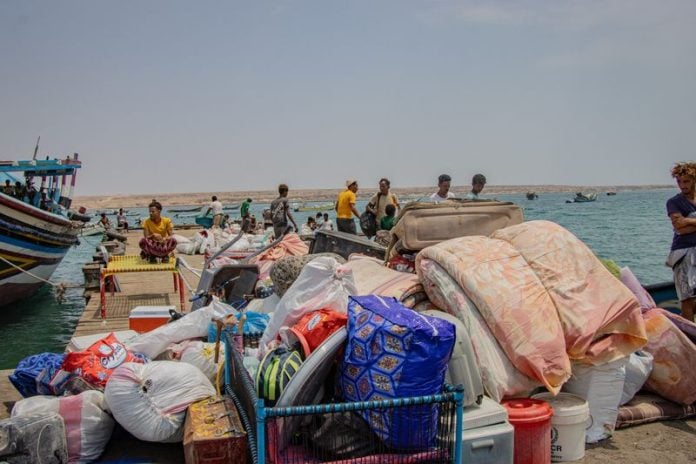
In Djibouti on the African shore of the Red Sea, Wahida Omer, 50, reached land after fleeing on a small boat across the Bab el-Mandeb Strait from Yemen when her home village of Dhubab came under attack as the Houthis swept into the area. Her husband had been left behind and she had no idea if he was alive, dead or captured by the Houthis.
“The sea was frightening, difficult,” she said in an interview filmed by the International Organization for Migration. Those on the boat were “crying the whole way, and we arrived still crying” with nothing to eat.
The IOM says more than 100,000 Yemenis have been displaced by the latest fighting, mostly within Yemen.
The Houthis, who have seized Yemen’s entire Red Sea coast since last week in a lightning advance, say the Saudi Air Force has conducted hundreds of airstrikes in recent days. They in turn have fired missiles and drones at targets across the border.
On Wednesday, the Houthis said they had shot down a Saudi F-15 fighter jet. Video they released overnight showed fighters shouting “Allahu Akbar” in the charred wreckage of a crash site and holding up a piece of a military aircraft wing bearing Saudi insignia.
“We want the Saudis to cease their blockade and occupation of our country, and to stop their aggression against us. This is our demand!” Houthi leader Abdul Malik al-Houthi said in a televised speech, seated with a traditional dagger in his belt. Slogans on the wall behind him read: “Death to America, death to Israel, a curse upon the Jews, victory for Islam.”
TRUMP HOPES WAR WILL END SOON
The spread of the Middle East war to Yemen and Saudi Arabia threatens to worsen the global energy supply shortage caused since the United States and Israel attacked Iran in February.
Global crude prices eased slightly on Thursday but remain well above $100 a barrel after shooting to the highest levels since May. The cost of fuel for consumers has risen even more sharply, with the average retail price for diesel in the United States setting a new all-time record on Thursday just shy of $6.40 a gallon.
U.S. President Donald Trump has so far rebuffed pleas from the Saudis for military support fighting the Houthis, who agreed a ceasefire with the United States last year after Washington bombed the group for two months.
“Well, hopefully we are towards the end of the war,” Trump told reporters on Wednesday. He said the Iranians “want to make a deal. We’ll see how that works out.”
No negotiations between the United States and Iran to end the war have been held since an interim agreement reached in June collapsed within weeks.
The U.S. Navy is trying to guide ships through the Strait of Hormuz, the outlet to the Gulf along Iran’s coast, where a fifth of global oil and liquefied natural gas passed before the war, and is also imposing a blockade of Iranian ports.
Iran says the strait is closed and will remain shut until Washington lifts the blockade. It is seeking an agreement with neighbouring Gulf states that would let it collect fees from ships passing through the strait.
War in Yemen and attacks on Saudi Arabia have jeopardised the main alternative route for Gulf oil, with the Houthis capturing the Red Sea coast and islands inside the Bab el-Mandeb, or “Gate of Tears”, the strait at its mouth.
Saudi Arabia’s East-West Pipeline, which allowed it to pump oil across the Arabian Peninsula and ship it from the Red Sea, has been shut since it was struck last week in an attack Riyadh said came from Iraq, where Iran-backed militias also operate.
(Reporting by Reuters bureauxWriting by Peter GraffEditing by Alexandra Hudson and Andrew Heavens)
Disclaimer: This report is auto generated from the Reuters news service. ThePrint holds no responsibility for its content.