





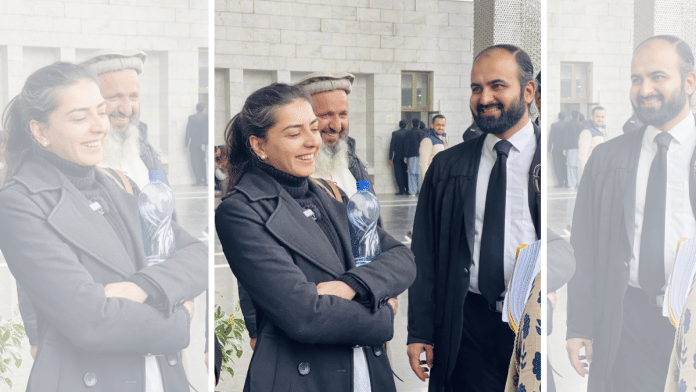



New Delhi: The lawyer daughter and son-in-law of former Pakistan minister Shireen Mazari were sentenced by a court to a combined 17 years in prison for their ‘anti-military’ posts on social media under the contentious Prevention of Electronic Crimes Act (PECA).
On Saturday, the additional district and sessions court in Islamabad found human rights lawyer Imaan Zainab Mazari-Hazir and her husband Hadi Ali Chattha guilty of cyberterrorism, glorification of terrorism, and the dissemination of false information. The sentences will run concurrently, Dawn reported.
Mazari, a human rights lawyer, has represented victims of human rights violations and is an outspoken critic of extrajudicial killings and abductions. Her mother had served as the Federal Minister for Human Rights under the Pakistan Tehreek-e-Insaf (PTI) government.
Ali is a criminal lawyer who represents blasphemy accused victims. He had also worked with the Asma Jahangir Legal Cell, representing victims of sexual violence, rape and enforced disappearances.
Pakistani journalists, digital rights advocates, and civil society have long been waging a war against the PECA. Originally passed in 2016 to combat cybercrime, it has become the state’s primary tool to intimidate and criminalise free speech, especially after Pakistan passed a bill in January 2025 to amend the Act granting the government sweeping powers to regulate social media.
Penalties include up to three years in prison and a fine of up to PKR 20 lakh for spreading fake news. The law also prohibits sharing statements from banned organisations or their members, and broadens the definition of SM platforms to include any online information management systems.
In its editorial, Dawn called the sentencing “as another low point in the history of Pakistan’s justice system.”
“This judgment is a blatant assault on the Constitution and a chilling warning to every lawyer, journalist, and citizen who dares to speak. The use of PECA to impose an excessive and punitive sentence for expression is not law enforcement, it is state overreach,” Moniza Kakar, a prominent human rights activist, told ThePrint.
She added that this sentence will not withstand appellate scrutiny, and that it underscores the urgent need to dismantle the use of PECA as a tool of intimidation rather than justice.
“Such disproportionate punishment has no place in a constitutional democracy and reflects a systematic misuse of cybercrime laws to silence dissent. When criticism is criminalised and free speech is treated as terrorism, the justice system ceases to protect rights and begins to police opinions,” she said.
The sentencing
Mazari and Chattha were each sentenced to five years in prison and fined PKR 5 million under Section 9 of the PECA, which criminalises the “glorification” of proscribed organizations or individuals. They were also sentenced to 10 years in prison and fined PKR 30 million under Section 10 (that deals with Pakistan’s cyberterrorism provision), and an additional two years under Section 26-A for spreading alleged false information.
The couple were already in custody at Rawalpindi’s Adiala jail taken away in a dramatic manner on 23 January, where they were publicly manhandled.
According to the written order, Mazari had “consistently disseminated highly offensive, misleading and anti-state content” on social media between 2021 and 2025, with the “active connivance” of her husband through reposts and amplification.
The judgment stated that her posts aligned with the narratives of banned militant groups, including the Balochistan Liberation Army and Tehreek-i-Taliban Pakistan, and undermined public trust in state institutions by accusing the armed forces of involvement in terrorism and enforced disappearances.
It also said that the accused falsely portrayed Pakistan as a “terrorist state” and alleged collusion between state institutions and proscribed organisations, claims that amounted to cyberterrorism under Pakistani law.
The court also found Mazari guilty of spreading false information, citing her claims that the state operates torture cells and forcibly disappears citizens without providing proof.
The hearing itself was contentious. Appearing via video link after police cited security concerns, Mazari accused prison authorities of mistreatment and said she and her husband were not being provided food or water. She then announced that they were boycotting the proceedings and left the virtual hearing before its conclusion. The court proceeded to reserve its decision and later issued the verdict.
Rights groups swiftly condemned the ruling. The Amnesty International said the case reflected a “lack of adherence to due process” and described it as retaliatory, aimed at silencing dissent. The Human Rights Commission of Pakistan called the prosecution a tool of intimidation.
Mazari’s mother Shireen Mazari described the judgment as “totally illegal,” arguing that a pending transfer application before the Islamabad High Court barred the trial court from issuing a verdict.
Rana Sanaullah, a senior adviser to the prime minister, rejected claims of an unfair trial, saying the couple were given multiple opportunities to cross-examine witnesses and had repeatedly disrespected the court.
Sanaullah criticised Mazari’s anti-government stance and her criticism of constitutional amendments, saying they were “efforts to curtail judicial independence”.
“If she wants to criticise or curse the government, she is free to do so. But when we are picking up the bodies of martyrs every day, then these people should at least consider the circumstances,” he stated.
Information Minister Attaullah Tarar hailed the ruling as the “first official and final result” of the PECA enforcement.
What is the case?
The case originated from a complaint filed in August 2025 by Pakistan’s National Cyber Crime Investigation Agency, which accused Mazari of disseminating content aligned with militant groups and blamed the couple for portraying security forces as responsible for disappearances in Balochistan and Khyber Pakhtunkhwa.
Her trial was one of the most discussed trials. The Pakistan government issued a demarche to the Norwegian ambassador for attending the proceedings.
According to Frontline Defenders, a global network of journalists, the legal proceedings against Mazari and her husband have “evidence of serious procedural irregularities and attempts to influence the outcome of the trial and their legal defence”.
In November, an international jurist’s body published an open letter condemning the “ongoing judicial harassment” of the couple. “The ongoing trial is part of a broader troubling trend of judicial harassment aimed at exhausting the lawyers’ time and resources, discrediting their work, and obstructing their ability to represent victims of state violence,” Lawyers for Lawyers said.
These cases, it said, appeared to lack both legal and factual basis and were clearly related to their exercise of the right to free expression.
In December, civil society members took out rallies against the detention. Baloch activist Mahrang Baloch published a letter in solidarity with the couple.
“For years, Imaan and Hadi have been at the forefront of human rights advocacy—amplifying marginalised voices and speaking out against all forms of injustice and atrocities. The fabricated case brought against them, exposes the oppressive tactics of the state and highlights how easily the justice system can be used to target those who defend fundamental rights,” the letter stated.
(Edited by Tony Rai)
Also Read: Army chief lambasts Chinese infra push in Shaksgam Valley. ‘We consider it illegal action’
Is anyone from India dwelling Aman ki Asha brigade, Communist sympayhizers, Chrislamist brethren , socialist andolan jeevis, JNU eliists, wannabe liberalists condemning the brutal human rights violation in the greatest democratic state of their jaane-e-jigar Pakistan for this case?