





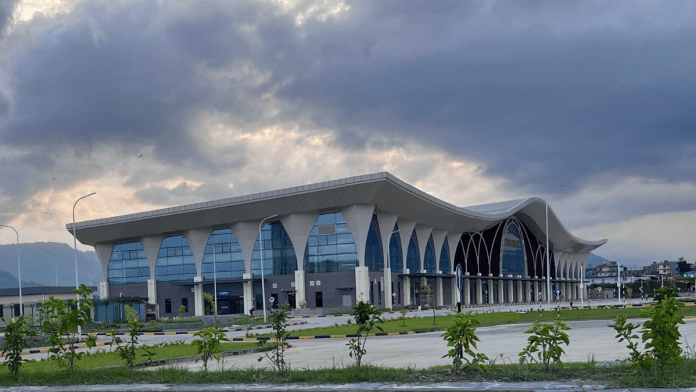



New Delhi: Nepal’s anti-corruption agency has filed what it describes as the ‘largest corruption case’ in the country’s history, charging 55 senior Nepalese officials and employees of the Chinese state-owned contractor, CAMC with inflating the cost of the Pokhara International Airport, a flagship project under China’s Belt and Road Initiative (BRI), by roughly $74 million.
The Commission for the Investigation of Abuse of Authority (CIAA), filed the case Sunday at Nepal’s Special Court, naming 55 individuals, including five former ministers and 10 former secretaries, along with China CAMC Engineering Co. Ltd., the airport’s builder. CAMC is the construction wing of China’s state-owned conglomerate, SINOMACH.
The agency alleges that Nepalese officials and the Chinese contractor colluded to deliberately inflate costs through fake invoices, overbilling and fraudulent procurement including the usage of substandard materials.
The project was made out of a BRI loan, not a grant therefore Nepal will now have to pay the entirety of the inflated amount. The graft agency has asked the court to recover Rs 8.36 billion from each of the 56 defendants — the largest financial penalty the agency has ever sought, according to local reports. The final sentencing, however, depends on a court verdict.
The anti-graft authority also said that three separate investigations are underway related to the Pokhara airport. A Nepalese Special Court had in December 2024 convicted 11 individuals in a corruption case involving purchase of 2 Airbus A330s.
Strategy, no substance
Pokhara International Airport, inaugurated with much fanfare in January 2023 was promoted by Beijing as a BRI “flagship project”. However, despite a budget of $215.96 million and its strategic location as the gateway to the Annapurna Circuit, the airport has virtually no scheduled international flights. Only a single weekly route, operated by Himalaya Airlines, a Nepal-China joint venture, connects Pokhara to Lhasa.
Previous technical assessments identified flaws in the airport’s physical and navigational design, including runway limitations that impose weight penalties on medium-haul aircraft.
According to the CIAA’s investigation, committee members and senior bureaucrats misused their authority by endorsing cost estimates that lacked technical justification and violated Nepal’s Public Procurement Act.
Even academicians are involved. Three professors from Tribhuvan University’s Institute of Engineering, Rabindra Nath Shrestha, Santosh Kumar Shrestha and Surya Gyawali, are accused of submitting a favourable but “technically baseless” report that recommended the project cost be raised to $230.06 million. According to the charge sheet, members of the review committee admitted they were instructed to produce their report quickly and without access to necessary documents.
The CIAA charged that CAMC and Nepalese officials used the committee’s recommendations to justify approving an inflated contract of $244.04 million.
Between August 2018 and February 2024, Nepal paid CAMC $224.77 million, of which $74.34 million, investigators say, represents losses from overvaluation and fraudulent billing.
Among those charged are former tourism ministers Post Bahadur Bogati (deceased), Bhim Prasad Acharya, Deepak Chandra Amatya, Ram Kumar Shrestha and former finance minister Ram Sharan Mahat. Also named are numerous high-ranking bureaucrats, including secretaries, joint secretaries, civil aviation chiefs and a former Supreme Court registrar.
The case also implicates senior officials of China CAMC Engineering Ltd, including Chairman Wang Bo and Regional General Manager Liu Shengcheng.
Marred by controversies
The Pokhara airport project has been marred by controversy for decades. First conceived in 1971, the plan faced repeated delays due to political turmoil, insurgency, public resistance and disputes over site studies and cost estimates.
In 2011, after a secret MoU surfaced, showing then-finance minister Barsha Man Pun privately committing to support CAMC in securing the contract, the MoU was later scrapped, but it fueled suspicions that the bidding process favoured Chinese firms aligned with Beijing’s financing requirements.
When bidding opened in 2012, CAMC unexpectedly offered the lowest proposal at $305 million, far above Nepal’s own estimate of $169.69 million. All three bids came from Chinese Exim Bank–approved contractors, as the bank had said that only its designated firms would be eligible for financing.
After labour unions and anti-graft officials raised objections, the case went on for years before eventually moving forward in 2014 when a government panel recommended a revised cost of $215.96 million. The figure was later adopted in the contract.
Construction formally began in 2017, financed through a 20-year loan from China’s Exim Bank: 25% interest-free and the rest at 2% annual interest. Nepal is now obligated to repay the loan using airport revenues but those revenues have not happened.
After the airport was completed, Beijing began portraying it as a Belt and Road Initiative project, however Nepal had quietly resisted that designation.
According to a New York Times investigation in 2023, the CAMC failed to finish runway excavation and refilling, left heating and ventilation systems unbuilt, and evaded taxes of $16 million that it was contractually required to pay. Several items listed as completed in payment records including a fuel supply facility had not been constructed at all.
Meanwhile, Nepal’s then government had formally asked China in August 2025 to convert the $216 million loan into a grant. Prime Minister K.P. Sharma Oli reportedly discussed the request with President Xi Jinping in November, however no agreement was announced.
(Edited by Vidhi Bhutra)