





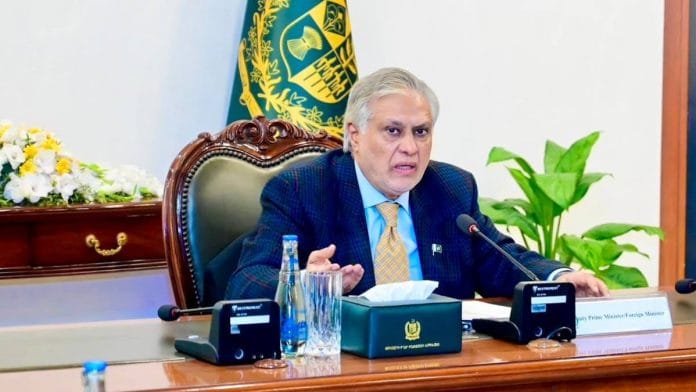



New Delhi: Amid burgeoning debt, Islamabad is set to allow the United Arab Emirates to acquire a stake worth approximately $1 billion in the Fauji Foundation—the multi-billion-dollar conglomerate formed by its army. The potential rollover of $2 billion worth of loans by Abu Dhabi is also expected.
On Saturday, Pakistan Deputy Prime Minister and Foreign Minister Ishaq Dar stressed that the UAE would acquire “some shares”. A liability of about $1 billion would end on 31 March, if that transaction is completed, he said.
“We are currently engaged with the UAE…regarding the rollover of $1 billion a few weeks ago. They will be acquiring some shares, and our liability will be eliminated. The shares are of the Fauji Foundation Group. After extensive meetings by the committee, it is taking the lead. We hope that this transaction will be completed by 31 March,” Dar said at a year-end press briefing by the Pakistan foreign office.
Loan conversion into stake, Dar said, would ensure that the $1 billion liability will no longer be active. The UAE is set to further roll over another $2 billion worth of loans, as Pakistan’s debt burden continues to grow.
As of June 2025, official data reports Pakistan’s total external debt at $91.8 billion, with its total public debt standing at approximately $286.8 billion. The total size of Pakistan’s economy is roughly $410 billion according to the International Monetary Fund (IMF).
Islamabad has had to shore up its current account deficit to signal to the IMF that it can continue to meet the requirements of its bailout package. It has raised roughly $12 billion in the last couple of years from bilateral partners.
“I was right to say that Pakistan would not have taken $12 billion from the begging bowl if it had acted on the IMF programme. We would not have been able to balance our accounts, and the IMF was not willing to come on board. I am grateful that the UAE is also involved. I recognise their co-operation. Saudi Arabia supported $5 billion in this period. China supported $4 billion via a state-to-state deposit, and the UAE supported $3 billion,” said Dar.
The announcement of a move to convert loans into investments comes just after Islamabad concluded the privatisation of Pakistan International Airlines (PIA).
However, the government received minimal immediate fiscal relief from the $482 million sale, as it retained over $2.3 billion in legacy airline liabilities in a separate entity.
A further rollover of the loans owed to the UAE came after a meeting between Prime Minister Shehbaz Sharif of Pakistan and President Sheikh Mohammed bin Zayed Al Nahyan. The Emirati President landed in Pakistan Thursday, his second visit to Pakistan this calendar year.
Pakistan has a long history of seeking IMF support, having been under 23 programmes since 1958, and remains in a cycle of requiring financial bailouts. The South Asian nation is currently being supported by at least two IMF programmes, including a $7 billion Extended Fund Facility (EFF) and a Resilience and Sustainability Facility (RSF) worth roughly $1.3 billion.
Apart from the IMF, Pakistan has also relied heavily on China. Between 1999 and 2023, Beijing has committed $75.62 billion in projects across Pakistan through loans and grants, according to AidData, a research lab set up by the College of William and Mary.
Of its total commitment, China has extended roughly $26 billion in general budgetary support to Pakistan, according to AidData. China and Pakistan have been closely engaged in building the CPEC economic corridor, connecting the Chinese province of Xinjiang to the port of Gwadar in Balochistan.
From 2022 to earlier this year, the Pakistani economy faced several challenges, including high inflation, a liquidity crisis, natural disasters, and the COVID-19 pandemic. As a result, the economy slowed down between 2019 and 2022.
In 2023, the economy contracted by 0.2 per cent according to the IMF. Growth for the 2025 fiscal year is projected by the IMF to be roughly 2.7 percent.
(Edited by Madhurita Goswami)