





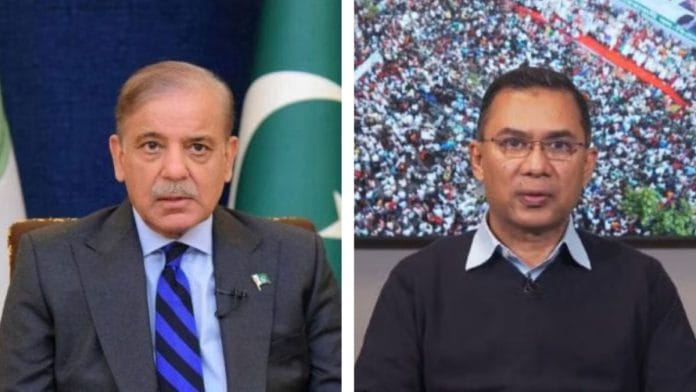



New Delhi: Pakistan Thursday described the 1971 Bangladesh Liberation War as “complex and open to different interpretations”, days after Dhaka referred to the crackdown as “one of the most heinous genocides in history” of the country.
Pakistan’s Foreign Affairs spokesperson Tahir Andrabi, speaking at a media briefing, said: “Pakistan considers the events of 1971 to be complex and open to different interpretations. This warrants constructive engagement grounded in activity, mutual respect, and a shared commitment to historical accuracies.”
He added: “Pakistan reaffirms its commitment to a forward-looking relationship with the brotherly people of Bangladesh based on mutual respect and constructive cooperation, which strengthen people-to-people ties, economic engagement and regional stability serving the mutual interest of all countries.”
Bangladesh’s newly elected Prime Minister Tarique Rahman made the remarks to mark ‘Genocide Day’ on Wednesday, 25 March, which is observed annually to mark Pakistani military’s crackdown on the country’s independence movement during Operation Searchlight in 1971.
“In the history of freedom-loving Bangladesh, 25 March 1971 remains one of the most disgraceful and brutal days. On that dark night, the Pakistani occupation forces carried out one of the most heinous genocides in history against the unarmed people of Bangladesh in the name of ‘Operation Searchlight’,” a statement by Rahman said.
Rahman also called it a deliberate act of mass killing. “The genocide of 25 March was a pre-planned massacre. Why this organised killing spree could not be resisted remains a matter of historical research regarding the visible role of the political leadership of that time,” he said, stressing the importance of the need to “know about the genocide” and “honour the sacrifices of the martyrs”.
Bangladesh-Pakistan relations have long been strained over the legacy of the Liberation War. Dhaka has repeatedly demanded a formal apology from Islamabad and international recognition of the atrocities committed by the Pakistani military. Pakistan has maintained the matter was settled through earlier agreements.
Ties between the two countries had warmed considerably as Nobel laureate Muhammad Yunus came to lead the interim Bangladesh government, which was installed following the fall of the Sheikh Hasina government on 5 August 2024. The two countries held their first foreign secretary-level talks in more than a decade during Yunus’s tenure.
Rahman’s Bangladesh Nationalist Party (BNP), elected back to power this year, has historically taken a more pragmatic line on Pakistan than its political rival, the Awami League of Sheikh Hasina, which had made the legacy of 1971 a defining plank of its foreign policy.
Pakistan’s Foreign Minister Ishaq Dar had declared that 2025 was a turning point in bilateral ties with Bangladesh, calling it a major “ice-breaker” at a year-ending press conference in Islamabad and describing the two nations as “brothers”.
During an August 2025 visit to Dhaka, Dar went further, claiming that all outstanding issues from the 1971 war had been “settled” decades ago and urging Bangladesh to “clean its heart” and move on. He cited the 1974 tripartite agreement between Bangladesh, Pakistan and India, and former Pakistani president Pervez Musharraf’s 2002 visit to Dhaka, as evidence that the chapter had been closed.
Bangladesh’s then foreign adviser Touhid Hossain publicly rejected that assertion, reiterating Dhaka’s long-standing demands: a formal apology, repatriation of Pakistani nationals stranded in Bangladesh, and a fair share of pre-1971 financial assets.
The two sides had earlier sought common ground when Yunus met Pakistani Prime Minister Shehbaz Sharif on the sidelines of the D-8 ( Developing Eight Organisation for Economic Cooperation) summit in Cairo in December 2024.
Yunus had said it would be nice to resolve things “once and for all for the future generations”. Sharif responded by saying the 1974 tripartite agreement had settled things, “but if there are other outstanding issues”, he would be happy to look at them.
Also Read: Bangladesh’s economic crisis is a cautionary tale. For India too