





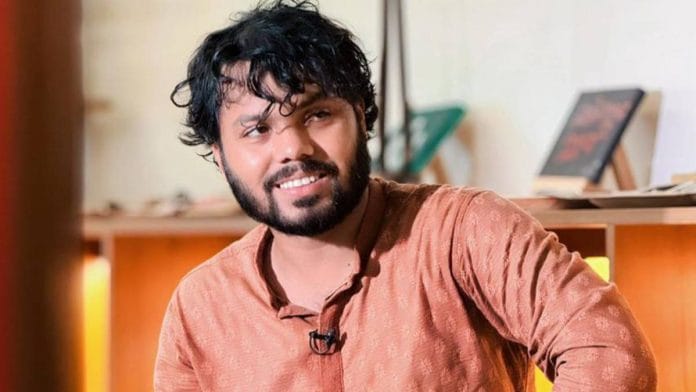



New Delhi: “If you ask me who is a heavyweight in the coming polls, I’d say it is me in Dhaka,” Bangladesh political leader Sharif Osman Hadi had declared on 11 December, the day the country announced its poll dates. A day later, he was shot at by bike-borne assailants and critically injured with a bullet lodged in his head.
Hadi, 32, leader of the “revolutionary” Inqilab Moncho, died in Singapore Thursday, with the news of his death triggering a fresh wave of arson and violence in the country.
While he had aimed to fight independently in the February elections, Hadi’s death has become a political tool for all major parties in Bangladesh and a diplomatic flashpoint for already strained India-Bangladesh relations.
Within hours of the attack on him, members of the student-led National Citizen Party (NCP) had accused India of colluding with now in-exile former prime minister and Awami League chief Sheikh Hasina, and alleged that the shooters were sent by her and had later fled to India.
Thursday night, protests erupted across Dhaka. The offices of two of the country’s largest newspapers, Prothom Alo and The Daily Star, were set on fire. Demonstrations soon spread to other cities, including Rajshahi, where protesters attempted to march towards the Indian Assistant High Commission.
Hadi was himself extremely critical of Hasina, having played a key role in the July-August 2024 uprising in Bangladesh that led to her ouster.
As a founder of the Inqilab Moncho that emerged from the 2024 uprising, he was also known for his fierce opposition to what he described as “Indian hegemony” in Bangladesh, his advocacy for the rights of “July martyrs”, and his role in the protests that eventually led the Muhammad Yunus-led interim government to ban the Awami League in May this year.
The Inqilab Moncho describes itself as “a revolutionary cultural platform inspired by the spirit of uprising” on its website, declaring: “Our goal is to stand against all forms of domination and to protect freedom and sovereignty while building a state based on justice.”
Over the past year, the platform has grown into a politically influential force, spearheading campaigns to arrest leaders and activists of the Awami League. According to reports, the group has led efforts to arrest “all terrorists” of the Awami League “from central to grassroots levels” and to ensure the security of “July warriors”.
“I know there are many mechanisms working in the Bangladesh elections but if you ask on the basis of acceptance and love, I know I am the heavyweight in Dhaka,” Hadi said in his final interview. “A bunch of students defeated Hasina. I will make it to the parliament and I will make it on the goodwill of the people.”
“If we still lose, I have nothing to lose,” he added. “If I get 50,000 votes now, it will go up to 50 lakh in the next five years.”
Speaking to ThePrint, Shafquat Rabbee, political columnist and founder of Centrist Nation TV, said Hadi was a Gen-Z phenomenon.
“His brand of nationalistic rhetoric reached the politically aware youth over the last one year, before it all exploded into the mainstream media right after he declared his candidacy for Dhaka-8 constituency where he was positioning himself against heavyweights from major political parties,” Rabbee said.
“He debated with his adversaries, engaged everyone and won repeatedly in the eyes of the social media audience,” he added.
Also Read: Anti-India protests in Bangladesh: 2 visa centres closed, student leader says ‘we will behead Delhi’
Death and politics
Within hours of Hadi’s death, Inqilab Moncho announced it on Facebook in a post written in Bangla, framing it explicitly as part of a larger struggle.
“In the struggle against Indian hegemony, Allah has accepted the great revolutionary Osman Hadi as a martyr,” the post reads.
The platform had earlier warned that it would bring the country to a standstill if Hadi did not survive the attack. “If Osman Hadi answers the call of his creator and joins the ranks of martyrs,” it said, “the oppressed and freedom-loving people of Bangladesh should gather at Shahbagh to uphold national sovereignty.”
“If the killer flees to India, they must be arrested and brought back at any cost through discussions with the Indian government.”
The Bangladesh authorities have accused a person identified as Faisal Karim Masud of shooting at Hadi. The Daily Star reported that a Dhaka court had granted three days’ remand each for Sibion Diu and Sanjay Chisim for allegedly helping Masud flee to India.
Yunus announced Hadi’s death in a late-night address to the nation, calling it “an irreparable loss for the nation”. He declared a day of national mourning, ordered flags to be flown at half-mast across the country and at Bangladeshi missions abroad, and announced special prayers at all places of worship Friday.
In his televised address, Yunus said the attack on Hadi was intended to destabilise the country ahead of elections. “The objective of the conspirators is to derail the election. This attack is symbolic—meant to demonstrate their strength and sabotage the entire electoral process,” he said.
“No leniency will be shown to the killers,” Yunus said. “The country’s march toward democracy cannot be halted through fear, terror, or bloodshed.”
But as the government urged restraint, Hadi’s death quickly ignited unrest and became a potent political symbol in a country already on the edge. It is now being used for anti-India rhetoric by parties Hadi was critical of.
NCP members Nahid Islam and Hasnat Abdullah have over the past week made several incendiary statements against India at protest rallies organised by Inqilab Moncho, threatening to “isolate (India’s) Seven Sisters” and giving refuge to “separatists” from the Northeast.
However, earlier this year, Hadi had accused the NCP of distorting the legacy of the July movement. “NCP’s mistakes are threefold. NCP has axed the July movement, many of them have become corrupt and this unity has basically been destroyed by the NCP,” he told the media.
He was also sharply critical of the interim government. When asked how much he would rate the Yunus administration, he said 6/10, praising its role in prosecuting Hasina but accusing it of failing to deliver on democratic reforms and the promised July charter.
Who was Osman Hadi?
Hadi was a poet, an orator and popular IELTS instructor at a coaching centre for 10 years, from where he became known to a large number of young men and women who became ambassadors of his oratory and personality, Rabbee told ThePrint.
According to him, Hadi was immensely popular across social media in Bangladesh. His reels on Facebook and his regular news talk show appearances kept producing “two-line master blasters which made rounds on YouTube and Facebook, making him a sought after talk show guest”.
Rabbee said Hadi’s popularity stemmed from the fact that he refused to join any newly formed political party after the 2024 protests and rather “focused on creating a cultural pressure group called Inqilab Moncho, with the objective of fighting the remnants of the fallen dictator’s media and cultural wing”.
“He created a small cultural office under Inqilab Moncho’s banner where anyone could come and read books handpicked by Hadi and listen to his oratory. The killers of Hadi now appear on CCTV footage sitting next to him inside Inqilab Moncho, listening quietly to his lectures,” he added.
Speaking to ThePrint, political analyst Mubashar Hasan said Osman Hadi was a flamboyant, popular leader who popularised a counterculture. He championed certain rhetoric about anti-Indianism, but he made it clear that he was not against Indian people.
“In Bangladesh, he is a symbol of resistance by the students. So that’s why he became so important and started Inquilab Moncho. It’s a new cultural front, countercultural front. So, he was immensely symbolic, politically and culturally to Bangladesh’s new uprising, student movement,” he said.
Osman Hadi, who studied at a local madrasa before coming to Dhaka University, built his appeal around a Bengali Muslim identity. He was the son of an Imam, deeply religious, who in his last interview said his biggest influence is Allah.
Backed by influential anti-India voices and media platforms such as Amar Desh, Hadi rapidly gained prominence as a sharp critic of India.
He pushed for a radical break with Bangladesh’s founding legacy, advocated greater space for Islamist-aligned forces, and openly engaged groups like Hefazat-e-Islam, putting him at odds with the BNP.
‘We want neighbours—not masters’
In an interview with Centrist Nation TV two weeks ago, Hadi said “we believe that we are mentally captured by India”.
“We are made to think we have no capacity, no capability, that we are always dependent on Indian approval. But we are not anti-Indian. We are anti-aggression—any kind of aggression.”
When asked what he meant by Indian hegemony, he said: “Many Bangladeshis are conditioned to believe we have no independence, that we need India’s permission to act—even to engage with other neighbours. This mindset is false.”
“We have the sea, resources, and alternative connections. Yet culturally and economically, India dominates. Indian films flood our theatres, Indian TV channels operate freely here and earn advertising revenue, but Bangladeshi channels aren’t allowed the same access in India. That’s cultural and economic discrimination,” he asserted. “We want neighbours—not masters.”
When asked how he would reshape India-Bangladesh relations, Hadi said: “We don’t deny geography—India is our neighbour, and we share over 4,000 km of border. But India invested everything in a mafia-style political party that destroyed Bangladesh’s democracy.”
“The future relationship must be people-centric. India should acknowledge the July uprising, stop sheltering corrupt forces, respect Bangladesh’s sovereignty, stop border killings, halt environmentally destructive projects, and consult Bangladesh on international rivers.”
He clarified that “when we say India, we mean the Indian government, not Indian people. Many Indian citizens supported our July uprising”.
Speaking about his platform, Hadi said: “If you observe our activism closely, you’ll see we are deeply connected to our history, culture, and heritage. The term Inquilab Zindabad (long live the revolution) was introduced over 100 years ago during the anti-colonial independence movement when India, Pakistan and Bangladesh were united under British rule.”
“During the July uprising, when we were on the streets, we began chanting Inquilab, Inquilab, Zindabad, Zindabad. People connected instantly. When we proposed the (platform’s) name, there was no hesitation—everyone embraced it.”
In Hadi’s words, his influences were Bangladesh’s national poet Kazi Nazrul Islam, Sher-e-Bangla A.K. Fazlul Huq and former president Ziaur Rahman.
“I don’t want personal honour—I am simply an inquilabi,” he said. “If I die, the idea lives on. A person can die; an idea cannot. We are building a movement, not a personality cult.”
(Edited by Nida Fatima Siddiqui)
The so called student revolution has only one goal — brutalize Bangladeshi civil society and thereby prepare it for a jihadi take over. Before Hasina was deposed some of the most radical militants were freed, including Bangladesh Al Qaeda Chief. This militants chief modus operandi was brainwashing gullible young
People into hating Bengali civil society and ingraining a suicide cult. The cornerstone of this militant ideology is to show themselves as more real and thereby legitimate than the development and peace oriented state apparatus. So he dubbed his own arrest in 2021 as “militant natak” or militant drama that the state was staging. So the states actions are dram while his extremist cultivation is real
And legit. Some foolish students fell for this kind of militant realism and is taking Bangladesh to its complete destruction.
Isnt it ironical that the deceased leader openly threatened severing parts of Indias northeast and when something happens to him, his supporters move their target to India ? Who are we fooling ? This entire “relovution” was a sham ! If it would not have been, there would be a democratically elected government which these revolutionaries claimed died under previous regime ! But how gladly they accepted a non democratically elected interim government and rather than questioning Yunus , they found their favorite pastime in bashing India ! How convenient !