



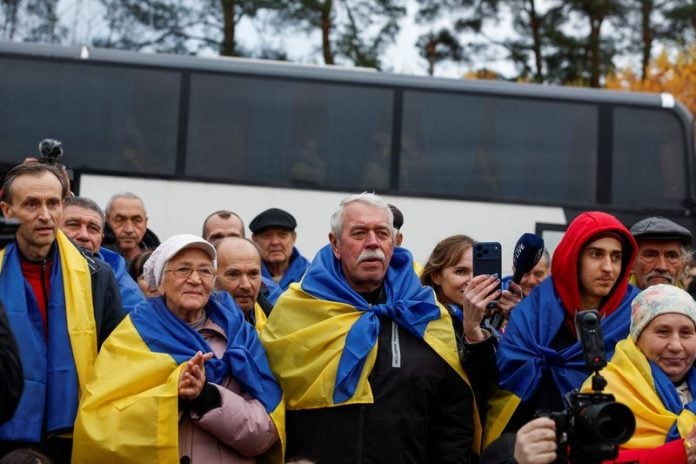
Nov 1 (Reuters) – Ukraine’s military said it evacuated 167 people from threatened areas of southern Kherson region on Sunday as a temporary local ceasefire expired — two days after buses carried residents out of the Russian-held town of Oleshky.
A six-day local ceasefire in Oleshky and the surrounding area was reached after mediation efforts by US first lady Melania Trump and with the involvement of Pope Leo.
The ceasefire expired at midnight Moscow time (2100 GMT). There was no immediate indication of any resumption of hostilities on either side.
It was the longest local pause in fighting since Russia’s full-scale invasion in 2022.
Ukraine’s Ombudsman for Human Rights Dmytro Lubinets, writing on Telegram, said both sides had “upheld the obligations they undertook throughout the duration of this period.”
Lubinets said he and Yana Lantratova, Russia’s commissioner for human rights, were “exploring possibilities to continue similar humanitarian efforts. It is important to maintain this interaction mechanism so that we can keep helping people and saving lives.”
Earlier, Ukraine’s General Staff issued a statement saying that its units, in cooperation with local authorities, “evacuated 167 civilians to safer points in the Kherson region.”
It said the evacuees included 22 children and 21 people with limited mobility requiring special assistance.
The governor of Kherson region, Oleksandr Prokudin, urged residents to be vigilant as the expiry of the ceasefire neared.
“I also strongly urge you not to visit the so-called ‘red zones’ – areas and settlements near the Dnipro,” Prokudin wrote on Telegram. “The intensity of Russian strikes there remains high, and the threat to life is extremely high.”
In Moscow, Kremlin spokesman Dmitry Peskov, quoted by Russian news agencies, said Russia had a positive view of how the operation was conducted in Oleshky, as well as of the coordination between the two countries’ human rights commissioners.
The pope said he hoped cooperation between Russia and Ukraine in implementing a ceasefire in Oleshky would pave the way for broader peace efforts.
Melania Trump, writing on X, said the ceasefire “has provided residents with the freedom to move, access to food, clean water, medicine, plus a renewed sense of dignity without the constant threat of attack”.
CIRCUITOUS JOURNEY
On Saturday, starved and exhausted residents of Oleshky crossed into Ukraine after a circuitous journey from the area, just a few kilometres from the front line.
They first travelled by bus via Crimea, annexed by Russia from Ukraine in 2014, to the Russian town of Anapa, before flying to Belarus from where they continued to Ukraine.
Those wishing to leave Oleshky – some for Russia, some for Ukraine – were taken initially to Crimea in 25 buses and nine ambulances, Lantratova said, before splitting into separate convoys.
It was not known how many chose to stay in Russian-held Oleshky, which lies on the Dnipro River opposite the region’s Ukrainian-held main town of Kherson.
The ceasefire, in place since Tuesday, allowed for the roads to be demined and food, medicines and other supplies brought into the town.
Russian forces took control of the town immediately after the February 2022 invasion of Ukraine, but Ukrainian troops recaptured much of the region, including the town of Kherson, later that year.
Military action continued in other parts of Ukraine on Sunday.
Regional governors and emergency services reported one death in a strike in the Sumy region on the Russian border, a frequent target, and at least one in the central region of Vinnytsia.
(Reporting by Ron Popeski and Alessandra Prentice; Editing by Chizu Nomiyama and Deepa Babington)
Disclaimer: This report is auto generated from the Reuters news service. ThePrint holds no responsibility for its content.