





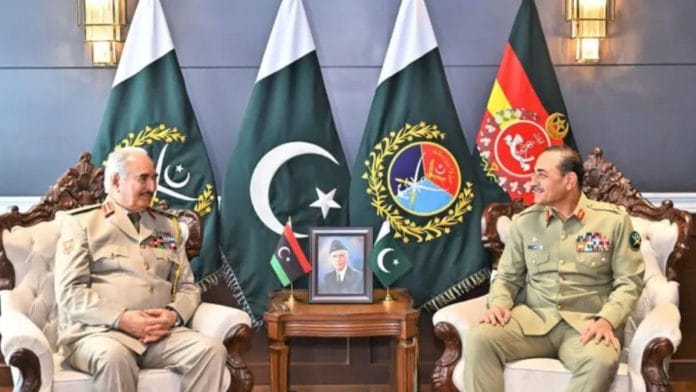



New Delhi: A meeting of two Field Marshals—Asim Munir and ‘strongman of eastern Libya’ Khalifa Haftar—on Monday marked a rare event in Pakistan. The Libyan Field Marshal Haftar travelled beyond his usual diplomatic circuit of Cairo, Abu Dhabi, and Moscow to meet with the Chief of Army Staff of Pakistan.
Haftar’s visit comes just a month after Field Marshal Asim Munir’s trip to Libya’s Benghazi from 17 to 19 December.
During that trip, Reuters reported that the two sides signed a joint cooperation agreement and military procurement deals valued at more than $4 billion. However, in a subsequent story, Reuters mentioned that there had only been talks between the two sides, disputing its earlier story. The original claim was puzzling because Libya has remained under a United Nations arms embargo since 2011.
The Pakistani government has made no public reference to such a deal.
Besides Munir, Haftar met Pakistan Prime Minister Shehbaz Sharif Tuesday, during the first two days of his five-day trip. The Libyan and Pakistani delegations held discussions on strengthening bilateral relations and promoting regional stability in Islamabad.
Conducted under military protocols and centred on meetings at the Pakistan Army headquarters in Rawalpindi, Haftar’s trip to Pakistan signals a quiet military diplomacy between Islamabad and eastern Libya’s power centre.
Officially, the trip was framed as a discussion on security cooperation.
In a statement, Haftar’s media office said the visit was undertaken at the invitation of the Pakistani side and aimed to strengthen bilateral relations, that is, finding and opening broader avenues of coordination in areas of mutual interest, “in a manner that serves the interests of both countries”.
The statement added that Haftar expressed satisfaction with the warm reception and said he hoped to expand bilateral ties and open “wide horizons for partnership across various fields”, reported The Libya Observer.
Libya’s rivals-turned-allies
Haftar arrived in Pakistan accompanied by his son Saddam, widely viewed as his heir apparent.
It was a day after Osama Hammad, the head of the eastern Government of National Stability (GNS), arrived in Pakistan. Hammad was among those who received Haftar at the airport.
Interestingly, during the Second Libyan Civil War, Haftar and Hammad had led rival, eastern-based factions, but they have reportedly been aligned since at least 2018.
Haftar’s rise as a prominent military figure was during the 2011 uprising that led to Muammar Gaddafi’s fall—an outcome made possible largely by the intervention of the North Atlantic Treaty Organisation (NATO). Afterwards, Haftar consolidated power in eastern Libya as the commander of the Libyan National Army (LNA)—now the Libyan Arab Armed Forces—but faced pushback from sections of society.
Only three years after Gaddafi’s fall, Libya had entered an all-out civil war, which continued from 2014 to 2020. During the course of those turbulent times, the equation between Hammad and Haftar changed and turned cordial.
The UN formally announced a ceasefire in Libya in 2020. Abdul Hamid Dbeibah became the Prime Minister of Libya’s Government of National Unity (GNU) in the UN-mediated peace process.
However, Libya’s political landscape remained deeply fragmented. Hamid’s UN-recognised GNU controlled western Libya from Tripoli, while the Government of National Stability (GNS) of Hammad and Haftar ruled the eastern regions. The military leaders are together with the stated objective of ending “outside interference” in Libya, including the UN-backed Dbeibah government.
From time to time, they also fight the Muslim Brotherhood, which, they say, is affiliated with Egypt and the UAE, as well as Ansar al-Sharia and Al-Qaeda affiliates that they often link to the Brotherhood.
The eastern authorities argue Dbeibah’s mandate expired after elections scheduled for December 2021 failed to take place. The UN, however, continues to support Abdul Hamid Dbeibah as Libya’s legitimate executive authority.
Why Pakistan is interested
The visits by Hammad and Haftar highlight a more substantive alignment of Libya with Pakistan.
Libya holds an estimated 41 percent of Africa’s oil reserves, and the eastern Army and authorities control large portions of the country’s oil infrastructure, making the GNS a major player for all countries interested in its oil. For instance, Egypt, the UAE, Saudi Arabia, and Russia have supported Haftar at various stages, citing their bid to counter Islamist movements.
Pakistan formally recognises the Tripoli government, but like many other states, it has increasingly engaged Haftar, as in the recent high-level defence discussions and cooperation agreements.
Turkey and Qatar, by contrast, back the Tripoli government more frequently, but Ankara has maintained channels to Haftar. There are reports of increasing Turkish engagement with the eastern Libyan authorities, as well.
The US officially recognises only the Tripoli authorities but has never severed ties with Haftar. Haftar reportedly even spent nearly two decades in Virginia after his capture, with alleged CIA assistance.
For Pakistan, there are other benefits. A major arms agreement with Libya’s eastern authorities worth over $4 billion in military equipment will be one of its largest defence export deals. It also potentially signals Islamabad’s willingness to operate as a flexible security provider in volatile regions.
At the same time, the Haftar ties are a broader recalibration of Pakistan’s regional military partnerships. Islamabad maintains close ties with Gulf states, has moved closer to Saudi Arabia through a mutual defence pact, and has a strong defence cooperation with Turkey.
Prior meetings have signalled increasing bonhomie between Pakistan and Libya, which have agreed not only to expand defence and naval cooperation but also to focus on maritime security and training, reflecting a strengthening of military ties between Islamabad and Libya’s eastern military forces.
During his visit to Benghazi, Asim Munir and Haftar reportedly discussed issues of mutual interest, regional security, and enhancing defence cooperation, and the line of the talks underscore the developing relationship.
Islamabad has also been seeking to diversify its defence partnerships and marketing its JF‑17 fighter jointly developed with China, in its search for an alternative to Western suppliers However, the precise details remain subject to official confirmation.
Pakistan’s engagement with Haftar helps his military in eastern Libya while also drawing Pakistan and, indirectly, China closer to the Mediterranean through defence cooperation and exports.
Days after Haftar’s visit, Saif al‑Islam Gaddafi, the most prominent son of former Libyan leader Muammar Gaddafi, was killed by unknown assailants in Zintan — an event that has raised concerns about Libya’s already volatile political situation within the country.
Other allies
On the other hand, Turkey and Pakistan are deepening their ties. Both are Sunni‑majority states, with strong political links to movements associated with the Muslim Brotherhood as well as long‑standing ties to China.
Turkey has pursued an expansive regional strategy, seeking influence from Somalia to Libya, and Pakistan appears to be following Ankara’s lead in projecting influence across Muslim‑majority African states by invoking history, religion and strategic solidarity, according to some analysts.
Pakistan’s involvement with Libya may reflect encouragement from the UAE and Saudi Arabia—both long‑standing supporters of Haftar.
A planned visit by the UAE President to Islamabad is widely being seen as part of a broader diplomatic engagement, but claims about expected “diplomatic or economic dividends” remain speculative.
Libya’s alliances, meanwhile, continue to change.
A failed 2019 offensive by Haftar was backed by the UAE, Saudi Arabia, Egypt, and Russia before Turkey intervened in support of the Tripoli government. But recent reporting confirms that the UAE and Saudi Arabia have maintained varying levels of engagement with both the eastern and western Libyan authorities.
Pakistan appears to be positioning itself within this fluid environment by strengthening defence ties with eastern Libyan forces while maintaining existing relationships with the Gulf States.
(Edited by Madhurita Goswami)
Also Read: Asim Munir & Shehbaz Sharif are jokes in Pakistan. Deal with India is another betrayal by Trump