





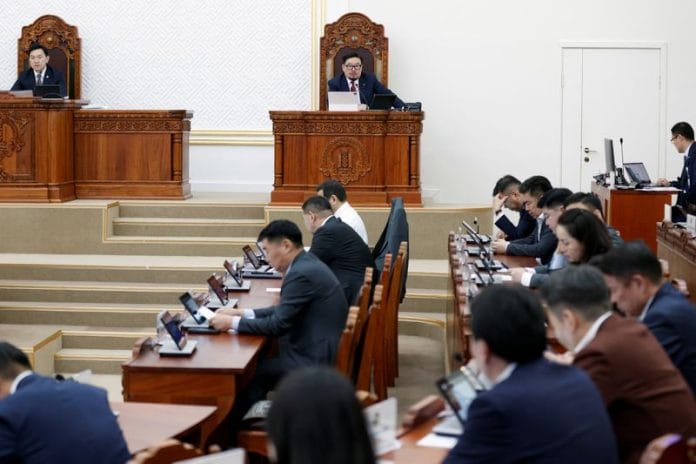



BEIJING, March 31 (Reuters) – Mongolia’s parliament on Monday confirmed Uchral Nyam-Osor as the nation’s third prime minister in nine months, following his predecessor’s resignation last week over strife within the ruling Mongolian People’s Party and a legislative stalemate.
During a parliamentary session on Monday, 88 out of 107 lawmakers voted to appoint Uchral to the coal-rich country’s No. 2 post, after the 39-year-old vowed to trim the bureaucracy and stabilise import prices, the official Montsame news agency reported on Tuesday.
The outgoing prime minister, Zandanshatar Gombojav, resigned on Friday, a move analysts say was a compromise to resolve a boycott of the parliamentary session by the opposition Democratic Party and a faction within the ruling MPP over the past two weeks. Zandanshatar assumed the post in June 2025 after Luvsannamsrai Oyun-Erdene was ousted following corruption allegations that erupted into street protests.
Despite the leadership change, political volatility and the impasse in parliament are unlikely to be quickly resolved.
“There is deep animosity between the ruling party and the opposition, divide among factions within a party, and endless corruption that stokes public discontent,” said Xu Tianchen, a senior analyst at the Economist Intelligence Unit.
With a highly competitive presidential election scheduled for June 2027, “everyone wants to get an edge in the run up to the ballot,” Xu said. “Stability is the last thing you can expect from Mongolian politics,” he added.
Formerly a cabinet member and deputy prime minister, Uchral had been serving as the country’s speaker of parliament, as well as the MPP’s chairman, before his appointment on Monday.
While Uchral has been regarded by some as a consensus figure with a pro-market, pro-reform agenda, underlying economic woes and government instability are likely to continue deterring foreign investment and delaying the structural reforms needed to wean the country off its reliance on mining.
“The overarching policy theme focusing on expanding mining exports will stay unchanged,” said Xu.
“But I’m not sure if foreign investors will buy into his policies after so many political dramas over the past 12 months,” he added.
(Reporting by Xiuhao Chen and Ryan Woo; Editing by Alex Richardson)
Disclaimer: This report is auto generated from the Reuters news service. ThePrint holds no responsibility for its content.