





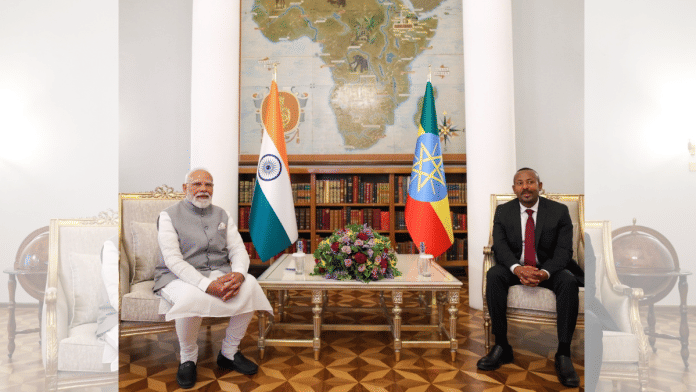



New Delhi: Prime Minister Narendra Modi landed in Addis Ababa, the capital of Ethiopia, Tuesday evening in what happens to be his first visit to the African country.His Ethiopian counterpart and Nobel Peace Prize winner Abiy Ahmed Ali personally received Modi at the airport and drove him to a hotel.
While Ethiopia is an integral part of India’s Africa strategy, the visit promises to further strengthen bilateral ties.
“I eagerly look forward to sharing my thoughts on India’s journey as the ‘Mother of Democracy’ and the value that the India–Ethiopia partnership can bring to the Global South,” Modi said in a statement before his departure for his three-nation tour of Jordan, Ethiopia and Oman.
Notably, the visit comes at a time when the world’s most populous landlocked country is caught in simmering tensions with its northern neighbour Eritrea over access to the Red Sea and Asmara’s ties to groups opposed to the Ethiopian government.
On 12 December, Eritrea announced its withdrawal from Intergovernmental Authority on Development (IGAD), the eight-member East African regional bloc that includes Ethiopia, reigniting geopolitical tension in the region.
Press Release : Eritrea has withdrawn its Membership from IGAD#Eritrea has formally informed the IGAD Secretary General of its decision to withdraw from the Organization.
Eritrea’s decision stems from, and is predicated, on the following poignant facts and events:
1. As it… pic.twitter.com/4kF0HUOome
— Ministry of Information, Eritrea (@shabait) December 12, 2025
ThePrint takes a look at the history of the two African neighbours and why any adverse spinoff can be a matter of concern for the mandarins in New Delhi.
Also Read: Trump calls it ‘most violent place on Earth’. In Sudan, sexual violence & starvation are weapons
History of conflict
Located in the Horn of Africa, a significant geopolitical region and the easternmost extension of the African continent, Ethiopia and Eritrea share a complex history. Their rivalry is rooted in conflict, with the first chapter of the saga being a 30-year war that resulted in secession of Eritrea from Ethiopia in 1991, leaving Ethiopia landlocked.
This was followed by a devastating border conflict known as the Badme War between 1998 and 2000 ending in the Algiers agreement and an independent border commission being established.
The Ethiopia-Eritrea Border Commission awarded the contentious region of Badme to Eritrea , Ethiopia initially rejected this. However, a fragile peace took hold after a 2018 peace deal between Ali and Eritrean President Isaias Aferwaki.
From 2020 to 2022, the two adversaries fought alongside each other against the Tigray People’s Liberation Front (TPLF), a political and military group, in Ethiopia’s northernmost region of Tigray.
The Tigray war ended in 2022 with a ceasefire being signed in Pretoria, South Africa between the Ethiopian government and TPLF, while President Isaias bitterly opposed the deal. According to the ceasefire terms, all foreign and Ethiopian forces were to withdraw from the Tigray region. However, the presence of Eritrea and allied forces was widely reported well in 2024.
What’s the recent tension
The current crisis is a blend of old border rivalries and Ethiopia’s reinforced will to gain sea access. While the two nations share a long history of conflict, current tensions revolve around Ethiopia’s need for direct access to the Red Sea.
Earlier this year, PM Abiy Ahmed Ali in an address to Parliament called for his country’s right to access the sea. “Ethiopia’s access to the Red Sea is inevitable. I prioritise peace and dialogue; please help us negotiate and find solutions,” he said.
Ethiopia attempted to solve its conundrum through a 2024 deal with Somaliland, a breakaway region of Somalia, offering it recognition in exchange for a port. But, resultant tensions with Somalia threw a wrench in the plan.
Turkish mediation was able to soothe this flareup, but it meant that Ethiopia did not gain the sea access it so coveted, leading to analysts fear that Addis Ababa will again look to Eritrea and the coastline it once lost particularly the Port of Assab, which sits a mere 60 km away from the Ethiopian border.
When Eritrea gained its independence in 1991, Ethiopia was to retain access to the Port of Assab, but this was rescinded when the war broke out in 1998, and remains a contentious issue today. Both nations have transitioned into an active military posture. Eritrea launched a nationwide troop mobilisation, following which Ethiopia reinforced its border deployments, signalling readiness for confrontation.
While Eritrea fought alongside the Ethiopian forces, a shift in alliance seems to have taken place, with some TPLF elements coordinating with Eritrea further complicating the situation. With the International community apprehensive of a proxy war theatre developing in Tigray, adding to the instability of the Horn Of Africa.
In a statement issued over the weekend, UN Secretary-General António Guterres through his spokesperson called for both nations to recommit to peace.
“At a time of renewed tensions, the Secretary-General urges Eritrea and Ethiopia to recommit to the vision of lasting peace and the respect for sovereignty and territorial integrity embodied in the Algiers Agreement and strengthen efforts to build good neighbourly relations,” he said, calling upon both countries to continue working with regional and international partners to advance development cooperation for the benefit of all.
Why it matters to India
A direct military confrontation, or even a proxy war, may lead to disastrous consequences for the global trade infrastructure in and around the Red Sea at a time when the shipping sector is already strained. Any disruption of maritime traffic, port facilities and coastal airspace will have wide-reaching consequences to the global economy.
With bigger players such as the Gulf nations, Turkey, Russia, and western powers already in competition for dominance over the Red Sea region, any possible disruption has the potential to turn into a global issue, reducing the space for a regional resolution.
As the Horn of Africa is already caught in a myriad of geopolitical tensions such as the war in Sudan or the insurgency in Somalia, apprehension of the conflict spilling over into the larger region and crossing bilateral borders remains ever-present.
India will be keeping a watchful eye on the developments, as though the issue may appear as a distant African concern, it carries direct potential to affect New Delhi’s trade security, energy costs, and the geopolitical security of the wider Indian Ocean-Red Sea arc.
With the Horn of Africa perched on the strategic Bab-el Mandeb-Red Sea route, which carries a large share of India’s exports, any conflict driven disruption will inflate export costs, at a time when US tariffs and uncertainty around a trade deal is already proving to be a hurdle in India’s economic advancement.
With the emerging need to make diplomatic inroads in Africa, to counter China’s strategic advances, the course and outcome of this probable conflict will impact the next steps India must take to ensure its influence as a reliable partner to have and continuity of relations already established.
Disha Vashisth is a TPSJ alumna currently interning with ThePrint.
(Edited by Tony Rai)
Also Read: Thailand launches airstrikes at disputed border with Cambodia, Trump-led ceasefire in jeopardy