





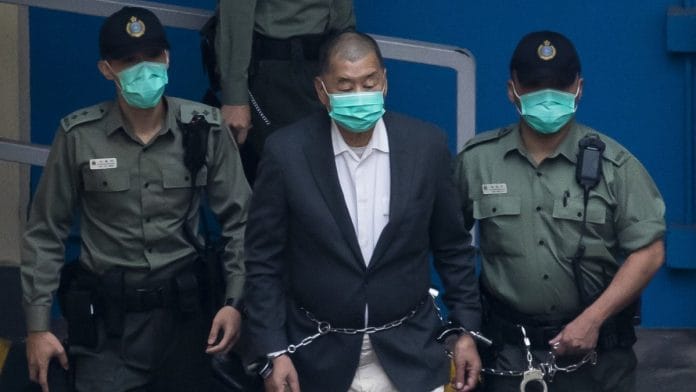



Hong Kong: A Hong Kong court has overturned former media mogul Jimmy Lai’s conviction in a fraud case, in a rare win for the pro-democracy advocate serving a 20-year sentence for national security charges.
The city’s Court of Appeal on Thursday quashed the prison term of five years and nine months for the separate 2022 fraud case. The founder of the now-defunct Apple Daily newspaper was previously convicted for using the former headquarters of his media company for purposes not specified in a lease.
The Court of Appeal ruled that prosecutors had failed to prove the offense, including Lai’s alleged deceit.
Lai and his lawyer did not attend the ruling, online news portal HK01 reported. He had been convicted of most crimes he was charged with except a partial victory in 2023 over an unauthorized protest.
The Hong Kong government didn’t immediately respond to a request for comment.
Unless overturned, the decision will shave off some prison time for the 78-year-old. The Hong Kong government can still escalate the case to the Court of Final Appeal, though it has not said whether it intends to do so.
Lai was sentenced earlier this month by three government-picked judges to 20 years in prison for collusion and sedition charges. It was the heaviest penalty yet meted out under a 2020 Beijing-imposed national security law, effectively condemning Lai to spend the rest of his life behind bars.
The ruling sealed China’s yearslong effort to silence its most defiant and influential critic in the semi-autonomous Chinese city, renewing calls for his release from Western governments.
During the national security sentencing, the judges ordered 18 years of the new term to run consecutively to Lai’s fraud sentence. He was previously set to complete that as soon as June this year or, without a one-third remission for good conduct, in 2028, according to a court statement.
Lai has been previously convicted of several unauthorized assembly charges for his participation in pro-democracy protests that swept the Asian financial hub in 2019. Those protests largely ended after the enactment of the National Security Law the next year that significantly raised the cost of dissent.
This report is auto-generated from Bloomberg news service. ThePrint holds no responsibility for its content.
Also Read: There can never be a ‘G2’ with US & China—Chinese political scientist Yan Xuetong at Delhi lecture