





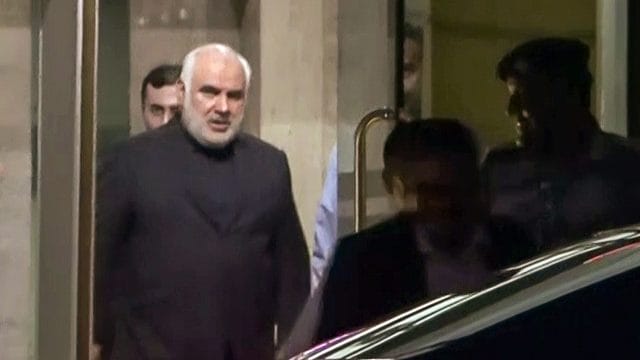


New Delhi: India summoned Iranian ambassador Dr Mohammad Fathali Saturday after at least two Indian-flagged merchant vessels were fired upon by Iranian gun-boats in the Strait of Hormuz.
Sources confirmed to ThePrint that the ambassador was summoned by M. Anand Prakash, Joint Secretary (Pakistan, Afghanistan and Iran) in the Ministry of External Affairs, as New Delhi lodged a strong protest over the actions of the Islamic Revolutionary Guard Corps (IRGC).
At least one of the vessels fired upon is a very large crude carrier (VLCC) carrying roughly two million barrels of oil from Iraq towards India, according to media reports.
“UKMTO has received a report of an incident 20NM northeast of OMAN. The Master of a Tanker reports being approached by 2 IRGC gun boats, no VHF challenge that then fired upon the tanker. Tanker and crew are reported safe. Authorities are investigating,” the United Kingdom Maritime Trade Operations (UKMTO) said in a statement Saturday.
The agency also received reports of a second attack around 25 nautical miles Northeast of Oman against a container ship. This vessel was hit with an unknown “projectile” which caused some damage to the containers, the organisation said.
The UKMTO was established by the British Royal Navy in 2011, with an office in Dubai to help coordinate and exchange information across the Arabian Sea, the Red Sea, the Persian Gulf and the Gulf of Oman.
It is likely that the VLCC that was fired upon by the IRGC is the Sanmar Herald, which has changed its name to“INDIANSHIPINDIANCREW” on its automatic identification system (AIS), according to multiple marine tracking websites.
The two incidents come as confusion remains over the status of the Strait of Hormuz. Iranian Foreign Minister, Seyed Abbas Araghchi, declared the global waterway “completely open” Friday, following the announcement of a ceasefire between Israel and Lebanon.
Araghchi said that the Strait of Hormuz will remain open for the remaining period of the ceasefire agreed to between US-Israel and Iran, which came into effect on 8 April.
However, US President Donald Trump announced that the US naval blockade, imposed on Iran last week, will remain despite the opening of the strait until Tehran agrees to a peace deal. The Iranian Armed Forces Saturday declared that the Strait of Hormuz has “returned to its previous state” due to the continued ceasefire breaches by the US.
“As a result, control over the Strait of Hormuz has been returned to its previous state, and this strategic waterway is under strict management and control by the Armed Forces,” a spokesperson for the Iranian Armed Forces said Saturday, as reported by Iranian media.
The US’ “repeated breaches of commitments and a history of misconduct” has led to the situation, the spokesperson added. The reimposition of strict control by the Iranian army has further muddied the waters of the status of the critical waterway.
Roughly a fifth of energy flows through the Strait of Hormuz annually. The Strait has effectively been closed since the end of February, following the joint US-Israel strikes on Iran. During the 40-day conflict, India negotiated directly with Iran for permission to let its ships transit the narrow passage connecting the Persian Gulf to the Gulf of Oman.
One of the conditions of the ceasefire agreed to between the US, Israel and Iran, brokered by Pakistan almost two weeks ago, was the reopening of the Strait of Hormuz. However, Iran refused to do so until the ceasefire extended to Lebanon. Islamabad and Tehran had originally announced that Beirut was a part of the ceasefire agreement.
The US and Israel denied the claim, with Tel Aviv continuing attacks across Lebanon. However, on Friday, Trump announced that Israel will cease its hostilities against Lebanon for 10 days, as Tehran and Washington continue to negotiate an end to the conflict.
The fragile ceasefire across two-fronts has led to fears of open conflict breaking out again, as the negotiations continue.
Trump has maintained that Iran has “agreed to everything” demanded by the US, an assertion rejected by Tehran.
“The President of the United States made seven claims in one hour, all seven of which were false. They did not win the war with these lies, and they will certainly not get anywhere in negotiations either. With the continuation of the blockade, the Strait of Hormuz will not remain open,” Mohammad Ghalibaf, Speaker of the Parliament of Iran, and one of the negotiators of the peace deal, said in a statement on social media platform X Saturday.
“Passage through the Strait of Hormuz will be conducted based on the “designated route” and with “Iranian authorization.” Whether the Strait is open or closed and the regulations governing it will be determined by the field, not by social media,” he added.
(Edited by Niyati Kothiyal)