





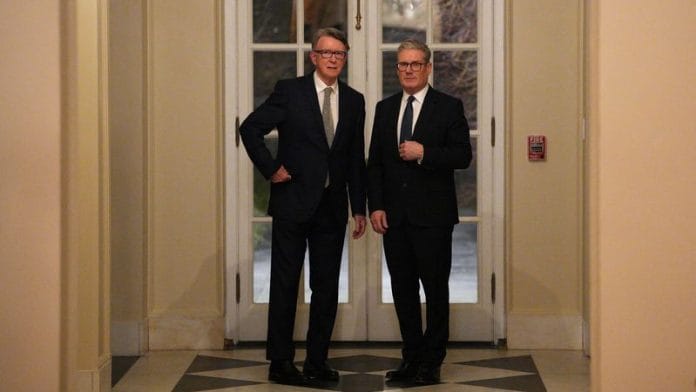


New Delhi: When Boris Johnson’s turbulent premiership was finally terminated in the summer of 2022, the political execution was conducted by a firing squad formed of his own cabinet.
Over 40 dramatic hours, a succession of top government figures declared their unwillingness to keep serving a prime minister most voters had long concluded lacked honesty and judgment. By the end, Johnson had lost 50 ministers including his chancellor of the exchequer and his education, health and work and pensions secretaries.
Prime Minister Keir Starmer is facing similar questions about his own probity because of his reckless decision to appoint Peter Mandelson, a close friend of the deceased pedophile Jeffrey Epstein, as UK ambassador to the US. Though he remains wildly unpopular with the public and his party is braced for a trouncing in important local and regional elections next month, Labour lawmakers have been unwilling or unable to reach for the pearl-handled revolver.
Time and again, Starmer’s parliamentary party has stepped back from the brink, largely because it cannot agree on who would succeed him, or even the type of government that person should lead.
The Labour left won’t accept the ambitious Health Secretary Wes Streeting, another Mandelson acolyte, or Home Secretary Shabana Mahmood, who’s too anti-immigration for their tastes. The right has conniptions over union-friendly ex-Deputy PM Angela Rayner and Energy Secretary Ed Miliband, a net-zero champion. The most popular candidate with public and party is Manchester Mayor Andy Burnham. Starmer has blocked him from reentering Parliament for reasons of pure self-preservation.
That has led to a non-contest, with wannabe contenders, wary of the taint of betrayal which attaches to those who attack first, reluctant to declare themselves while Starmer remains in situ.
It may be that this dynamic continues even after the May 7 elections, expected to be brutal. But Starmer’s authority is so shot that few believe he’ll serve the full term. As Labour lawmaker Jonathan Brash said this week: “As far as the prime minister is concerned, it’s not a case of if, it’s when.”
Wariness about toppling the PM has some logic. Labour members of Parliament don’t know who might enter the fray or what they’d do should they win. They rightly fear that what follows could be even worse.
Yet as Starmer staggers through another week of damning revelations about Mandelson, something finally seems to have shifted in his cabinet. They may lack the ruthlessness of the 2022 Tories who forced Johnson out of No. 10, but they are beginning to hint at how they see a post-Starmer future.
The prime minister can no longer rely on senior colleagues to show him unconditional loyalty or defend his missteps. Foreign Secretary Yvette Cooper, Work and Pensions Secretary Pat McFadden and Scotland Secretary Douglas Alexander, usually the most cautious members of the government, have all criticized Starmer in recent days. Miliband made clear that he’d opposed Mandelson’s appointment.
There have been critical leaks to the media about Starmer’s sacking and hanging out to dry of Olly Robbins, the official in charge of the Foreign Office, for not telling the PM Mandelson had failed a security vetting.
Meanwhile, even as Robbins was giving evidence this week before a committee of MPs, a beauty pageant of possible PM contenders was playing out in another corner of Westminster. Miliband, Rayner, Chancellor of the Exchequer Rachel Reeves and even Starmer’s Chief Secretary Darren Jones used a conference to set out their stall for how they’d grow the economy — the party leader’s chief promise at the last election.
This happened a few days after Burnham let himself be photographed visiting Rayner’s house. Some see echoes of the famous 1994 “Granita Pact” struck between Tony Blair and Gordon Brown in a north London restaurant before the latter stood aside after the sudden death of Labour leader John Smith.
In these subtle movements we can detect the first signs of the serious thinking required as Starmer’s premiership nears its end. The PM and his No. 10 operation will no doubt see disloyalty and factionalism. The truth is that this is a necessary precursor to a contest everyone but he accepts is inevitable.
The first priority for anyone who thinks they have what it takes for the top job is the intellectual heavy lifting of determining what they want to do with the power they would wield. This is probably Starmer’s biggest failing and something he largely sub-contracted to his former Chief of Staff Morgan McSweeney, a weakness that tragically influenced his thinking on letting the New Labour architect Mandelson back into the fold.
The UK prime minister still heads up one of the world’s largest economies, one that’s a permanent member of the UN Security Council and a leading member of the North Atlantic Treaty Organization. Starmer has dealt with this side of business well enough, if you set aside his choice of Washington ambassador.
More pressing for prospective replacements is to answer the question of how they can abide by Labour’s electoral mandate — including a pledge not to raise general taxation and to limit borrowing — while presenting their candidacy as a break from the failing policies of Starmer and Reeves. Burnham might be popular now, but the contortion of keeping both Labour’s public-sector ultras and the bond markets happy would test the greatest leader.
At least it seems some cabinet members understand their duty lies not in propping up Starmer but in figuring out what should follow. Next week McSweeney gives evidence to the same parliamentary committee on the Mandelson affair. What he says then could prove lethal for the PM. The cabinet must be ready to pick up the pieces if Starmer finally blows up.