







The conflict between the US and Iran has focused the world’s attention on the Strait of Hormuz. But there is another, less-discussed global chokepoint to the west of the Persian Gulf: the Bab el-Mandeb Strait at the southern end of the Red Sea. And now the Houthis of Yemen, Iran’s strongest remaining proxy group, have declared a blockade against Saudi Arabian traffic through it.
Iran has already created the blueprint for shutting down a vital passage in the face of attacks by a vastly greater power. It has used a combination of small-boat attacks, drone strikes, short-range ballistic missiles, and mines. While the Iranians do not enjoy either sea or air superiority, their occasional strikes and threats have caused many shipping owners to decline to take the risks to crew, cargo and insurance costs.
The Bab el-Mandeb is equally vulnerable. It lies between war-torn Yemen on the Arabian Peninsula and the poor African nations of Djibouti and Eritrea on the Horn of Africa. It is only 31 miles long and around 16 miles wide; the name roughly translates to “Gate of Tears” in recognition of its difficult navigational challenges.
What makes the strait so significant is its linkage with the Suez Canal, roughly 1,200 miles to the north and about three days of sailing by a merchant craft. The Suez Canal typically carries about 12% to 15% of global trade, roughly 30% of global container traffic, and more than $1 trillion of goods annually. It also handles about 10% of seaborne oil trade. The only alternative to the Red Sea route is the long and costly voyage around the Cape of Good Hope at the southern tip of Africa.
The Houthis have previously demonstrated the ability to interfere with shipping in and around the strait, contributing to a sharp reduction in Suez Canal traffic between 2023 and 2025. If both the Bab el-Mandeb and Hormuz are closed, we could face a global oil shock and economic crisis.
How far can the Houthis go to bottle up this second front in the US-Iran war? And what can the West, the Gulf states and the rest of the world do to keep it open?
I know these waters well, having first sailed them in the mid-1980s on a Navy cruiser, USS Valley Forge. I’ve been back many times: commanding my own destroyer, USS Barry; leading a carrier strike group during the 2003 invasion of Iraq; and, as the supreme allied commander of the North Atlantic Treaty Organization, running multinational effort against Somali pirates.
But the Houthis are a new kind of threat. They have been equipped, trained and groomed by Iran and, since 2023, have shown an aptitude for attacking, capturing and sinking merchant ships. They have a deep hatred of Israel and the US. They have been engaged in a vicious civil war against their countrymen for decades and despise Saudi Arabia and the United Arab Emirates for meddling in that internal conflict.
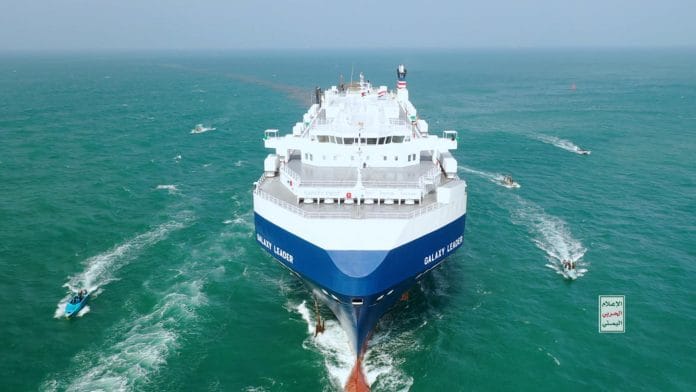
If they opt for a blockade of all shipping, the Houthis could easily strike 5 to 10 large commercial vessels daily. They have drones and some shorter-range ballistic missiles that could be effective. While not as technically advanced as the Iranians, they are capable of planting mines, operating small-boat swarms, and using drones and missiles provided by Tehran.
The best approach here, much as in combating Somali pirates more than a decade ago, is to internationalize the defensive forces. A first step could be putting the merchants into convoys of three to five ships, and escorting each with a guided-missile frigate or destroyer. It would be a good idea to let Europe take the lead — the European Union was extremely effective in counterpiracy operations — perhaps coordinated as a deployment of NATO’s Standing Naval Forces. No matter the coalition makeup, there are good bases in Djibouti, including French military facilities and the US naval station at Camp Lemonnier.
With careful diplomacy, it might be possible to expand the mission to include participation by local states. Given the stream of revenue enjoyed by Egypt from the Suez, it might be willing to use its relatively large navy. Jordan has its port city of Aqaba at the north end of the Red Sea. And the Saudis have vital oil terminals on their long Red Sea coast. Strategically, Arab navies could operate to the north of the strait in the Red Sea, while Western forces protect the convoys to the south in the Gulf of Aden.
If these measures prove ineffective, it may be necessary for the US to resume strikes on land targets in Yemen, as it did before a tenuous truce was reached in May 2025. Some low-risk but high-payoff targets would be the Houthis’ logistical links with Iran; drone maintenance and production facilities; ballistic-missile storage areas; and command-and-control nodes.
A Houthi closure of the Bab el-Mandeb wouldn’t just affect global shipping — it would be a way for Iran to broaden the war against the US beyond the Persian Gulf. The best way to keep that from happening is to learn from the past and plan for it now.
Disclaimer: This report is auto generated from the Bloomberg news service. ThePrint holds no responsibility for its content.