







By Laila Bassam, Thomas Suen and Pesha Magid
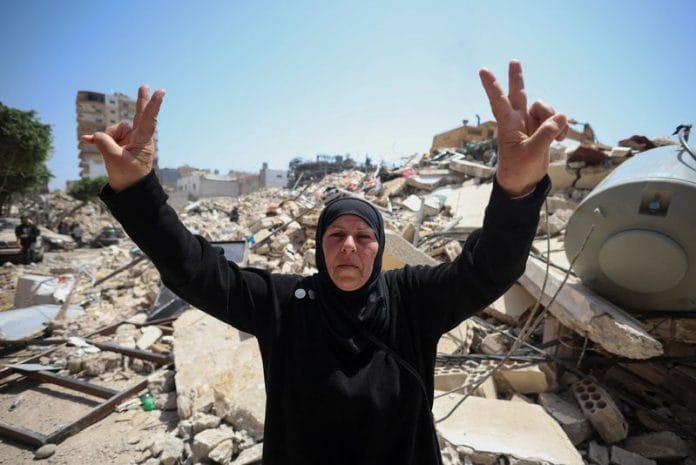
BEIRUT/QASMIYEH/JERUSALEM, Lebanon, April 17 (Reuters) – People uprooted by the war in Lebanon began returning to devastated towns and neighbourhoods on Friday, with many finding their homes destroyed or uninhabitable and hesitant to stay for fear a ceasefire between Hezbollah and Israel could unravel.
U.S. President Donald Trump announced the 10-day ceasefire agreement between the governments of Lebanon and Israel on Thursday, adding to optimism that the parallel war between the United States and Iran could be nearing an end.
While Trump says Lebanon and Israel will work towards a longer-term deal, the ceasefire leaves big questions. Notably, it does not demand Israel withdraw troops occupying parts of the south, where Israel’s defence minister said Israeli troops would continue to demolish homes he claimed were being used by Hezbollah.
Iran-backed Hezbollah, which operates independently of the Lebanese state, says it maintains “the right to resist”.
SCARED TO RETURN
In the Hezbollah-controlled southern suburbs of Beirut, hills of rubble stood where there had once been apartment blocks and the smell of death hung in the air. Ali Hamza said he found his home intact, but that people were scared to return for now.
“It is impossible to live in these circumstances, and with these smells. A full return is difficult now, despite the hardship of displacement”. He had gathered school books from the house: “We lost everything; we don’t want them to lose the school year.”
In Qasmiyeh in southern Lebanon, cars were driving across a makeshift crossing over the Litani River, hastily erected after the ceasefire came into effect at midnight local time (2100 GMT). Israel destroyed all the bridges over the Litani during the war, blowing up the one at Qasmiyeh on Thursday.
Lebanon was dragged to war on March 2, when Hezbollah opened fire at Israel in support of Iran, sparking an Israeli offensive that authorities say has killed more than 2,100 people and displaced 1.2 million just 15 months after the last Hezbollah-Israel war. Hezbollah’s Shi’ite Muslim constituents have borne the brunt once again.
Hezbollah fired hundreds of rockets and drones at Israel. Two Israeli civilians and 13 Israeli soldiers have been killed in the hostilities with Hezbollah since March 2, Israel says.
ISRAEL TO HOLD ‘SECURITY ZONE’
Israel’s Defence Minister Israel Katz said territory south of the Litani River, which meets the Mediterranean 30 km (20 miles) north of the Israeli border, had yet to be cleared of Hezbollah militants and arms.
“This will have to be done politically or through the continuation of the IDF’s military activity after the ceasefire ends,” he said.
Katz said Israeli forces would continue to hold seized territory, saying Israel had established a “security zone” extending 10 km (6 miles) into Lebanon.
Lebanese President Joseph Aoun, whose administration this week held Beirut’s highest-level contact with Israel in decades, said Lebanon faced “sensitive and pivotal” negotiations with Israel.
He said his focus was to ensure the ceasefire stood, Israel withdrew, and prisoners were released.
The Lebanese government has sought Hezbollah’s peaceful disarmament for a year, and banned its military activities on March 2.
‘IT’S UNLIVEABLE’
Israel ordered residents out of swathes of the south during the war.
“There’s destruction and it’s unliveable. Unliveable. We’re taking our things and leaving again,” said Fadel Badreddine, who was visiting the largely destroyed southern city of Nabatieh with his wife and son.
Hezbollah halted fire at Israeli targets when the ceasefire came into force but has stopped short of publicly endorsing the deal. Hezbollah has credited Iranian pressure on Washington for yielding the ceasefire.
Lina Khatib, an associate fellow at the Chatham House policy institute in London, said it was likely there would be “a continuation of Israeli activity in southern Lebanon to bolster its objective of establishing a buffer zone”.
“Even if there are military infringements of the terms of the ceasefire, this will not necessarily mean abandoning the different stakeholders’ political commitment to the ceasefire terms,” she said.
Trump said Lebanon had agreed to “take care of Hezbollah”.
Any move by the Lebanese state to disarm Hezbollah by force would risk conflict in a country shattered by civil war from 1975 to 1990. Attempts by a Western-backed government to curb Hezbollah in 2008 prompted a brief civil conflict.
Trump said he would be inviting Prime Minister Benjamin Netanyahu and Aoun to the White House for “meaningful talks” between the two countries.
The Lebanese army reported ceasefire violations by Israel, including intermittent shelling of several southern Lebanese villages, and urged citizens to hold off on returning to southern villages and towns.
There was no immediate comment from the Israeli military.
(Additional reporting by Nazih Osseiran in Beirut, Aziz Taher in Nabatieh and Ahmed Kerdi in Beirut; Writing by Tom Perry; Editing by Alex Richardson)
Disclaimer: This report is auto generated from the Reuters news service. ThePrint holds no responsibility for its content.