







By Alexander Cornwell
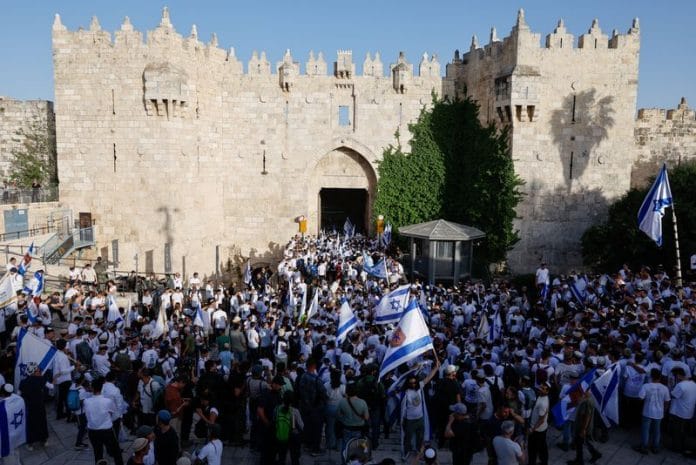
JERUSALEM, May 14 (Reuters) – Thousands of Israeli nationalists marched on Thursday through the Muslim quarter of Jerusalem’s walled Old City under heavy security, in an annual event marking Israel’s capture of the city’s east in a war nearly six decades ago.
The parade, the main celebration of Jerusalem Day, has become a show of force for Jewish nationalists but is seen by Palestinians as a blatant provocation aimed at undermining their ties to the city.
“Jerusalem is our holy city. It is our holy city forever,” said Shira Gefen, a 53-year-old Israeli who travelled to Jerusalem from her home near Haifa for the rally.
Israel captured East Jerusalem in the 1967 Middle East war and later annexed it, a move that the United Nations and most countries have not recognised.
“We are very happy and excited to be here. This is the heart of the world and the heart of all Jewish people,” said George, a 65-year-old Israeli who lives near Ashkelon in the country’s south. He declined to give his last name.
Israeli authorities deployed thousands of police officers, some in riot gear, in Jerusalem, including at Damascus Gate, the main gateway to the Old City’s historic Muslim quarter.
The police erected barricades around the Damascus Gate area, preventing Palestinians who do not live in the Old City from entering. Palestinian shopkeepers in the Old City said they were forced to close ahead of the parade.
TENSIONS
The march frequently inflames tensions as ultra-nationalist Jewish groups stream through Palestinian areas of the Old City. In the past, crowds of demonstrators, including many youths, have chanted slogans such as “Death to Arabs”.
The parade’s path starts in West Jerusalem and ends at the Western Wall, a remnant of an ancient retaining structure revered by Jews as the Temple Mount, a vestige of their faith’s two ancient temples. Muslims refer to that area as Al Haram Al Sharif, or the Noble Sanctuary, the third holiest site in Islam.
At one point during Thursday’s march, Israeli police forced activists seeking to provide a protective presence to Palestinians — along with members of the media — out of the Old City, before later allowing journalists to return while restricting them to an area by the Austrian Hospice.
Palestinians view the Jerusalem Day procession as part of a broader campaign to bolster Jewish presence across the city to their detriment.
They have long sought East Jerusalem as the capital of a future Palestinian state.
(Reporting by Alexander CornwellEditing by Gareth Jones)
Disclaimer: This report is auto generated from the Reuters news service. ThePrint holds no responsibility for its content.