





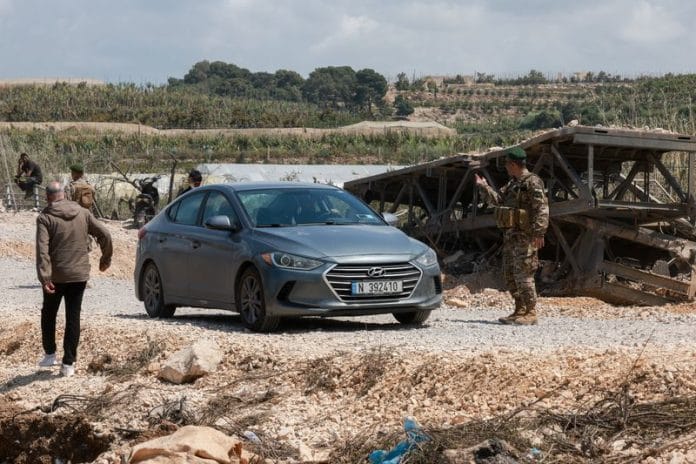


By Laila Bassam, Maya Gebeily, Maayan Lubell and Steven Scheer
BEIRUT/JERUSALEM, April 20 (Reuters) – Israel on Monday told residents of south Lebanon to stay out of a belt of territory at the border and not to approach the area of the Litani River, entrenching its grip over southern Lebanon despite a ceasefire in the war with Hezbollah.
The U.S.-mediated, 10-day ceasefire took effect on Thursday, largely halting the war between Israel and Iran-backed Hezbollah that spiralled out of the conflict between the United States and Iran.
But it remains fragile, with Israeli troops occupying territory deep in the south, aiming to create a buffer zone to shield northern Israel from Hezbollah attack, while the group says it maintains the “right to resist” Israeli occupation.
Lebanese Parliament Speaker Nabih Berri told the pan-Arab Asharq Al-Awsat newspaper that Washington was making an effort to extend the ceasefire agreed by the Israeli and Lebanese governments, after he met the U.S. ambassador to Lebanon.
Following the highest level contacts in decades between Israel and Lebanon last week, a U.S. State Department spokesperson said Washington would host a second round of ambassador-level talks between Lebanon and Israel on Thursday. Hezbollah strongly opposes the contacts.
MAPS DELINEATE AREA OF ISRAELI OCCUPATION
Hostilities between Hezbollah and Israel reignited on March 2, when the Lebanese group opened fire in support of Tehran, sparking an Israeli offensive that led Israel to invade the south and which authorities say killed nearly 2,300 people in Lebanon.
The Israeli military posted a map on social media with a red line through 21 villages across the south, and said residents should not move into the area between it and the border. It said Israeli troops were maintaining positions in the south “in the face of ongoing terrorist activities” by Hezbollah.
The map named more than 50 other villages to which residents should not return. The Israeli military also said “it is not allowed” to approach the area of the Litani River, which meets the Mediterranean some 30 km (20 miles) north of the border and mostly flows to the north of the area the Israeli military said residents should stay out of.
On Sunday, the Israeli military published a similar map, showing for the first time its new deployment line inside Lebanon running 5-10 km deep.
The Israeli military has been carrying out demolitions in villages in the south, saying it is acting against infrastructure belonging to Shi’ite Muslim Hezbollah.
An Israeli military official said Hezbollah had built up and embedded “its presence in civilian infrastructure” in the area “over many decades”.
Senior Lebanese politician Ali Hassan Khalil, a Berri aide and Hezbollah ally, said Israeli forces had carried out varying degrees of destruction in 39 occupied villages since the ceasefire. Khalil told Reuters the destruction of civilian homes was a “clear war crime”.
The Israeli military didn’t immediately respond to a request for comment.
Earlier, during a briefing with reporters, an Israeli military official didn’t answer questions about the scale of Israeli demolition operations in the south, denying the military was “removing villages”.
A photo showing the desecration of a crucifix smashed by an Israeli soldier in a southern Lebanese village home to Christians triggered widespread condemnation on Monday from Israeli, U.S. and church officials.
LEBANON APPOINTS EX-AMBASSADOR TO LEAD TALKS
The Lebanese government has been sharply at odds with Hezbollah over its decision to join the regional war on March 2, having sought the group’s peaceful disarmament for the past year, and had called for negotiations with Israel.
Hezbollah says the ceasefire is thanks to Iran.
Lebanese President Joseph Aoun said Lebanon’s talks with Israel would be handled by a delegation led by its former ambassador to Washington, Simon Karam.
A senior Lebanese official earlier said Beirut had informed Washington that circumstances were not correct for a face-to-face meeting with Israeli Prime Minister Benjamin Netanyahu.
Hezbollah fired hundreds of rockets and drones at Israel during the war. Its attacks have killed two civilians in Israel while 15 Israeli soldiers have died in Lebanon since March 2, Israel says.
Hezbollah has not disclosed its casualty figures. At least 400 of its fighters had been killed by the end of March, according to sources.
Hezbollah on Monday said explosive devices previously planted by its fighters had detonated as Israeli military vehicles were moving through an area of the south on Sunday, destroying four tanks.
Israel’s military denied this. It later said an armoured vehicle was likely damaged by an explosive device in the south on Sunday, but there were no casualties.
(Reporting by Jana Choukeir in Dubai, Steven Scheer, Maayan Lubell and Alexander Cornwell in Jerusalem, Laila Bassam, Maya Gebeily and Tom Perry in Beirut; Writing by Tom Perry; Editing by Aidan Lewis)
Disclaimer: This report is auto generated from the Reuters news service. ThePrint holds no responsibility for its content.