





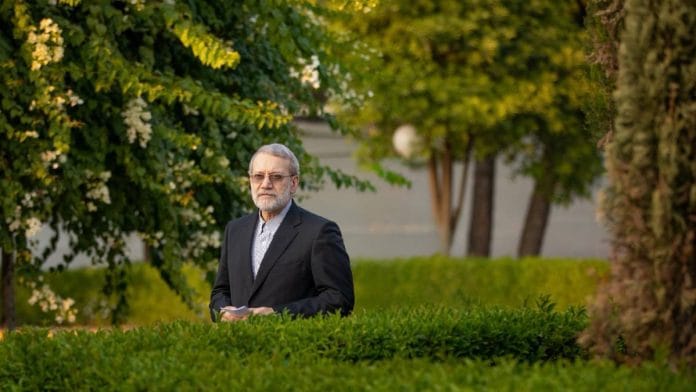



New Delhi: Iran’s security chief Ali Larijani, 67, was confirmed killed in a strike near Tehran Tuesday. His X handle early Wednesday carried the message: “God’s servant, joined to God.”
Iran’s Fars News Agency reported that Larijani died in a US-Israeli air attack while visiting family on the eastern outskirts of Tehran. Earlier, Israel’s defence minister had said Larijani was targeted in a military operation and assassinated. Soon after, a message was posted from Larijani’s X handle.
Larijani’s death removes one of the Islamic Republic’s most experienced power brokers, often referred to as the brutal “kingmaker”. Long regarded as “the quintessential insider”, Larijani had emerged as a central figure in Iran’s wartime strategy following Supreme Leader Ayatollah Khamenei’s death on 28 February in US-Israeli strikes.
Though constitutionally barred from becoming Supreme Leader because he was not a cleric, Larijani was widely seen as the regime’s de facto coordinator, shaping national security decisions, directing foreign policy responses and managing internal dissent.
He has a divided legacy of being both a pragmatist and a repressor who was behind the suppression of the 2009 and the 2026 mass protests in Iran.
When protests over an economic crisis erupted in the country in January, Larijani was credited with the brutal crackdown on protestors. According to reports, the Ayatollah bypassed President Masoud Pezeshkian’s authority and turned to Larijani, head of the Supreme National Security Council.
Born into a prominent clerical family once referred to by TIME magazine as the “Kennedys of Iran”, Larijani rose alongside the Islamic Republic itself. He joined the Islamic Revolutionary Guard Corps (IRGC) during the Iran-Iraq War in the 1980s, later moving into senior government roles that would define his career. Over the decades, he served as culture minister, head of state broadcasting, chief nuclear negotiator and speaker of parliament for 12 years.
As head of Iran’s state broadcaster IRIB, he reportedly helped consolidate a conservative dominance over the media landscape where reformist voices were marginalised and programming often reflected the ideological priorities of the ruling establishment.
Later, as secretary of the Supreme National Security Council, Larijani played a pivotal role in shaping Iran’s nuclear strategy and broader defence posture. He was key in the passage of the 2015 nuclear agreement in the parliament as speaker. Yet, he later resigned as chief negotiator in 2007 after clashing with then-president Mahmoud Ahmadinejad over strategy.
Disqualified twice from running for president, he remained an influential figure and was recalled as head of the Supreme National Security Council in 2025 by the Ayatollah after the 12-day war with Israel.
Following the February US-Israeli strikes that killed Khamenei and senior military figures, Larijani’s posture shifted markedly. In public statements and media appearances, he framed the conflict as existential, warning that Iran’s adversaries would “regret their actions”.
He was last seen on the streets of Tehran on Al Quds Day openly challenging US President Donald Trump to attack him, even as the US offered $10 million for information on him.
Also Read: Israel says Larijani killed in midnight strikes. Then comes Iran intel chief’s handwritten note
Who’s next?
After Larijani, Saeed Jalili, a senior Iranian diplomat and prominent hardline figure, is increasingly being viewed as the candidate to assume a central role in Iran’s security establishment.
Jalili, 60, is best known for his role as Iran’s chief nuclear negotiator from 2007 to 2013 under Ahmadinejad. He, unlike Larijani, was critical of the 2015 nuclear agreement, and said that it gave too much power to the West. He has a hardline reputation and has repeatedly opposed conciliatory policies.
As a volunteer with the Basij militia, he was seriously wounded in the Iran-Iraq War, losing part of his right leg—an injury that earned him the name “Living Martyr”, a title that carries symbolic weight in Iranian culture.
After the war, he was part of the foreign ministry and rose through the ranks, eventually securing a position on the Supreme National Security Council. His influence expanded as he became a trusted figure within conservative and hardline circles.
In 2013, Jalili ran for president but finished third. He has since then, remained an influential voice, particularly among factions that favour a more confrontational approach to foreign policy and internal governance.
(Edited by Nida Fatima Siddiqui)
Also Read: The key figures steering Iran amid war & regional tensions: Mapping Pezeshkian’s presidential circle