





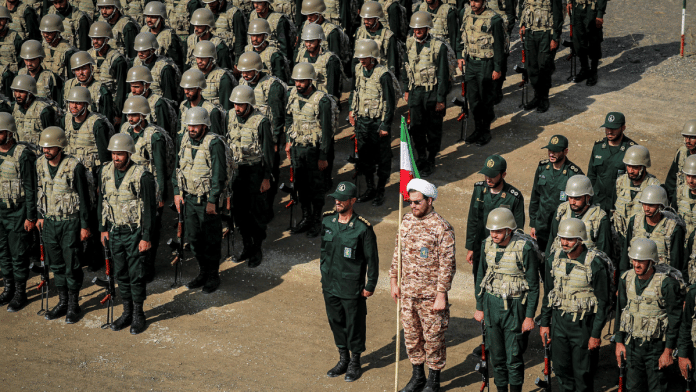



New Delhi: The European Union (EU) has listed the Iranian Revolutionary Guard Corps (IRGC) as a terrorist organisation, placing it in the same category as al-Qaeda, Daesh, Hamas, and the Islamic State. “If you act as a terrorist, you should also be treated as a terrorist. We are also sending a clear message that if you are suppressing people, it has a price,” European Commission vice-president Kaja Kallas said Thursday.
This move comes at a time when the IRGC is accused of mass executions during Tehran’s crackdown on protests over inflation and the currency collapse. The EU, with its 27 member nations, including France, has unanimously condemned the acts and designated the IRGC as a terrorist organisation. Earlier, Paris was reluctant to declare the IRGC a terrorist organisation, as it would risk detention of its citizens and embassy operations.
In 2019, the US became the first country to label the IRGC as a terrorist organisation, followed by Canada, and the UK. With the EU now joining the ranks, the scrutiny on Iran’s elite military wing has intensified.
To grasp the significance of this decision, it is essential to examine how the IRGC was formed, how it operates, and the extent of its military, political, and economic influence, both within and outside Iran.
Also Read: Trump’s Board of Peace has member countries who are also part of China’s BRI project
The origin
Solely answerable to Iran’s Supreme Leader Ayatollah Ali Khamenei, IRGC is Iran’s most powerful and feared organisation with an independent land, air and navy presence. Its influence is not limited to the military, but visible in politics, education and the economy.
It took shape in 1979 after Iran’s Islamic Revolution uprooted the pro-Western monarchy and brought an Islamic Republic in its place. At that time, it rallied loyal militias to counter the distrusted regular army, tied to the ousted Shah Reza Pahlavi.
Beginning with just 10,000 members with a mandate to protect the Iranian revolution, IRGC had grown to 3,50,000 by 1986 during the war with Iraq. It led attacks on the front lines during the war, built Iran’s first ballistic missiles, and absorbed the Basij volunteer militia.
Today, IRGC has 150,000-190,000 active troops, and a million more in its Basij volunteer reserves, making it far stronger than Iran’s regular army. It runs the country’s missile and nuclear programmes, cyber warfare, and key defences.
In the present context, IRGC is also mandated to crush internal dissent and external threats as seen in the recent protests as well as the 2009 Green Movement, a pro-democracy protest wave in Iran that erupted after the disputed presidential elections.
It was also responsible for the killing of hundreds of protesters during the 2022-2023 demonstrations that followed the death of Mahsa Amini.
Under the leadership of Khamenei, IRGC has shifted its focus to business as well. It has built a massive front company, Khatam al-Anbiya Construction Headquarters, also known as GHORB. The conglomerate has expanded, from infrastructure development to oil production and telecom, among other sectors. In the process, it dodged Western sanctions.
Politically, IRGC allies have taken major executive roles, as seen in the case of former President Mahmoud Ahmadinejad who is said to have been a senior officer in the IRGC’s Special Brigade in 1986.
Large imprint
For foreign operations, the IRGC’s Quds Force has inculcated several armed groups in different regions: the Hezbollah (Lebanon), Hamas (Gaza Strip), Houthis (Yemen), and Shia militias (Iraq and Syria).
These groups are known as the Axis of Resistance, as they propagate Iran’s narrative and vision abroad. However, most of these groups have limited operational readiness.
In 2024, Argentina’s top criminal court concluded that Iran’s Revolutionary Guard and Hezbollah were responsible for the 1994 bombing of a Jewish centre in Buenos Aires. Tehran denied any role in the suicide attack that killed 85 people and injured at least 300.
Four years earlier, it downed a Ukrainian passenger jet, killing all 176 onboard the aircraft. Tehran had announced that its military ‘unintentionally’ shot the plane, after repeatedly denying Western accusations of its role.
More recently, in 2024, US prosecutors charged three Iran-based men, including an IRGC official, over an alleged plot to abduct and kill an Iranian-American journalist in New York.
The killing of General Qasem Soleimani, head of the Quds Force, in an American strike in Iraq in 2020 was a setback for IRGC. Another blow came in last year’s Operation Rising Lion when Israel eliminated Hossein Salami, commander-in-chief of IRGC, and Brigadier General Amir Ali Hajizadeh, commander of the IRGC Aerospace Force, among others.
(Edited by Tony Rai)
Also Read: US Treasury Secy Bessent slams India-EU FTA, says ‘Europeans funding war against themselves’