





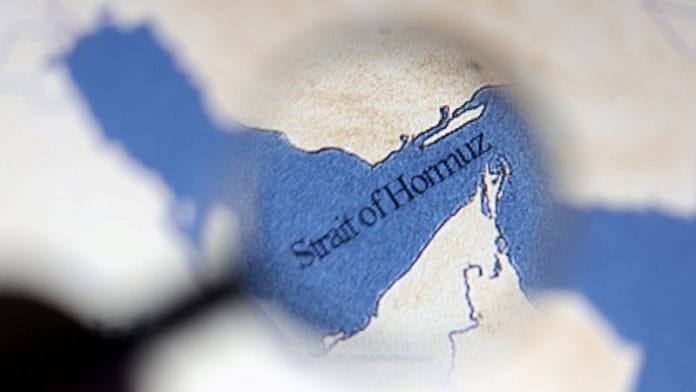



New Delhi: Iran Sunday declared that the Strait of Hormuz is “not closed” and maritime traffic is “not suspended”, while pointing out that apart from those linked to the US and Israel, vessels are currently allowed to transit subject to “safety and security regulations”.
“It is emphasized that vessels, equipment, and any capacities belonging to the aggressing parties—namely the United States and the Zionist regime—and other participants in this aggression do not qualify as engaging in normal and non-hostile passage. They will be dealt with in accordance with the legal framework arising from the state of conflict and pursuant to the decisions and measures of the competent Iranian authorities,” the Iranian foreign ministry said in its statement.
The statement added: “Non-hostile vessels, or those belonging to or affiliated with other countries, provided that they do not participate in or cooperate with acts of aggression against Iran and comply with the declared safety and security regulations and measures, may, in coordination with the competent Iranian authorities, benefit from safe passage through the Strait of Hormuz.”
The Iranian statement came hours after US President Donald J. Trump promised to “obliterate” “various power plants” in the West Asian nation, if Tehran did not “fully open” the Strait of Hormuz within 48 hours. The strait is considered a global chokepoint, as around a fifth of the world’s energy supply flows through the waterway. Shipping through the Strait of Hormuz has been disrupted since the war began on 28 February.
The disruptions to global shipping and Iran’s strikes at energy infrastructure in the region have led to a spike in the prices of crude oil, and a curtailment in supply of other resources such as liquified natural gas (LNG).
The price spike has hit the US, with a gallon of gasoline in many states nearing $4. Gasoline prices in the US are up by around 30 percent since the war began, which is politically challenging for Trump as the country heads to mid-term elections later this year.
The US President had run a campaign of promising to lower gasoline prices, attacking his predecessor Joe Biden’s policies. The surge in oil prices led the US to waive sanctions on the sale of Iranian oil already at sea last week in an attempt to ensure more supply of crude in the global market.
“Strait of Hormuz is not closed. Ships hesitate because insurers fear the war of choice you initiated—not Iran. No insurer—and no Iranian—will be swayed by more threats. Try respect. Freedom of Navigation cannot exist without Freedom of Trade. Respect both—or expect neither,” Iranian Foreign Minister Seyed Abbas Araghchi said in a statement late Sunday.
Also Read: Invasion of Iran’s Kharg Island won’t solve Trump’s oil problem
Hope floats for India
A number of Indian vessels are currently stranded in the Strait of Hormuz. Earlier this month, two vessels carrying LPG were allowed to transit through the waterway following negotiations between New Delhi and Tehran. Two more ships are currently transiting through the strait with their destination as India. Both ships—the Jag Vasant and Pine Gas—are carrying LPG from Kuwait and the United Arab Emirates, respectively.
“Accordingly, and as repeatedly emphasized, the Strait of Hormuz is not closed, and maritime traffic through it has not been suspended. Navigation in the Strait continues, subject to compliance with the aforementioned necessary measures and considerations arising from the wartime situation,” the Iranian statement said.
Iran has vowed to strike energy infrastructure and water plants across the region if its power plants are hit by the US. M.B. Ghalibaf, the Speaker of the Iranian Parliament said that “critical infrastructure, energy infrastructure and oil facilities” throughout the region will be considered as “legitimated targets” and destroyed in an “irreversible manner” in a statement on Sunday following Trump’s threats.
For India, the West Asia war has impacted the supply of LNG and LPG. India’s largest supplier of LNG, QatarEnergy, has seen its plants in Ras Laffan industrial city attacked by Tehran last week. Around $20 billion worth of annual revenue has been wiped out through the damage to QatarEnergy’s Ras Laffan plants.
Similarly, India’s purchases of Russian crude has seen a surge in the last few days, after the US gave New Delhi a waiver. The US spent most of 2025 pushing India to diversify its crude oil purchases away from Russia and even imposed punitive tariffs of 25 per cent on New Delhi. However, to stabilise global energy markets, the Trump administration has sought India’s aid by allowing it to purchase Russian crude.
(Edited By Nardeep Singh Dahiya)
Also Read: Trump’s Iran war drive exposes limits of ‘Yes Sir’ cabinet