







By Parisa Hafezi, Steve Holland and Nayera Abdallah
DUBAI/WASHINGTON, April 17 (Reuters) – Iran temporarily reopened the Strait of Hormuz on Friday following a ceasefire agreement in Lebanon, raising optimism about peace talks, but Tehran warned that it could close the crucial waterway again if the recent U.S. Navy blockade of Iranian ports continued.
Foreign Minister Abbas Araqchi announced on social media that the strait, a slender chokepoint in global energy trade, was open for all commercial vessels for the remainder of the U.S.-brokered 10-day truce that was agreed on Thursday between Israel and Lebanon, which was invaded by Israel after the Iran-allied Hezbollah militant group joined the fighting.
U.S. President Donald Trump, who with Israel launched the war on Iran on February 28 that has killed thousands of people and led to the strait’s de facto closure, told supporters at a rally in Arizona that Araqchi’s announcement marked “a great and brilliant day for the world.”
But subsequent statements and clarifications from both sides left uncertainty over how quickly shipping might return to normal, and some vessels could be observed making unsuccessful attempts cross the strait on Friday before turning back.
Trump said a U.S. blockade of ships sailing to Iranian ports, announced after talks with Iran last weekend ended without agreement, would remain until “our transaction with Iran is 100% complete”.
Iran responded sharply, with Iran’s parliament speaker and senior negotiator Mohammad Baqer Qalibaf saying in a social media post that the strait, which until recently carried about a fifth of the world’s oil trade, “will not remain open” if the U.S. blockade continues. He also said Trump had made multiple false claims about the peace talks on Friday.
Iran has said all ships must coordinate with the Islamic Revolutionary Guard Corps, which was not the case before the war. The Defense Ministry said in a statement quoted by state television that military vessels and ships linked to “hostile forces”, U.S. and Israel, were still not permitted to pass.
Vessel traffic data showed a group of around 20 ships, including container ships, bulk carriers, and tankers, moving through the Gulf toward the Strait of Hormuz on Friday evening, but most ended up turning back, although it was not clear why. The group included three container ships operated by French shipping group CMA CGM, which declined to comment.
It was the largest group of vessels to attempt the transit since the start of the war.
It also was unclear how the two sides would address Iran’s nuclear program, which has been a key sticking point in peace talks so far, with Iran defending its right to what it says is a civilian nuclear energy program.
Trump told Reuters the U.S. would remove Iran’s stockpiles of enriched uranium. Foreign Ministry spokesperson Esmaeil Baghaei told state TV the material would not be transferred anywhere.
Separately, a senior Iranian official said that Iran hoped a preliminary agreement could be reached in the coming days that could extend a ceasefire that is due to expire next week. That could buy more time for negotiations on lifting sanctions on Iran and securing compensation for war damages, the official said.
OIL PRICES TUMBLE, STOCKS JUMP
Oil prices fell about 10%, and global stocks jumped on the news that marine traffic might flow through the strait again. [O/R] [MKTS/GLOB]
Shipping companies cautiously welcomed Iran’s announcement but said they would require clarifications, including about the risk of mines, before vessels move through the entry point to the Gulf.
The U.S. Navy warned seafarers that the mine threat in parts of the waterway was not fully understood and said they should consider avoiding the area.
After a video conference on Friday, more than a dozen countries said they were willing to join an international mission to protect shipping in the strait when conditions permit, Britain said.
DIPLOMACY PROGRESS
Trump told Reuters there could probably be more peace talks this weekend. Some diplomats said that was unlikely given the logistics of gathering in the Pakistani capital Islamabad, where the talks are expected to take place.
A Pakistani source involved in mediation efforts said an upcoming meeting could result in an initial memorandum of understanding, followed by a comprehensive peace agreement within 60 days.
A senior Iranian official told Reuters there had been an agreement on unfreezing billions of dollars in Iranian assets as part of the accord, without giving a timeline. Later on Friday, Trump, who has repeatedly referred to a peace agreement as a “deal” or “transaction”, said at his Arizona rally with supporters that “no money will exchange hands in any way, shape or form.”
At last weekend’s talks, the U.S. proposed a 20-year suspension of all Iranian nuclear activity, while Iran suggested a halt of three to five years, according to people familiar with the proposals.
Two Iranian sources have said there were signs of a compromise that could remove part of the stockpile.
Trump told Reuters the U.S. might not act quickly. “We’re going to go in with Iran, at a nice leisurely pace, and go down and start excavating with big machinery,” he said in a phone interview. “We’ll bring it back to the United States.”
He mentioned “nuclear dust”, a reference to the aftermath of bombing strikes by the U.S. and Israel on Iran’s nuclear installations in June last year.
Despite Trump’s optimism, Iranian sources told Reuters that “gaps remained to be resolved” before a preliminary agreement, while senior clerics struck a defiant tone during Friday prayers.
“Our people do not negotiate while being humiliated,” cleric Ahmad Khatami said.
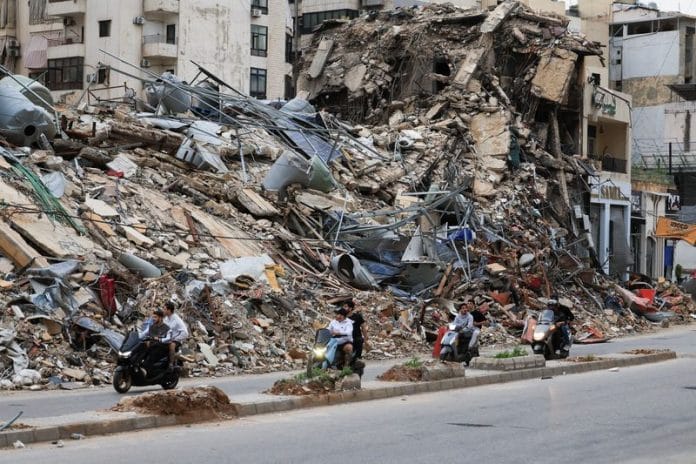
The U.S.-backed ceasefire between Israel and Lebanon appeared to be largely holding on Friday, despite Lebanese Army reports of some Israeli violations. Paramedics said an Israeli drone strike killed one person in southern Lebanon.
The conflict was reignited on March 2 when Hezbollah opened fire on Israel in support of Iran, prompting an Israeli offensive that authorities say has killed nearly 2,300 people.
(Reporting by Reuters bureaus; Writing by Andy Sullivan, Sharon Singleton, Ros Russell and Jonathan Allen; Editing by Alex Richardson, Andrew Heavens, Nia Williams and Alistair Bell)
Disclaimer: This report is auto generated from the Reuters news service. ThePrint holds no responsibility for its content.