



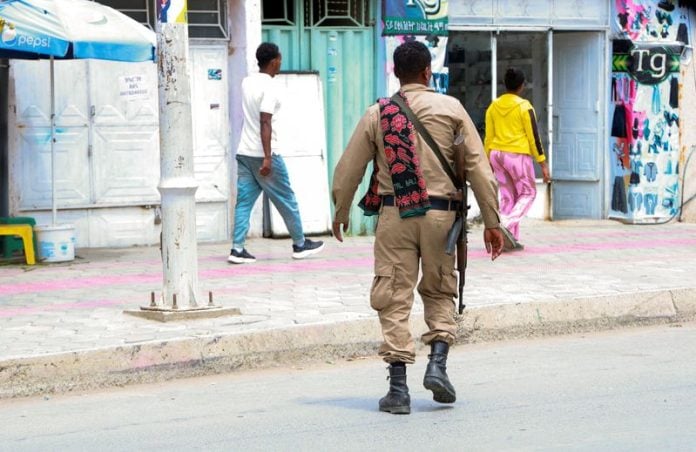
Sept 25 (Reuters) – Internet and phone networks were disrupted in the northern Ethiopian region of Tigray on Friday, after fighting broke out this week between the federal military and Tigrayan forces in the most serious escalation of violence since a 2020-2022 war.
Four people with knowledge of the matter, including a diplomatic source, told Reuters that Tigray’s ruling party, the Tigray People’s Liberation Front, had ordered private operator Safaricom and state-owned Ethio telecom to cut off access to phone and internet networks in the region.
One of the sources had earlier said TPLF restrictions on mobile communications may be part of a tactic to neutralise government forces’ advantage in using battlefield drones, by preventing them from accessing the mobile network.
The TPLF did not respond to a request for comment. A source close to the group, speaking on condition of anonymity, denied it was responsible and blamed the government.
Calls and messages by Reuters reporters to numbers on Ethio telecom’s network were not going through on Friday, while there was limited connectivity to Safaricom customers. NetBlocks, a monitor that reports internet outages, confirmed the internet was disrupted in the area.
Spokespeople for Prime Minister Abiy Ahmed’s office, Ethio telecom and Safaricom’s Ethiopian subsidiary did not immediately respond to requests for comment.
The shutdown has sparked fears of a return to the dire conditions experienced by people in Tigray during the 2020-2022 war when the federal government severed communications, and access to food, cash and medicines was severely restricted, pushing hundreds of thousands of people into famine-like conditions.
The fighting this week prompted people to rush to shops to stock up on basic supplies and withdraw cash, with residents telling Reuters shelves were being emptied from panic-buying.
Tigrayan forces and their allies seized three local airports and launched attacks against federal troops in Afar and Amhara in what they called a defensive war to counter aggression by Abiy’s government. The federal government has accused Eritrea of financially backing the TPLF and its allies, which Asmara denies.
Renewed war could further destabilize a region already unsettled by deteriorating ties between Ethiopia and Eritrea, Sudan’s civil war, frictions over Red Sea access and spillover from Middle East conflicts.
The United Nations and the European Union have called for restraint and a return to an African Union-brokered peace process that had ended a conflict that killed hundreds of thousands of people.
‘BLACKOUT’
Tigray residents told Reuters that Ethio telecom had stopped working late on Thursday, cutting off access to crucial mobile money transfer services.
“Even Safaricom doesn’t work in all places… you have to move from place to place to get connectivity,” a resident of the regional capital Mekelle told Reuters.
Some residents also said they had witnessed people being forced to join the war effort.
“Currently, TPLF fighters are still going house to house in search of youths. I am hiding in the house and I didn’t go to work,” a resident of Maichew town told Reuters.
Earlier this month, a risk advisory note shared with diplomats and reviewed by Reuters said that the TPLF had taken steps to disrupt telecommunications services in Tigray by removing Ethio telecom transformers in several towns.
Drones provide a major battlefield advantage for the Ethiopian military against the TPLF, which is not known to have deployed them. The military has large stocks of imported and domestically manufactured drones that it has been using to attack targets in Tigray since last month, according to the non-profit Armed Conflict Location & Event Data project.
Fears are also growing for the UNESCO-listed rock-hewn churches in the holy town of Lalibela in Amhara, with flights to the town’s airport suspended on Thursday due to fighting nearby.
(Reporting by Ammu Kannampilly, Aaron Ross and Giulia Paravicini; Writing by Elias Biryabarema; Editing by Clarence Fernandez, Christian Schmollinger, Peter Graff)
Disclaimer: This report is auto generated from the Reuters news service. ThePrint holds no responsibility for its content.