






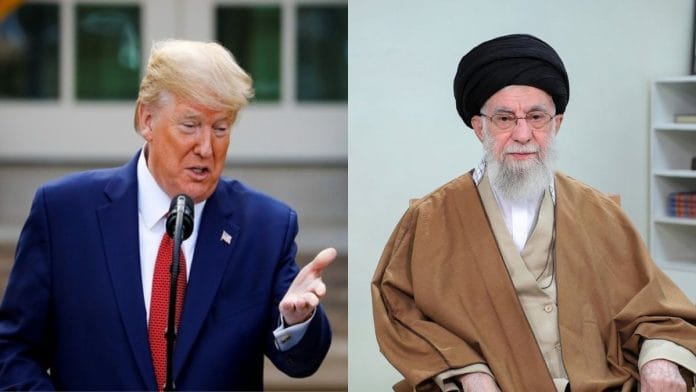



How much does Donald Trump know about about Iran, the country he is threatening to strike for the second time in a year? I don’t ask this to take a cheap shot at the president, but because a lack of basic understanding about complex societies in the Middle East has bedeviled US decision makers right back to the 1979 fall of the Shah, if not before.
Asking what the White House knows is natural, too, given the scattershot comments from Trump about his reasons for sending a carrier fleet to the Gulf, and his demands not to deploy those forces. So far these have included: Stop killing protesters, surrender the nation’s nuclear program, shrink your ballistic missile program and end support for Tehran’s network of proxies across the region.
The Iranian regime is clearly confused, as are most of us. Responses from Ayatollah Ali Khamenei and his officials have ranged from let’s talk (about nuclear) to forget about it (ballistic missiles and proxies), and make my day — we will unload everything we have on you and your allies. Negotiators for the two sides are due to meet in Istanbul on Friday.
That confusion is a mark of US success only if Trump is conducting a crazy-like-a-fox strategy in which the aim is to wrongfoot his opponent while a well-considered plan to reach a desired endgame — for example, changing the regime in Tehran — is underway. Distraction is this president’s forte. He can calculate, reasonably, that even if his political base dislikes foreign wars and his Gulf and Turkish allies worry about blowback, nobody complains about short and glorious victories once they’re delivered. The problem is that such triumphs are rare; even if achieved, the US would need a lot of knowledge to manage the inevitable fallout.
This isn’t just about the intelligence necessary for a successful operation. Israel has penetrated Iranian security elites to an extraordinary degree, so that threshold almost certainly has been met. But Israel’s interests are not necessarily those of the US, and forcing the collapse of a regime, no matter how monstrous, is messy.
Israel’s Prime Minister Benjamin Netanyahu has been unusually quiet about the US military build-up in the Gulf. He seems to have gently opposed any symbolic American strike when Trump threatened action at the height of last month’s protests, before the president had deployed the forces needed to do more. But Israel’s hesitation was probably because it didn’t want to risk serious retaliation against its cities without achieving the longer-term security rewards of destroying the Islamic Republic. Netanyahu was holding out for a bigger strike capable of delivering the prize — and for that he’d be willing to risk significant missile strikes on Tel Aviv, a wider regional conflict or chaos in Iran.
This might work for Israel, which sees Tehran’s threat as existential, but the US isn’t in that position. Nor is Turkey, which worries about refugees flooding over its border, or the Gulf States, which fret that Iran might attack their oil infrastructure. These countries need a stable end-state for the whole region, and achieving that requires a deeper understanding of how the Islamic Revolutionary Guard Corps, Iran’s political leadership and its citizens would react to further air strikes. In these areas, the US has a history of not knowing enough.
Jimmy Carter famously hosted the Shah on New Year’s Eve 1977, just days before the start of protests that would topple him. The then-US president toasted his guest for leading “an Island of stability” in a turbulent region. Carter did so because he was being told — and went on being told until nearly the end — that the Shah’s rule was safe, and that Ayatollah Ruhollah Khomeini and the role of religion in Iran were unimportant. The Central Intelligence Agency didn’t even know the Shah was sick with cancer — and this despite a huge US presence in the country at the time.
I’d like to think that lesson was learned. The US hasn’t had an embassy in Iran since the hostage crisis and is painfully aware of its reliance on others for information and analysis. So it has set up various efforts to compensate over the years, including virtual embassies and the appointment of so-called Iran Watchers, located in spots outside Iran such as the United Arab Emirates. But the US record in Afghanistan and Iraq suggests it still lacks the humility to recognize what it doesn’t know.
If the Trump administration has a clear outcome in mind, it has to be thinking about how even an extended bombing campaign can split the regime from its security forces and so topple Khamenei. Then it needs to know how to ensure what follows makes the country less, not more, of a threat. That’s not a given should Khamenei be deposed by a more effective leader from the IRGC. China and Russia also have to acquiesce, rather than act to make Trump pay a high price. And there can be no descent into Syria- or Libya-style disorder in an ethnically fissured nation of more than 90 million people.
Unfortunately, one possible explanation for the erratic nature of Trump’s statements on Iran is that he doesn’t have a defined endgame, or a well-considered plan for reaching it. After last year’s joint airstrikes with Israel and the successful US rendition of Venezuelan President Nicolas Maduro from Caracas, he has unprecedented leverage that won’t last forever; he may just want to use it while he has it to get what he can.
From what Trump told a Fox News reporter at the weekend, that may well be the case. Asked what his plans were for Iran, he said he couldn’t make those public, but that: “Look, the plan is that [Iran is] talking to us, and we’ll see if we can do something.”
Or, to put that more crudely, Trump has found himself holding Thor’s hammer in the form of US military prowess and he’s in search of nails. The question is whether the kind of face-saving nuclear deal Khamenei’s envoys might be willing to make will satisfy the US president, or whether — having committed this much firepower to the region — he sets the bar too high and has to pull the trigger, without worrying about what comes next.