









Europe has been through many ages in its busy history: the age of discovery, the age of reason, the age of expansion, the age of destruction, and the age of unification. Now it is entering a new one: the age of humiliation.
Europe’s tussle with Donald Trump over whether the US can forcibly buy Greenland from Denmark may be surreal. But it fits a broader pattern. The US (or China) acts. Europe reacts. The US (or China) moves decisively. The EU debates and dithers. This week Europe’s elite went into paroxysms over Trump’s threats to use force or tariffs to gain control of Greenland only for Trump to perform a pirouette and claim that he had made a deal with NATO’s secretary general, Mark Rutte, a deal that had, in fact, been on the table for some time. The storm has now blown over until Trump fixates on something else — or decides that the Greenland deal is a rip-off — and Europe has to respond to external provocation once again.
From the 15th century onward, Europe was the primary force in human history — sometimes for good (the Renaissance and the liberal ideal), sometimes for evil (Nazism and Communism) but always with world-changing consequences. Europeans invented the defining technologies of the modern age, from the printing press to the steam engine, as well as the defining political ideas.
Europeans imposed their will on the rest of the world through imperialism and colonization, exporting more than 60 million people from 1600 to 1950 and littering the globe with places such as New Spain, New England, New France, New Caledonia, New Amsterdam. Two-thirds of the current members of the United Nations belonged to European empires at one stage of their history.
Yet for all its gunboat diplomacy, Europe triumphed by attraction as well as compulsion. The colonies adopted European (mainly British) sports such as golf, tennis, cricket and football. Ataturk ordered Turks to abandon the fez in favor of the European-style hat. Jawaharlal Nehru modeled the newly independent India’s parliament on Britain’s, even down to the detail of having a Speaker.
Europe all but destroyed itself in the two most devastating wars in modern history — wars that started in the heart of Europe but spread to the world. Yet when the dust cleared Europe remained at the heart of the great contest between capitalism and communism. Europe also engaged in a history-defining form of self-cleansing, creating a new type of politics and a new type of society: a post-national state and a mixed economy that provided all its citizens with generous benefits and holidays. In 2005, Mark Leonard summed up the exultant mood after the creation of the Euro in his book Why Europe Will Run the 21st Century.
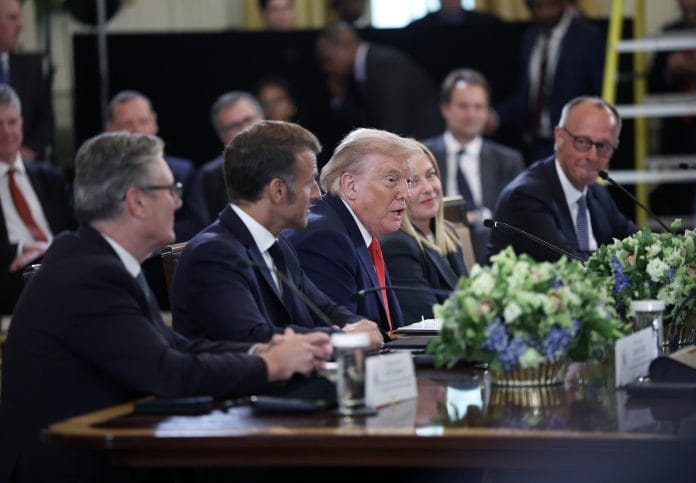
We can kiss goodbye to all that: Europeans are now clearly a history taker rather than a history maker. The lead actor of world affairs for five centuries has been reduced to a mere bystander, a key dynamo of historical change transformed into a potted plant.
European leaders have belatedly woken up to the extent of their impotence. Eurocrats argue that they must earn a seat at the table to avoid becoming part of the menu. Emmanuel Macron worries that Europe must reform or die. In a searing 2024 report Mario Draghi, a former head of the European Central Bank, said that, without radical change, “we will inexorably become less prosperous, less equal, less secure and, as a result, less free to choose our destiny.” But the truth is that the chances of bold reforms may already have gone.
Europe’s political leadership is either unimpressive (Friedrich Merz) or exhausted (Macron) or both (Keir Starmer). The last leader to have any chance of pushing through major reforms, Angela Merkel, wasted her 16 years in power pursuing one of the most misguided policies in recent decades — importing cheap energy from Russia in order to sell manufactured goods, particularly machine tools, to China. Today politics is paralyzed: The European Commission is a zombie bureaucracy, the center is fragmenting and a populist right is on the march everywhere, with the French National Rally at about 33% in the polls and the even more hardline Alternative for Germany at 25%.
Europe’s share of global GDP has shrunk from more than 30% in 1995 to less than 20% today. Only four of the world’s top 50 tech companies are European — and there is little chance of that changing: From 2008 to 2021, close to 30% of European “unicorns” (startups that went on to be valued over $1 billion) relocated their headquarters abroad, the vast majority of them in the US. Even the old-fashioned industries that dominate the European economy and R&D funding are suffering: European electricity prices are two to three times higher than prices in the US and China, and a new generation of cheap Chinese electric vehicles is poised to devastate Europe’s biggest manufacturing industry, car-making.
Economic stagnation is undermining Europe’s two remaining claims to history-making: its standard of living and its intellectual firepower. On a per capita basis, real disposable income has grown almost twice as much in the US since 2000 as in the EU. The 2026 QS World University Rankings puts only five European universities in the top thirty, and four of those are in England.
Europe has made a series of big bets that have gone spectacularly wrong. It bet on the benign nature of both Russia and China. Both turned out to be malign. It bet on freedom of movement — and then doubled down in 2016 when Angela Merkel welcomed close to 300,000 Syrian refugees. But the combination of high immigration and free movement drove the British to leave the European Union — marking the first time the organization has contracted since its foundation — and fueled the rise of populism.
Europe’s bet on the US being willing to stump up about two-thirds of the cost of NATO until Kingdom Come is unraveling. European politicians have been unusually bold in their denunciations of Trump in Davos this week. Macron warned about a “new colonial approach.” The Belgian prime minister, Bart De Wever, urged Europeans to defend their “self-respect.” But what could Europe have done if Trump had not performed his pirouette? Could strong words really have been turned into strong actions? Europeans have more to lose from the breakdown of NATO than America does, just as they have more to lose from a tariff war.
Europe’s other big bet, on the durability of the free market, is also going south. The European economy is the most open to the world — its trade to GDP ratio exceeds 50% compared with 37% in China and 27% in the US. It is also the most exposed to international headwinds: Europe sources about 40% of its imports from a handful of suppliers; about half of those imports originate from potentially hostile nations (and that does not include the US). With protectionism on the rise, mercantilism a la mode, Trump wildly swinging his tariff axe and conflagrations breaking out all over the place, Europe is horribly exposed.
Driving all these bets was the desire for the easiest option. The Europeans have habitually either argued that there are no difficult tradeoffs (between greenery or growth, for example) or else punted tough decisions (like paying for defense) into the indefinite future. No one is loathed more in the EU than Boris Johnson. But Johnson’s slogan of having your cake and eating it defines Europe’s weakness.
The sidelining of Europe is a tragedy. Europe embraces a collection of principles — global cooperation, liberal universalism and calm decision-making — that the world sorely needs. Yet Europe has brought upon itself a tragedy by underinvesting in hard power and allowing generous feelings to crush economic dynamism. The chances of a continent of political homunculi miraculously producing a new generation of de Gaulles or Churchills are slim.
The historian A.J.P. Taylor once said that Europe had produced more history than it could consume and was therefore bound to export it abroad. Today Europe seems doomed to produce less history than it can consume and watch idly by as more vigorous nations shape the future.
This column reflects the personal views of the author and does not necessarily reflect the opinion of the editorial board or Bloomberg LP and its owners.
Adrian Wooldridge is the global business columnist for Bloomberg Opinion. A former writer at the Economist, he is author of “The Aristocracy of Talent: How Meritocracy Made the Modern World.”
Disclaimer: This report is auto generated from the Bloomberg news service. ThePrint holds no responsibility for its content.
Also read: 17th-century India was an Eldorado for the French—Taj Mahal, jewel mines, unimaginable wealth