






By Miranda Murray
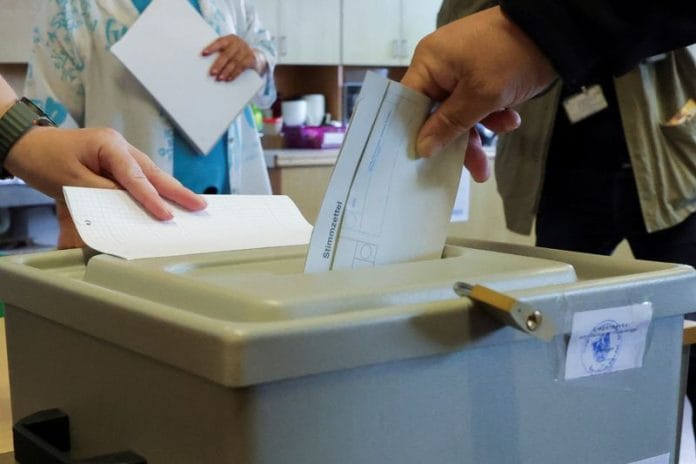
BERLIN, Sept 6 (Reuters) – Voting began in the eastern German state of Saxony-Anhalt on Sunday in a closely watched election that could see the Alternative for Germany (AfD) become the first far-right party to lead a state government since World War Two.
Under its 35-year-old lead candidate Ulrich Siegmund, the AfD has polled above 40% for months and has a realistic shot at winning an absolute majority if several smaller parties fail to clear Germany’s 5% hurdle to enter parliament.
The exact percentage that would constitute an absolute majority will depend on how many parties overcome that hurdle, but Siegmund has said his aim is to reach 45% or more of the vote.
The vote is seen as a barometer for the government of Chancellor Friedrich Merz, who has attempted to chip away at the AfD’s popularity by taking a tougher line on migration and security.
About 1.7 million voters have until 6 p.m. (1600 GMT) to cast their ballot before polls close, with initial results expected shortly after.
Turnout was running well above the level seen at the previous state election in 2021, with 34.72% of eligible voters having cast their ballots by noon, compared with 22.4% previously, the state election commissioner said.
Recent surveys place the AfD at just over 40%, followed by Merz’s Christian Democrats (CDU) at 23%.
An outright majority would allow the party to sidestep Germany’s political “firewall”, under which mainstream parties refuse to govern with it.
Achieving an absolute majority is a high bar to clear in Germany’s proportional electoral system, which was designed in part to encourage coalition governments and make it difficult for one party to rule alone.
If the AfD falls short, a CDU-led administration under incumbent state premier Sven Schulze is the most likely outcome, though much will depend on which smaller parties make it into parliament.
The state’s constitution requires the newly elected parliament to convene within 30 days of the vote, by October 6 at the latest, but there is no deadline for electing a new state premier.
AFD ‘CAN NO LONGER BE STOPPED’
For the AfD, Saxony-Anhalt is a test run for its larger ambitions of securing national power in the next federal election set for 2029.
“No matter the outcome of tomorrow’s election, we have already made history,” said Siegmund at a final rally on Saturday evening.
“Because what we have started here in Saxony-Anhalt — that is currently sweeping across all of Germany — can no longer be stopped,” he told the crowd in the state capital, Magdeburg.
If elected, the AfD plans to push schools and cultural institutions towards more traditional values, curb immigration and overhaul public broadcasting.
However, without an absolute majority, the AfD, which has been classified as “far-right extremist” by the state security service, would struggle to enter government due to the firewall.
Siegmund, who arrived to cast his vote in his hometown of Tangermuende on a blue Simson moped, greeted by throngs of excited fans, has ruled out coalition talks with other parties.
Falling short of that opens the prospect of complex coalition negotiations among the other parties.
Polls suggest one of the CDU’s current coalition partners, the Free Democratic Party, will fail to enter parliament, while the other, the Social Democratic Party (SPD), is under 10%.
The small left-wing populist Sahra Wagenknecht Alliance (BSW), the only party not to rule out a coalition with the AfD, risks missing out as well.
That could leave Schulze, who is favoured in polls as voters’ top choice for leader, scrambling for a viable majority.
One option could be a minority government led by Schulze that would depend on passive tolerance from the Left Party — a model used in the neighbouring eastern German state of Thuringia.
Schulze, casting his vote in Magdeburg with far fewer crowds, said he hoped for a high turnout after what he described as a physically and mentally demanding election campaign.
(Reporting by Miranda Murray, Editing by Franklin Paul and Sharon Singleton)
Disclaimer: This report is auto generated from the Reuters news service. ThePrint holds no responsibility for its content.