



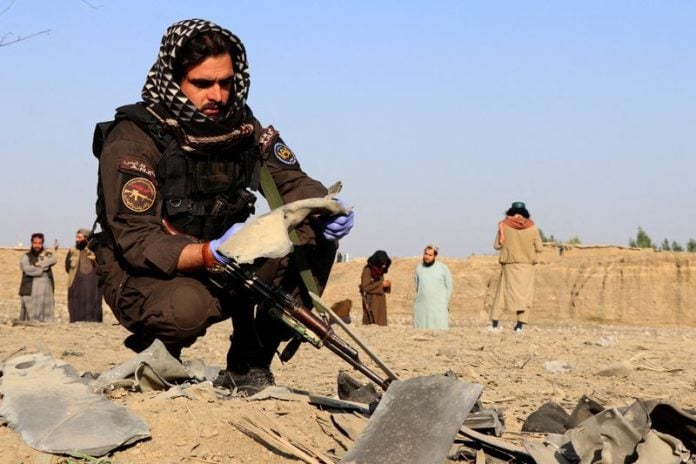
By Asif Shahzad
ISLAMABAD, Sept 24 (Reuters) – Pakistan’s air force struck 10 locations in Afghanistan on Thursday, its second round of strikes in four days after three months of relative quiet along the two countries’ 2,600-km (1,600-mile) border.
Islamabad said it struck militant hideouts in retaliation for drones launched from Afghanistan. Kabul denied sending the drones and said the seven Afghan fatalities in strikes this week were all civilians.
Here is what is driving the latest escalation, and why previous attempts to contain it have failed.
WHY HAVE THE FORMER ALLIES TURNED ON EACH OTHER?
Islamabad initially viewed the Taliban government as a potential ally when it returned to power in Afghanistan in 2021. Then-Prime Minister Imran Khan applauded the Taliban’s return, saying Afghans had “broken the shackles of slavery.”
Pakistani frustration soon mounted, however, as militants launched widening insurgencies in Pakistan’s southwest and northwest.
Pakistan has since accused its archrival India and the Taliban-run government in Kabul of providing the militants with funds and weapons as well as a safe haven in Afghanistan. The Afghan Taliban and the Indian government deny these allegations.
Frustration in Islamabad spilled into cross-border fighting last year when Pakistan carried out an air strike on the Afghan capital Kabul in October, targeting the head of the Pakistani Taliban militant group, Pakistani security officials said at the time.
The Pakistani Taliban, a group that operates separately from the Afghan Taliban that run the government in Kabul, later said their leader survived the strike.
Pakistan has also accused the Afghan Taliban of hosting Baloch insurgents, a secular armed movement seeking independence for the southwestern province of Balochistan.
HOW DID PRIOR ESCALATION SPIRALS END?
A first ceasefire, signed in Doha in October, soon faltered. Clashes reached a peak in intensity this spring when hundreds were killed in shelling and air strikes.
In the deadliest incident, more than 400 people were killed in one of the Pakistani air strikes on Kabul, which the Afghan Taliban said hit a drug rehabilitation centre. Islamabad defended the strikes as having “precisely targeted military installations and terrorist support infrastructure.”
Chinese-mediated talks produced a ceasefire in March that quelled the fighting but again postponed a resolution of the underlying dispute.
WHAT TRIGGERED THE LATEST ESCALATION?
Nearly three months of relative quiet ended last week with two major militant attacks in northwestern Pakistan, killing at least 30 people, including 15 police officials and 6 soldiers.
At least 8 militants, including suicide bombers, killed 24 people, including 15 police officials, at a police facility in northwestern Kohat district last Friday. An Islamist militant group – Shura Ittehad-ul-Mujahideen led by militant commander Hafiz Gul Bahadur – claimed the attack.
Two days later, on Sunday, an exchange of fire with militants killed 4 soldiers and 2 officers in adjacent Hangu district.
WHAT ARE THE MAIN MILITANT GROUPS IN THE NORTHWEST?
Pakistan’s widening insurgencies are waged by competing groups with different support bases and ideologies but a common enemy in the Pakistani state.
Most recent attacks by militants in northwestern Pakistan have been attributed to Tehreek-e-Taliban Pakistan (TTP), commonly known as the Pakistani Taliban.
It was formed in 2007 by a group of Islamist outfits from the Pashtun ethnic group operating in northwestern Pakistan, which borders Afghanistan.
The TTP was modelled on the Afghan Taliban, the predominantly ethnic Pashtun movement that conquered Afghanistan in the 1990s before being ousted by a US-led invasion in 2001.
TTP fighters also fought alongside the Afghan Taliban in Afghanistan and sheltered Afghan fighters in Pakistan, forging a close bond over the Afghan Taliban’s 20-year insurgency.
Pakistan mounted a series of military operations against the TTP on its own soil, with limited success.
In recent years, the group’s attacks have primarily targeted Pakistani security forces rather than civilians, allowing it to make inroads into local communities.
The leader of the Shura Ittehad-ul-Mujahideen group that claimed responsibility for last week’s attack in Kohat – Hafiz Gul Bahadur – once hosted al Qaeda and Arab Islamist fighters in the bordering region, said Abdul Basit, an analyst at Singapore’s S. Rajaratnam School of International Studies.
The group initially focused attacks on US and NATO forces in Afghanistan, but turned against Pakistan after its military conducted a major offensive around 2015 targeting a safe haven of the group in North Waziristan district, Basit said. That pushed the group’s fighters into Afghanistan.
The long-term repercussions of that shift are still playing out today, said Basit, as Bahadur’s group has become “an umbrella of different militant groups where al Qaeda is the architect and Gul Bahadur is the face.”
(Reporting by Asif Shahzad; Editing by Rick Noack)
Disclaimer: This report is auto generated from the Reuters news service. ThePrint holds no responsibility for its content.