







By Leila Miller and Maximilian Heath
BUENOS AIRES, May 21 (Reuters) – U.S. House Foreign Affairs Committee Chairman Rep. Brian Mast has warned U.S. Secretary of State Marco Rubio of “Chinese malign influence” in a bid for a major contract in Argentina, according to a letter seen by Reuters.
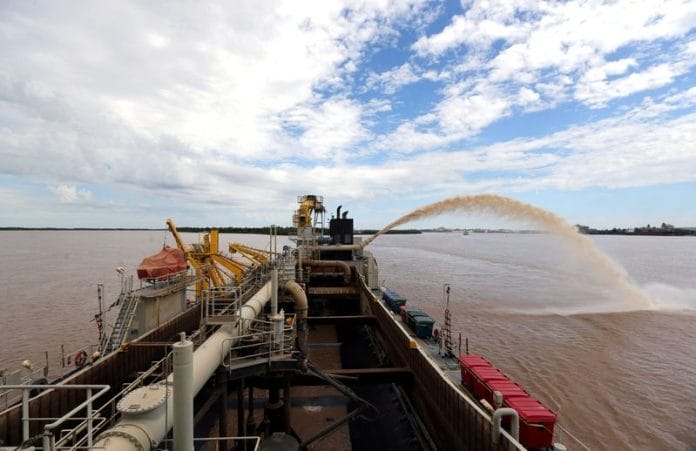
The April 23 letter concerns an auction for a 25-year contract to dredge and operate Argentina’s Parana River, a vital waterway for most of the country’s agricultural exports, that Argentina estimates will reach $10 billion in investment.
The terms of the tender, which is in its final phase with a decision expected in the coming days, explicitly barred state-owned companies, preventing bids from Chinese firms.
But Mast alleged that China was attempting “to circumvent that choice through a private sector proxy.” There is “serious concern” that Jan De Nul, a Belgian dredging company vying for the contract, “maintains deep and ongoing links to PRC state-owned entities” through Servimagnus, an Argentine firm that’s part of Jan De Nul’s consortium, the letter claimed.
Jan De Nul has managed the Parana waterway for decades and is competing for the contract against the Deme Group, whose consortium includes investment firm KKR & Co and U.S.-based Great Lakes Dredge & Dock Corp. In the bid’s point-score system, Jan De Nul has been ahead.
The Trump administration, a close ally of Argentina’s President Javier Milei, has expressed concern about Chinese influence in Latin America, including Argentina, where Beijing in March was its second-largest trading partner.
Awarding the contract to Jan De Nul “would be unacceptable and damaging to Argentina’s national security, America’s national security and our bilateral relationship,” the letter said.
China’s foreign ministry did not immediately respond to requests for comment.
In response to Reuters’ questions, Jan De Nul and Servimagnus called the claims of ties between the companies and Chinese capital during the bidding process “absolutely false and malicious,” and said that “there is no participation by Chinese companies, either as partners or as suppliers.”
Last Tuesday, Argentina’s National Ports and Navigation Agency celebrated the culmination of the bid, calling it a process that had seen “strong multisectorial support.” In a statement, the agency said that the company and Deme have had partnerships with Chinese companies but “this is not grounds for disqualification.”
U.S. LOBBYING
About 80% of Argentina’s agricultural and agro-industrial exports leave the country via the Parana River, flowing from the Rosario agro-industrial hub and surrounding areas to the South Atlantic Ocean.
Deme’s consortium was approved by the U.S. Department of Commerce’s Advocacy Center, which helps companies pursuing foreign contracts, according to a person in contact with the consortium who requested anonymity.
The lobbying effort resulted in Milei adviser Santiago Caputo flying last week to D.C. to meet with officials, including Mast, Michael Jensen, senior director for Western Hemisphere affairs on the National Security Council, and Alec Oxenford, Argentina’s ambassador to the U.S.
Caputo was told that the U.S. had “grave concerns” about Chinese involvement in the bid, according to a person familiar with the visit. The person said the concerns stemmed partly from allegations of frequent contact between the Chinese embassy and Servimagnus’ office in Argentina.
The consortium, in a May 11 letter addressed to Jensen seen by Reuters, has also alleged “clear bias” against U.S.-backed investment, saying that the timeline for companies to present a technical offer was rushed and had benefited Jan De Nul.
Argentina’s anti-corruption prosecutors’ office has also signaled concern about “serious and obvious” procedural irregularities in the bidding process.
(Reporting by Leila Miller and Maximilian Heath; Editing by Christian Plumb and Nick Zieminski)
Disclaimer: This report is auto generated from the Reuters news service. ThePrint holds no responsibility for its content.