





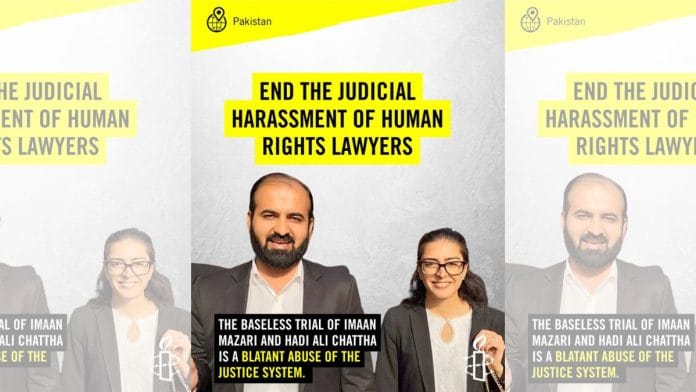



New Delhi: The European Union spokesperson for Foreign Affairs and Security Policy, Anouar El Anouni, condemned the sentencing of Pakistani human rights lawyers Imaan Zainab Mazari and Hadi Ali Chattha for allegedly posting content on social media that authorities said ‘threatened’ Pakistan’s state interests and security.
The two were served a jail term of 17 years by an Islamabad sessions court under the Prevention of Electronic Crimes Act (PECA).
Judge Afzal Majoka ruled that the posts supported the agenda of Pakistan Tehreek-e-Insaf (PTI), a party that has been proscribed.
El Anouni posted on X that the conviction over social media activity “goes against freedom of expression and the independence of lawyers”.
“These are not only key democratic principles, but also part of international human rights commitments,” he wrote.
#Pakistan: The conviction of human rights lawyers Imaan Mazari and Hadi Ali Chattha over social media activity goes against freedom of expression and independence of lawyers. These are not only key democratic principles but also part of 🇵🇰 international human rights commitments.
— Anouar El Anouni 🇪🇺 (@AnouarEUspox) January 28, 2026
Amnesty International called the verdict “the latest escalation in a sustained campaign of judicial harassment and intimidation by Pakistani authorities”.
PAKISTAN: Today’s arrest of human rights lawyers Imaan Mazari-Hazir and Hadi Ali is the latest escalation in a sustained campaign of judicial harassment and intimidation by the Pakistani authorities.
Imaan and Hadi were arrested today while on their way to a court hearing and… https://t.co/5OHCuo9qZQ
— Amnesty International South Asia, Regional Office (@amnestysasia) January 23, 2026
A joint statement by the International Bar Association, Lawyers for Lawyers and the Law Society of England and Wales criticised the Pakistani military’s role, saying the proceedings were intended to obstruct the lawyers’ work and punish them for exercising free expression.
Mazari and Chattha represented victims of enforced disappearances, extrajudicial killings, arbitrary arrests and custodial abuse, and frequently challenge military, police and intelligence agencies.
The charges
The court found the defendants had glorified Mahrang Baloch, a Baloch human rights activist born who leads the Baloch Yakjehti Committee (BYC) and campaigns against alleged enforced disappearances and other abuses in Balochistan, by praising her ‘victory sign’, and rallying support for her and other jailed BYC leaders.
Pakistani authorities have alleged the organisation acts as a “proxy” for terrorist and criminal smuggling groups. Baloch is listed in the Fourth Schedule of the Anti-Terrorism Act, a proscription that can trigger measures such as a passport embargo, freezing of bank accounts, bans on financial support and credit, arms-licence embargoes and employment-clearance restrictions.
The court said the defendants’ actions breached Section 9 of PECA, which bans ‘glorification of an offence’ and carries a maximum sentence of seven years’ imprisonment.
The court also held that calling Pakistan a “terrorist state” and criticising state institutions for human rights violations contravened Section 10 on cyber-terrorism, which carries a maximum penalty of 10 years.
In addition, the pair were charged under Section 26-A for allegedly “spreading false information likely to cause fear”, including claims about Mahrang Baloch’s alleged unlawful detention and the forced disappearance of Ghazi Amahullah, an Afghan king, for an offence punishable by up to two years’ imprisonment.
Also Read: Pakistan se azaadi. Grow up India, stop giving it prime real estate in your psyche