



By Julia Payne, Lili Bayer and John Irish
BRUSSELS, Sept 23 (Reuters) – The European Union faced a growing backlash on Wednesday for lifting sanctions on two Russian billionaires, with some of its members saying the move undermined a pillar of support for Ukraine’s war effort and that it signalled the bloc would bow to blackmail.
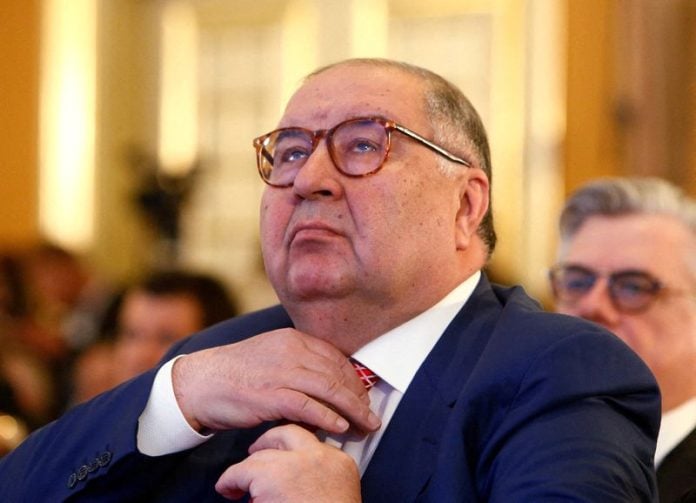
Following pressure from France and despite pleas by Ukraine, the EU agreed on Tuesday to end asset freezes and travel bans on Russian-Uzbek metals tycoon Alisher Usmanov and Mikhail Fridman, co-founder of one of Russia’s biggest conglomerates.
France privately told partners that Azerbaijan was using Usmanov’s sanctions case to pressure Paris over two French citizens held there, three diplomats told Reuters.
Azerbaijani President Ilham Aliyev on Wednesday pardoned a French national jailed for espionage, a move that Paris said was a “humanitarian gesture”.
France’s push to lift sanctions on Usmanov prompted Luxembourg to demand the same treatment for Fridman, who has launched a $16-billion claim against it for freezing his assets.
‘ONE HELLUVA PANDORA’S BOX’
Bill Browder, a British financier and opponent of Russian President Vladimir Putin, said “every sanctioned Russian oligarch” would now start working with “tinpot dictatorships around the world” to gain leverage to get sanctions lifted.
“France just opened one helluva Pandora’s box,” he posted on X.
Other governments felt they had little choice but to accept France’s demand, which Paris linked to national security, in return for the renewal of Russia-related sanctions on about 3,000 other people and organisations for the next three years, diplomats said.
Diplomats from multiple countries said they hoped the long renewal period would prevent others making a similar push any time soon. France was able to push through its demand partly because the sanctions were about to expire.
Within the EU, some of the most strident criticism came from the Baltic states. Latvia initially blocked the move before agreeing to abstain.
Estonian Foreign Minister Margus Tsahkna told Reuters during the UN General Assembly in New York that the move sent a “very bad signal at a wrong time, when Russia is actually putting more pressure on Ukraine”.
EU diplomats, speaking on condition of anonymity to discuss internal discussions, said discontent about the move was widely shared across the 27-nation bloc.
“This is certainly not a glorious moment,” one said.
UKRAINE QUESTIONS EU MOVE
Vladyslav Vlasiuk, Ukrainian President Volodymyr Zelenskiy’s commissioner for sanctions policy, said he was shocked to discover the EU was moving to lift sanctions on the two billionaires.
“I couldn’t really believe it. I didn’t really see it coming,” he said.
He welcomed the three-year rollover but asked: “Is it really worth (it) to de-list two names of this kind of magnitude?”
Asked about the move at a press briefing in Brussels on Wednesday, EU foreign policy spokesperson Christian Wigand underlined the renewal decision and said the bloc would keep applying more sanctions.
“We adopted 21 packages of sanctions. And in parallel, we are also working on a new set of sanctions,” Wigand said.
He said the EU wanted to increase pressure on Russia’s military industrial complex and its “shadow fleet” of tankers shipping oil and gas.
The EU’s foreign policy arm has proposed about 1,600 additions to the sanctions list. Some diplomats voiced hope that EU member states would swiftly approve the additions, to show the bloc remained committed to sanctions.
Some diplomats questioned France’s explanations for pushing to remove sanctions on Usmanov. French officials often seemed uneasy when defending their stance and when asked by reporters whether the Azerbaijan cases were the real reason for the move.
One senior European official said Paris had lost a lot of credibility, which could make it harder to push initiatives inside the EU as Emmanuel Macron enters his last few months as French president.
Guntram Wolff, a senior fellow at Brussels think tank Bruegel, said the move would not have a major impact on the war in Ukraine but sent “a very negative signal that the EU has been ready to make more or less dubious exemptions at a moment of political pressure”.
(Reporting by Julia Payne, Lili Bayer and Andrew Gray in Brussels and John Irish in New York, Writing by Andrew Gray, Editing by Timothy Heritage)
Disclaimer: This report is auto generated from the Reuters news service. ThePrint holds no responsibility for its content.