






By Liz Lee
BEIJING, Aug 28 (Reuters) – Chinese authorities have assessed that risks from an overflowing lake formed after a glacier collapse that triggered catastrophic flooding on the China-Nepal border had become manageable by Friday afternoon, allowing suspended rescue operations to resume.
Nepal and China both warned on Thursday of fresh risks of flooding in the Himalayas, with a dam from debris leading to the formation of a lake that had been threatening to collapse.
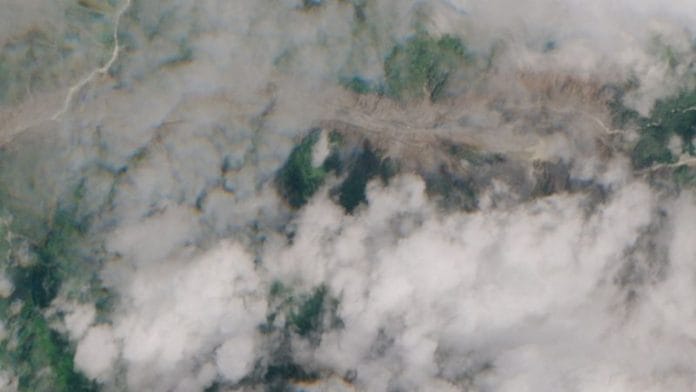
Reuters was able to identify the lake’s location, which straddles the border of both countries and lies upstream from the Gyirong border crossing, based on Nepali authorities and Chinese state media.
Wednesday’s flash flood devastated the border crossing, sweeping away people and vehicles, according to China’s CCTV.
China had been racing to reduce the risk of more flooding at the border crossing linking its Tibet region to Nepal, after hundreds were killed on Wednesday.
On Friday morning, the risk of the lake bursting and potential secondary disasters such as mountain collapses and avalanches prompted all Chinese rescue personnel and vehicles to withdraw to stand by in a safe area, state broadcaster CCTV said.
By noon, the risk posed was deemed manageable, allowing rescue operations to be continued and stepped up, CCTV reported.
The lake’s reservoir has topped 2.5 million cubic metres of water, up from the estimated 1.5-2 million cubic metres a Chinese eight-member engineering team dispatched to monitor the site recorded a day ago.
Authorities mobilised the engineering team to conduct aerial surveys and 3D modelling of the barrier lake on Thursday, according to another CCTV report.
One of the engineers, Chen Hanxiao, said challenges included difficult access to the site.
“After the glacier collapse created the lake, many isolated cliffs and steep cliffs appeared along its shoreline,” Chen told CCTV on Thursday evening.
The Gyirong border port area has seen light to moderate rainfall which has loosened and destabilised soil and rock surrounding the precarious zone upstream. The rain is forecast to continue over the coming week.
China on Thursday warned that 3 million cubic meters of water — the equivalent of about 1,200 Olympic swimming pools — were expected to flow into the still-dammed lake over the next three days, creating a high risk of a breach, with peak flow expected around September 1.
The formation of the lake was captured in aerial footage by a Chinese rescue team shown by state broadcaster CGTN. It showed masses of brown water accumulating in a basin with no visible outlet, that had already submerged bushes and trees and appeared to push against a barrier of debris and stones.
The official death toll on the Tibetan side rose to five while the number of people missing remain unchanged at 558.
Nearly 1,000 remain missing on both sides of the border, including as many as 540 foreigners from 31 countries, according to officials.
(Reporting by Liz Lee, Qiaoyi Li, Tiffany Le and Beijing newsroom; and Vinaya K in Bangalore; Editing by Lincoln Feast and Raju Gopalakrishnan)
Disclaimer: This report is auto generated from the Reuters news service. ThePrint holds no responsibility for its content.