



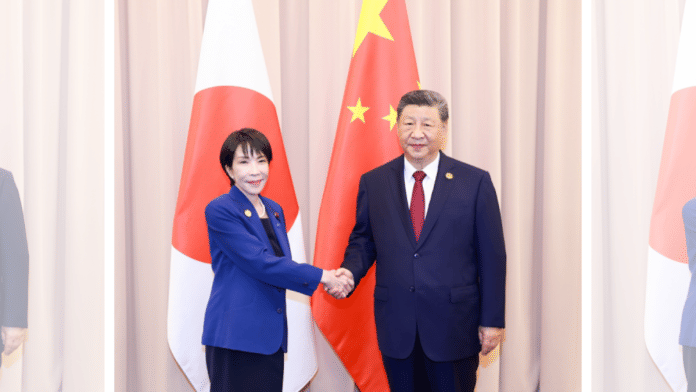
New Delhi: China Monday imposed stricter export restrictions on multiple Japanese companies and research institutions, in a continuation of Beijing’s ongoing economic coercion following Japan PM Sanae Takaichi’s statement on Taiwan last year.
Takaichi last year said that if China employs a naval blockade against Taiwan, it could become a “survival-threatening situation” for Japan, compelling it to mobilise its Self-Defense Forces, particularly if US forces intervening to protect Taiwan come under attack.
Beijing’s Commerce Ministry, Monday, added subsidiaries of Mitsubishi Heavy Industries and Mitsubishi Electric, along with several government-affiliated research organisations, including the National Institute for Defense Studies, to its export control list.
“Japan has stepped up its push for neo-militarism, accelerated remilitarization, deployed offensive weapons and launched offensive missiles outside its territory. In light of the above, China has decided to include relevant Japanese entities on the export control list and watch list in accordance with the Export Control Law and the regulations on export control of dual-use items and other relevant laws and regulations”, China said in a statement.
The designation bars Chinese companies from supplying the blacklisted entities with dual-use goods, that is, products with both civilian and military applications. This ban also prohibits foreign firms from re-exporting Chinese-origin dual-use items to them.
Dual-use products covered by the control laws include rare earth materials, industrial machine tools, batteries and semiconductor manufacturing equipment. The latest measures are part of Beijing’s widening use of trade restrictions as a foreign policy tool.
In a parallel move, the ministry placed another 20 Japanese companies and organisations on an export watchlist, subjecting future transactions involving sensitive technologies to heightened scrutiny. The list includes subsidiaries of Fujitsu, Hitachi, Komatsu, Mitsui E&S and drone maker Terra Drone, WSJ reported.
What is behind China’s restriction
Tensions between the two countries have steadily worsened since Takaichi’s comment last year. Beijing has repeatedly condemned the remarks, claiming they violate the spirit of Japan’s postwar pacifist constitution.
Takaichi has defended her position, arguing that Japan faces its most challenging security environment since World War II. Her government has expanded defence spending, eased restrictions on exports of lethal weapons and deepened security cooperation with allies amid growing concerns over China’s military activities in the East China Sea and around Taiwan.
The economic dispute has now broadened beyond export controls. The latest restrictions follow an earlier round of Chinese export controls imposed in February on Japanese defence contractors, including IHI and NEC.
In January this year, China banned exports of goods that could likely have military use to Japan. Other restrictions imposed by China include reduced commercial flights between the two countries and discouraging Chinese tourism to Japan.
Last week, Chinese authorities also announced the detention of two Japanese nationals without publicly disclosing the reasons, Financial Times reported.
Japan, meanwhile, has continued to protest China’s growing maritime presence near disputed waters. On Monday, Chief Cabinet Secretary Minoru Kihara accused China Coast Guard vessels of repeatedly entering Japan’s exclusive economic zone east of Taiwan and making what he called unilateral territorial claims. “Such activities by China are unacceptable to Japan,” he was quoted saying, adding that Tokyo had lodged repeated diplomatic protests.
Chinese and Russian warplanes also conducted joint exercises in the airspace near Japan, and Chinese ships reportedly sailed close to disputed islands near Taiwan, FT reported.
(Edited by Niyati Kothiyal)
Also read: Why China is upset with Indonesia over its new nickel mining rules