





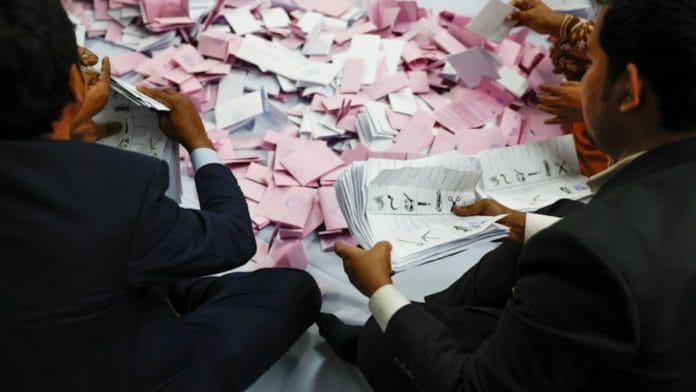



Bangladesh votes in the first parliamentary election to be held in the country since the ouster of former prime minister Sheikh Hasina.
Polls opened at 7.30 am and closed at 4.30 pm (local time). The counting of votes has begun.
Bangladesh’s Parliament (Jatiya Sangsad) has 350 members. Of the total 350 seats, 300 are filled through direct voting, while the remaining 50 seats—reserved for women—are filled through proportional representation. To form the government, a party or alliance must win at least 151 of the 300 seats filled through direct voting.
Stay tuned to ThePrint for the latest.
Bangladesh elections 2026 | LIVE UPDATES
9 pm: Early trends indicate 77% vote ‘yes’ for referendum
Early trends indicate that 77 percent of those who took part in the referendum voted in favour of adopting the July National Charter. What does the Charter say?
Read this report by Debdutta Chakraborty to know.
7.25 pm: Four jailed for ‘manipulating ballots’
At least four individuals have been jailed for allegedly manipulating ballots in three districts, The Daily Star reported.
It added that among those arrested was an office bearer of the Jatiya Subo Shakti. He was apprehended and handed over to the authorities by BNP supporters.
Also Read: Early voter turnout below 50% in Bangladesh. What it could mean for BNP, Jamaat
6.25 pm: Hasina thanks voters for ‘rejecting sham election’
Ousted prime minister Sheikh Hasina released a statement Thursday thanking the people of Bangladesh for “rejecting the sham election staged by the killer- fascist Yunus, who seized power illegally and unconstitutionally…”
The statement goes on to add that the “farce began through the capture of polling centers, gunfire, the widespread use of money to buy votes, stamping ballot papers, and taking agents’ signatures on result sheets”.
“Additionally, there have been observations that the number of voters on the voter list- especially in Dhaka- has increased abnormally, which is highly questionable and unbelievable,” the statement added.
On his part, Yunus hailed the election in a statement issued around 4.30 pm hailing the voter turnout. “The spontaneous participation of voters, the responsible conduct of political parties, the restraint shown by candidates, and the professionalism of all institutions involved in the electoral process collectively demonstrated that our commitment to democracy remains unwavering,” read the statement.,
6 pm: BNP, Jamaat-led alliance allege irregularities
BNP spokesperson Mahdi Amin in a statement says, “Since last night, we have witnessed violence, irregularities, and the use of black money in different areas in an attempt to make the election controversial.”
“We observed deliberate violations of the electoral code of conduct, aimed at discouraging voters through intimidation and keeping them away from polling centers. In many places, there were reports of pre-stamped ballots, fake voting, and allegations of votes cast in the names of deceased individuals. Many voters also complained that they were unable to cast their votes,” he added.
Amin also said there were “attempts to create local fake observers and mobs to obstruct voter participation”.
The BNP spokesperson went on to add that the party’s “victory is inevitable”.
The 11-party alliance led by Jamaat also alleged irregularities. Jamaat assistant secretary general Moazzem Hossain Helal told reporters that the alliance’s polling agents were expelled from 30 polling centres and that “bloody violence” had taken place in Noakhali-6, reported The Daily Star.
Also Read: BNP leader killed at Bangladesh polling station, party claims he was trying to stop fraud
5.30 pm: Bangladesh-US trade deal
Just days before polling day, the Bangladesh interim government and the US announced an agreement on reciprocal tariffs, which will see merchandise exports from Dhaka to America tariffed at 19 percent, while establishing a carve out textiles and apparels using American cotton.
“The US will further reduce the reciprocal tariff to 19 percent, which was originally set at 37 percent and later reduced to 20 percent in August last year. In addition, the US committed to establishing a mechanism for certain textile and apparel goods from Bangladesh using US produced cotton and man-made fiber to receive zero reciprocal tariff in the US market,” the Chief Adviser Muhammad Yunus’s office said Monday in a statement on X.
The agreement comes after nearly nine months of negotiations between Dhaka and Washington D.C., and once notified, may impact India’s largest exports to Bangladesh–cotton. In the 2024-2025 financial year, India exported $2.8 billion worth of cotton to Bangladesh, which was an 18 percent increase from the previous year.
The deal also comes amidst the ongoing restrictions imposed by both India and Bangladesh that have curtailed trade between both countries in the last year.
Read Keshav Padmanabhan’s report.
5.00 pm: Counting begins
Counting of votes is now underway after the conclusion of polling. Early trends are expected later tonight, with a clear picture Friday morning.
View this post on Instagram
4.20 pm: Oppn tried to take control of polling centres but we’re on ‘track to win’, says BNP’s Mahdi Amin
BNP spokesperson Mahdi Amin has said that the party is confident and “on track” to win the elections. In an exclusive interview with ThePrint’s Debdutta Chakraborty, Amin talked about the elections, alleged rigging and scattered incidents of violence that have been reported during the polling Thursday.
“People are voting after eight years so there is widespread hunger for free, fair and credible elections where it is peaceful and people can come without fear, and vote and choose their own representatives,” he said to a question on BNP’s expectation from the polls.
He added that while isolated incidents have been reported, the law enforcement agencies and the election commission are playing a “strong role” in maintaining law and order. He also urged these stakeholders to play a “neutral” and “professional” role by ensuring that there are no irregularities.
Read the report here.
View this post on Instagram
4.05 pm: Polling concludes
Voting concludes as the clock strikes 4.30 pm in Bangladesh.
Election Commission (EC) Senior Secretary Akhtar Ahmed said that voter turnout stood at 47.91 percent till 2 pm, based on data collected from 36,031 centres, The Daily Star reported. There were over 42,000 centres across the country.
Also Read: Oppn tried to take control of polling centres but we’re on ‘track to win’, says BNP’s Mahdi Amin
3.55 pm: ‘Will accept results if polls are peaceful’
BNP chairman Tarique Rahman today said that his party would accept the election results if the polls are held in free and fair manner. Referring to reports of irregularities at some polling stations, he said that some attempts to mislead voters had been observed, he told media persons.
3.50 pm: ‘Expect good election if armed forces perform their duties with sincerity’—Shafiqur Rahman
Jamaat-e-Islami chief Shafiqur Rahman is hopeful that Bangladesh will witness “good voting and a good election” by the end of the day, “if the armed forces carry out their duties with sincerity”.
Speaking at a media briefing Thursday afternoon in Dhaka, he said, “If a good election is held, a good government will be formed—a government that will think about the people of this country, a government of the people. But if any government is formed through fraud and forgery, that government will not understand people’s sufferings and will not have any bond with them.”
3.30 pm: What the July National Charter says
The Charter seeks to curb the power of the PM, enhance authority of the president, replace the term “Bengali” with “Bangladeshi” in Article 6(2), and introduce structural reforms, including a bicameral legislature. It contains 84 reform proposals, 47 through constitutional amendments, 37 through laws or executive orders. If approved, the next parliament must implement these reforms within 270 days, or the interim government’s bill passes automatically.
If approved in the referendum, key constitutional changes include all mother tongues to be recognised alongside Bengali as the state language and citizens to be identified as “Bangladeshis” rather than the “Bengali nation”. Also, the Constitution’s basic principles—Bengali nationalism, democracy, socialism, and secularism—will shift to equality, human dignity, social justice, religious freedom, and harmony.
Two additional fundamental rights will be added: uninterrupted internet access and protection of personal information.
In presidential powers, the president would be elected by secret ballot, instead of a public vote, and would appoint heads of various commissions without consulting the prime minister. The president would only be able to pardon criminals with consent from affected persons or families and would require a two-thirds vote from both parliamentary houses for impeachment.
The prime minister’s tenure would be limited to a maximum of two terms, or 10 years in total, over a lifetime. He/she would be barred from holding multiple positions simultaneously, and emergency declarations would require full cabinet approval with the Opposition present.
In terms of parliamentary structure, Parliament would become bicameral with a new 100-member Upper House. Seats in the Upper House would be distributed proportionally based on votes polled in the elections, seats reserved for women would gradually increase from 50 to 100, the Deputy Speaker would have to be from an opposition party, and MPs would be allowed to vote independently except on budgets and confidence bills.
3.15 pm: ‘NCP-Jamaat coalition will reset Bangladesh’s India policy. Dignity first, dialogue second’
On the alliance with Jamaat, National Citizen Party convenor Nahid Islam writes for ThePrint, “This wasn’t a marriage of ideological passion; rather, it was born of the brutal arithmetic of power as it actually exists in Dhaka. The NCP faced a stark binary. Remain in isolation and risk political extinction, or enter Parliament to shield the July mandate—and force structural reform from within.”
He adds, “In a country and a culture where exclusion from the halls of power has historically meant state-sponsored erasure, “neutrality” is just a polite word for surrender. The incoming Parliament will dictate the survival of the July Charter and decide whether stolen billions are recovered or laundered back into respectability. To remain outside that chamber would leave the foot soldiers of the revolution voiceless. With less than a year to organise and no inherited machine, the NCP could not responsibly gamble a mass movement on empty symbolism. Power abhors a vacuum, and in Bangladesh, that vacuum is invariably filled by oligarchs.”
Read the piece here.
2.30 pm: ‘Dear Narendrabhai, Bangladesh polls give India space to hit reset button’
In the latest National Interest (published 7 February), ThePrint Editor-in-Chief Shekhar Gupta writes: “This is no time for anger or bitterness over India’s preferred leader in Dhaka being turfed out, the interim government under Muhammad Yunus acted like a fully empowered one and made dramatic shifts in foreign policy. Yunus has spent a year-and-a-half warming up to Pakistan, systematically carrying out provocations—like visits by Pakistani military brass—to irritate India. His government has talked of buying significant weaponry, he’s made disastrous statements about India’s ‘seven sisters’ (the Northeast) being landlocked. He also made India’s safe harbour to Sheikh Hasina a deal-breaker. This is frightfully shortsighted from Bangladesh’s point of view and irritating from India’s. The good thing is that barring a miracle he might wish for, in another week he would’ve ceded power to an elected government. That’s the new juncture we’re talking about.”
Read the column here.
1.50 pm: ‘Bangladesh needs new secular leadership… not dynasties, not clerics’—Taslima Nasreen
Exiled Bangladeshi author has commented on the ongoing election, saying, “If any party must be banned on principle, it should be Jamaat-e-Islami, not secular parties.”
Nasreen’s remarks come in the light of the political importance the Jamaat could possibly assume if it becomes the main opposition after BNP’s victory.
While the polling is far from over and the results will be clear only by early Friday, Nasreen was alluding to the potential situation post-election.
Nasreen condemned the banning of Sheikh Hasina’s Awami League, saying, “Bangladesh needs new secular leadership committed to women’s rights, human rights, universal education, universal healthcare, and free speech—not dynasties, not clerics.”
She further added, “I hope the elected government unbans the Awami League, so that the opposition comes from secular or left-leaning parties, not a religious one.”
Nasreen has been in exile from Bangladesh since 1994 over her secular views and literary works, with multiple fatwas issued against her.
1.45 pm: ‘Vote without fear’—Bangladesh army chief
Bangladesh army chief General Waker-Uz-Zaman said Thursday after casting his vote that he had hoping for a fair election for the past year and a half. He said that according to the information he has received since morning, voting has been underway peacefully. He urged the people to step out and vote without fear.
1.30 pm: BNP leader dead in Khulna
A leader of the metropolitan BNP, 60-year-old Mohibuzzaman Kachi, died at a polling station in Khulna Thursday around 9 am. Mohibuzzaman Kachi was the former office secretary of Khulna Metropolitan BNP.
The party has alleged that he was opposing the manipulation of votes at the centre, upon which rival Jamaat supporters pushed him and he fell, suffering a head injury. He was later taken to the hospital, where the on-duty doctor declared him dead.
1.05 pm: Over 32% turnout across 32,789 polling centres at 12 pm
Bangladesh election commission senior secretary Akhtar Ahmed tells Pratham Alo that the voter turnout stood at 32.88 percent across 32,789 polling centres, as of 12:00 pm. There are approximately 43,000 polling centres across 64 districts of Bangladesh.
1.00 pm: Awami League’s absence from polls
Sheikh Hasina’s Awami League has been barred from the election. She has said that her party’s absence would leave millions of supporters without a candidate and push many to boycott the election, Reuters reported.
Hasina was sentenced to death for crimes against humanity by the Bangladesh’s International Crimes Tribunal. The verdict was announced in light of her party’s crackdown during the student-led uprising in 2024 that toppled her government.
According to Reuters, some Bangladeshis have vowed to stay away from polling booths, and say former Awami League voters would shape the outcome of the election.
12.50 pm: Around 27% turnout in 5 Dhaka constituencies till 12 pm
The voters turnout figures, as of 12 pm, are 27.2 percent in Dhaka-1, 28.8 percent in Dhaka-2, 25.1 percent in Dhaka-3, 26.5 percent in Dhaka-19, and 28 percent in Dhaka-20, The Daily Star reported.
12.30 pm: Crude bomb explosions in Gopalganj, Munshiganj
Three people, including a child, were injured in a crude bomb explosion at a polling centre in Gopalganj, which occurred around 9.00 am at Reshma International School polling centre in Nichupara area, according to the police, The Daily Star has reported.
Another crude blast followed by a chase and counter-chase incident took place at Makhati Gurucharan High School in Munshiganj Sadar upazila amid a clash between supporters of two rival candidates around 10.00 am, the police told The Daily Star.
12.15 pm: ‘Jamaat disrupting polling process’
BNP’s student wing, Bangladesh Jatiotabadi Chatra Dal, has alleged that Jamaat is trying to disrupt the polling process at various centres, and “casting illegal votes”. A member of the student wing told ANI, “We have evidence that they’re outcasting, misleading voters at the vote centres, and committing criminal activities there. They are casting illegal votes also… The new generation’s expectations fully meet the BNP’s expectations and are also in conflict with the demands of Jamaat-e-Islami…”
#WATCH | Dhaka, Bangladesh: Zubair, a member of BNP's student wing, Bangladesh Jatiotabadi Chatra Dal, says, The situation is actually two-sided. We are trying to control it, but the other large party, Jamaat-e-Islami, is trying to disrupt it. We have evidence that they're… https://t.co/t8eHrWAWJQ pic.twitter.com/2sammXXN4o
— ANI (@ANI) February 12, 2026
12.00 pm: Student-led NCP contesting 30 seats
National Citizen Party (NCP), led by the students who toppled the Sheikh Hasina government in 2024, has allied with Jamaat-e-Islami for this election. It is one of main partners in Jamaat’s 11-party coalition. Of the 350 seats in Bangladesh’s parliament, Jamaat is contesting from 224, while the youth party has been given 30 seats.
Jamaat has always opposed Bangladesh’s 1971 independence from Pakistan, and India’s involvement in the war that had followed. The alliance between the two parties comes in the backdrop of NCP previously accusing Sheikh Hasina of operating Awami League from India. The youth-led party had condemned India for allegedly interfering in Bangladesh’s affairs even after “54 years”.
11.50 am: Colours of resistance & change in Dhaka
The streets of Dhaka are painted in colours of resistance, revolution and demand for change. Artists have drawn references to the 1952 uprising, and even scenes and verses from the Bhagavad Gita. Visuals from the ground:
View this post on Instagram
11.40 am: What’s at stake in Bangladesh elections?
In the streets of Dhaka at least, BNP appears to have a clear lead. Across locations, people on the street have a consensus—Tarique Zia is the choice. While Jamaat still has a few takers, NCP has none. Watch ThePrint ground report:
11.30 am: Why Dhaka is key in high-stakes BNP-Jamaat showdown
For decades, an unwritten political equation has shaped Bangladesh’s electoral landscape: the party that secures a majority in the capital, Dhaka, often goes on to form the government. Since the mass uprising of the 1990s, the national mandate has closely mirrored Dhaka’s electoral outcome.
In the 5th National Parliamentary Election in 1991, BNP swept all 13 constituencies in Dhaka district and subsequently formed the government. In June 1996, the Awami League captured eight of the capital’s 13 seats, while the BNP won five—a result that marked the former’s return to power after 21 years. In 2001, the BNP-led four-party alliance again dominated Dhaka, winning all 13 seats before forming the government.
Following constituency delimitation in 2008, Dhaka’s seats increased from 13 to 20. In the 9th national election that year, the Awami League secured 18 of the 20 seats, paving the way for its alliance to assume power.
This year’s contest presents a markedly different political scenario. In the absence of the Awami League, the main electoral battle in Dhaka is between the BNP and the Jamaat-e-Islami-led 11-party alliance. The National Citizen Party (NCP) and Bangladesh Khelafat Majlis are also fielding candidates in several constituencies.
The BNP is seeking to reassert its dominance in the capital, while the Jamaat and its allies are aiming to erode the party’s traditional vote-base. In many constituencies, the primary contest is between the BNP’s “Sheaf of Paddy” symbol and rivals, including Jamaat’s “Scale”, NCP’s “Water Lily Bud”, and the “Rickshaw” symbol of Bangladesh Khelafat Majlis.
Two constituencies, in particular, have drawn significant attention. In Dhaka-10 Dhanmondi, often considered a bellwether seat, BNP candidate Sheikh Rabiul Alam is contesting against Jamaat’s Jasim Uddin Sarkar. ThePrint spoke to voters earlier in the area and the BNP may hold a slight edge here.
In Dhaka-17 (Gulshan–Banani), BNP chairperson Tarique Rahman is facing Jamaat’s Dr S.M. Khaliduzzaman in a closely watched race. Early indications suggest the BNP is performing strongly in this constituency.
Debdutta Chakraborty reports from the ground.
11.15 am: ‘Will accept results if voting is held in free & fair manner’
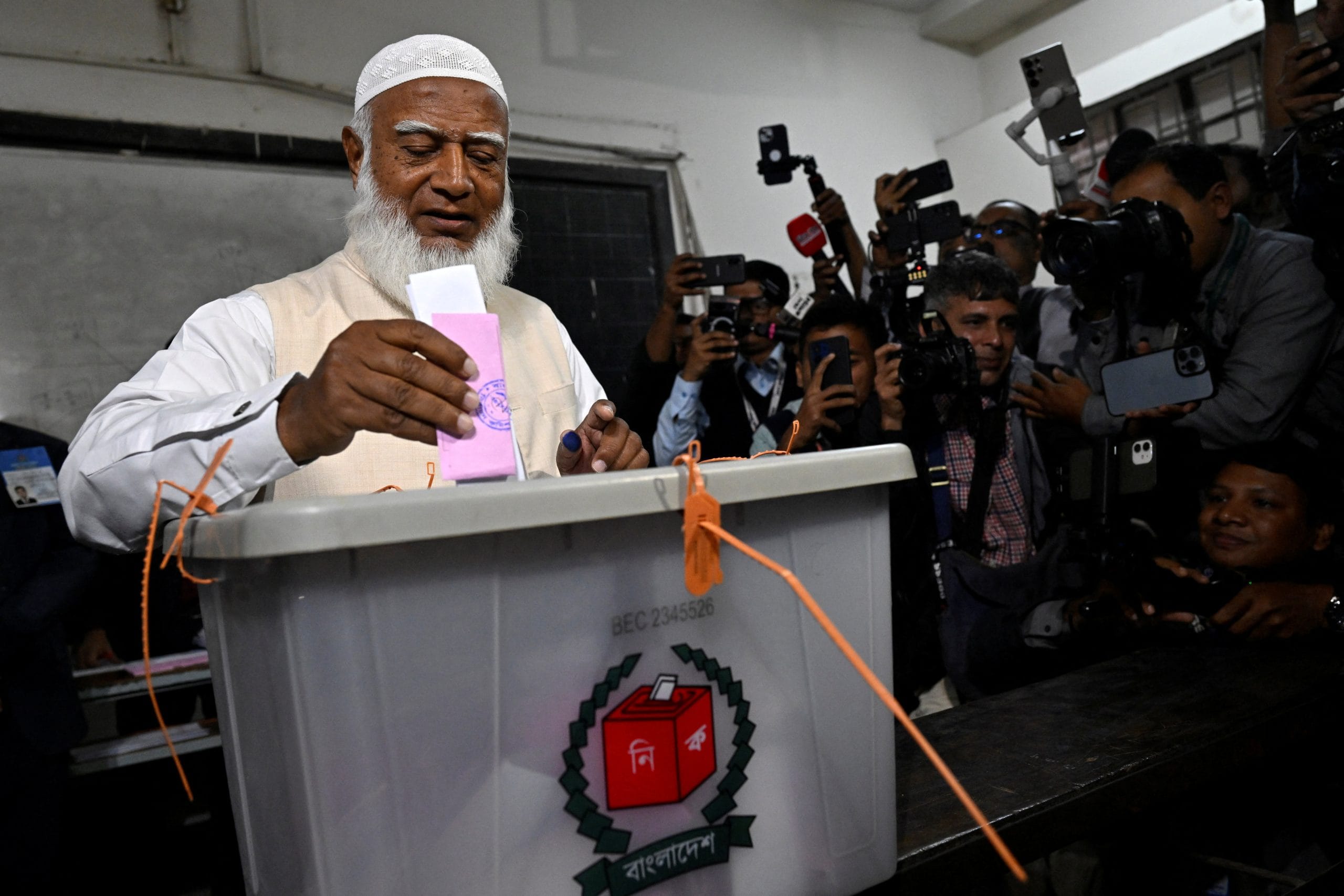
After casting his vote earlier today at Monipur High School and College polling centre in Dhaka, Jamaat-e-Islami chief Shafiqur Rahman said that his party will accept the results of the vote only if the polls are conducted in a free and fair manner.
“If the voting is held in a free and fair manner, we will accept the results. Others should also accept the verdict of the people,” he told media persons. He also urged voters to turn out in large numbers, and stressed that accepting the people’s will is fundamental to democratic process.
Rahman further said that he had been unable to vote in previous elections in 2014, 2018, and 2024, because he was in jail then.
11.00 am: BNP campaign is ‘Bangladesh First’—Tarique Rehman’s adviser
For the high-stakes election, BNP framed its campaign around sovereignty tempered by regional pragmatism, particularly when it comes to bilateral ties with India.
In an exclusive interview, Dr Ziauddin Hyder, adviser to BNP chairman Tarique Rahman, told ThePrint in Dhaka, “Our major focus even during the election campaign is ‘Bangladesh First’ but we need to expand the horizon of our collaboration and relationship so that people, across the country, you know, they feel comfortable.”
He added, “That means we would like to build a Bangladesh where we provide healthcare to everyone, we provide the right to education, food security, environmental protection, water management.” But the slogan, he stressed, does not imply isolation.
“Whatever we need from other countries, we will get them,” he said. “We will have bilateral talks. We will use our regional platforms or global platforms to make sure we cater to our citizens.” India, Bangladesh’s most influential neighbour, looms large in that calculus.
According to Dr Hyder, relations between the two countries have long been shaped by trade imbalances and unresolved disputes over transboundary rivers.
The BNP, he said, intends to engage India through diplomacy while strengthening Bangladesh’s own capacity to manage water resources.
Read here what else he told Debdutta Chakraborty in Dhaka.
10.30 am: ‘Birth of new Bangladesh’—Yunus
Muhammad Yunus, interim chief adviser, casts his vote. “This is a day of great joy. Today is the birthday of a new Bangladesh. We will celebrate this birthday throughout the day,” he told reporters outside the polling booth at Gulshan Model High School and College in Dhaka.
VIDEO | Bangladesh Elections 2026: Interim government chief Muhammad Yunus comes out of the polling station after casting his vote.#BangladeshElections2026 #Dhaka
(Full video available on PTI Videos – https://t.co/n147TvrpG7) pic.twitter.com/IByziWGzbi
— Press Trust of India (@PTI_News) February 12, 2026
10.05 am: Referendum vote will define Bangladesh’s future, but for many it’s a ‘don’t know’
More than three decades after Bangladesh last held a constitutional referendum, voters will return to the polls on 12 February to not only elect a new Parliament but also decide the fate of the July National Charter, a sweeping reform framework drafted after the 2024 anti-Hasina stir and endorsed by the interim government.
But on the streets of Dhaka, there seemed to be little awareness about the document that is set to define the country’s future. Some people appeared clueless about the fact that they had to vote in a referendum, that too on polling day.
Lincoln Stephen Saraow, 33, works at a coffee shop in Gulshan, a posh neighbourhood right behind BNP chairman Tarique Rahman’s residence. He said he is confused about whether to vote ‘yes’ or ‘no’ in the referendum. “I’ve read all the proposed reforms but was told I need to vote ‘yes’ for all to make it a ‘yes’ in total.”
“I don’t understand the referendum. I haven’t read it. But I have seen reels on Facebook and think it’s good for the country,” said 23-year-old Mohammed Imran Khan, a tea-seller in Dhaka’s Gulshan locality.
According to Yunus, the simultaneous election and referendum, a first in the country’s history, would bring an “unprecedented change” to Bangladesh’s political structure.
Yet, beneath the official optimism lies a dense web of legal, political and legitimacy concerns, particularly around the July National Charter itself.
Bangladesh’s past experience with referendums has centred around constitutional change. The last such vote, held in 1991, recorded a turnout of 35.2 percent, with 83.6 percent voting in favour of restoring parliamentary democracy. Before it, the Fifth Amendment, passed in 1979 during the tenure of President Ziaur Rahman, made referendums mandatory for any changes to the preamble or to particular articles of the Constitution.
That requirement was removed in 2011 through the Fifteenth Amendment under the Awami League government, which abolished the caretaker government system, restored secularism, re-established the four fundamental state principles (nationalism, socialism, democracy, secularism), increased seats reserved for women in Parliament to 50, and recognised Sheikh Mujibur Rahman as the ‘Father of the Nation’.
Read Debdutta Chakraborty’s report.
9.55 am: First elections since Hasina’s exit
Almost 127 million eligible voters are expected to vote in Bangladesh, as the country holds it first elections since the ouster of former Prime Minister Sheikh Hasina, following a student-led uprising. The uprising that began as an anti-quota stir in June 2024 quickly took aim at Hasina and the government at large.
On 5 August, 2024, Hasina fled Dhaka for India as the 15-year Awami League rule ended. This year’s election is a contest between the BNP led by Tarique Rahman and the Jamaat-e-Islami, which leads a coalition of 11 parties.
Bangladeshis will elect 350 members to its Jatiya Sangsad. Of the 350, 300 members are directly elected, while 50 seats are reserved for women. Nearly 2,000 candidates have registered to fight the polls, that has no representation from the Hasina-led Awami League.
Apart from the parliamentary polls, Bangladesh is also holding a referendum on the National Charter 2025. The Charter is a part of the package of reforms promised by the interim government led by Nobel Laureate Muhammad Yunus.
9.45 am: Tarique Rehman casts his vote
BNP chairman and son of former Bangladesh PM Khaleda Zia, Tarique Rehman casts his vote at a polling centre in Dhaka.
Bangladesh Elections | Tarique Rahman, Chairman of Bangladesh Nationalist Party-BNP and son of former Prime Minister of Bangladesh, Begum Khaleda Zia, cast his vote for the 13th Parliamentary elections, at a polling centre in Dhaka.
(Source: BNP Media Cell) pic.twitter.com/2bbk9XvNJZ
— ANI (@ANI) February 12, 2026
9.30 am: Tension at polling centre on eve of polls
Tension erupted at a polling centre in Narayanganj Wednesday night over allegations by a BNP candidate that Jamaat leaders and supporters were attempting to seal ballot papers with the support of the polling officer, The Daily Star reported.
Narayanganj-3 BNP candidate Azharul Islam Mannan alleged that the polling officer was “involved in Jamaat-e-Islami politics”. He also claimed that the officer opened ballot papers inside the centre Wednesday night and that party Jamaat activists were “preparing to seal them with his assistance”.
9.00 am: Jamaat, BNP supporters clash in Dhaka
A skirmish reportedly broke out between supporters of Jamaat-e-Islami and BNP supporters in Mirpur-10 Constituency, Dhaka as polling began Thursday morning. The situation was, however, later brought under control with the deployment of army personnel.
8.40 am: Polling continues amid heavy security
Visuals from a polling centre in Dhaka:
#WATCH | Bangladesh: Long queues of voters witnessed at a polling centre at the Gulshan Model School and College in Dhaka, as they await their turn to cast a vote.
Voting for the 13th Parliamentary elections begins. Parties, including the Bangladesh Nationalist Party, led by… pic.twitter.com/j8HHYzF9pr
— ANI (@ANI) February 12, 2026
8.15 am: A final push on the eve of polls
On the eve of polls, nationalism was on full display in the last big push by two of Bangladesh’s key political parties—the Jamaat-e-Islami and the Bangladesh Nationalist Party (BNP)—on the streets of Dhaka.
Both held press conferences where topics like India, Bangladesh’s foreign policy post polls, women’s rights, and even the sticky issue of minorities, were touched upon. One was smoothly organised, the other was chaos.
Standing before reporters after formal campaigning closed, Jamaat-e-Islami’s emir Dr Shafiqur Rahman called Thursday’s election a democratic reckoning decades in the making.
“People’s demand is a change in the political system,” he said. “We are also in favour of that. But it is people who will ultimately decide the matter. We are very confident in our people’s choice. And we are respectful to them also. And this is the essence of democracy.”
But it was his comment on minorities amid concerns about minority rights and rising political polarisation that caught the most attention. He said: “Bangladesh does not have minorities, everybody is a Bangladeshi…The country belongs equally to all who live in it—not as minorities and majorities, but as citizens.”
This comes a day after a 62-year-old Hindu trader was hacked to death by unidentified men inside his shop in Trishal upazila of Mymensingh, the latest in a series of similar attacks.
At the same time, Dr Rahman acknowledged the fragility of Bangladesh’s democratic journey. “Like other democratic countries in the world, we are a country where in the last 54 years, our democracy did not take its own shape. Rather, it has lost its path now and again. So, the election will be a tool to decide the future.”
Asked about his party’s chances of winning, he added: “Allah will see to that.”
Read Debdutta Chakraborty’s report.
7.30 am: Polls now open
The voting has begun and will continue till 4.30 pm (local time). Counting of votes will begin soon after. Voters are also voting on a national referendum today.
While there are multiple parties and alliances in the fray, the Tarique Rahman-led Bangladesh Nationalist Party (BNP) is seen as the frontrunner.
The BNP has fielded candidates in 288 of the 300 seats filled through direct voting, while its allies have fielded candidates in the remaining seats.
Another key formation is the 11-party alliance led by Jamaat-e-Islami.
Among its constituents is the National Citizens Party (NCP) floated by students who played a central role in the anti-Hasina stir.
This formation is contesting 298 seats.
Also Read: BNP’s Tarique Rahman a crowd favourite on Dhaka’s streets. But there’s also the ‘third’ front